Meeting with KEPCO, KHNP, construction company employees involved in Barakah nuclear power plant contract
Sharing 'nuclear power export' know-how... Government and affiliated research institutes also strategizing
[Asia Economy Reporter Baek Kyunghwan] On the 3rd, President Yoon Suk-yeol met with the key figures of the Barakah Nuclear Power Plant in the United Arab Emirates (UAE) to discuss opinions on further expanding nuclear power exports. He directly listened to what impressed the UAE, the client, and based on this, plans to prepare a new export success story. Centered on the Presidential Office, government ministries and affiliated organizations have begun preparations for nuclear power exports. The work of examining major countries' nuclear power policies and related legal systems has already started, and a customized export strategy will be announced soon.(Refer to the article 'Yoon Government Accelerates Nuclear Power Export... Customized Strategies for 45 Countries' dated the 2nd)
On the 3rd, President Yoon had lunch at the Yongsan Presidential Office with about ten people who played a leading role in securing and operating the Barakah Nuclear Power Plant. Present were the head of the KEPCO Abu Dhabi branch project management team and the head of the KHNP Abu Dhabi branch, who have been involved since the early stages of nuclear cooperation with the UAE, as well as current and former executives from companies responsible for design and construction such as Samsung C&T, Hyundai Engineering & Construction, and Doosan Enerbility.
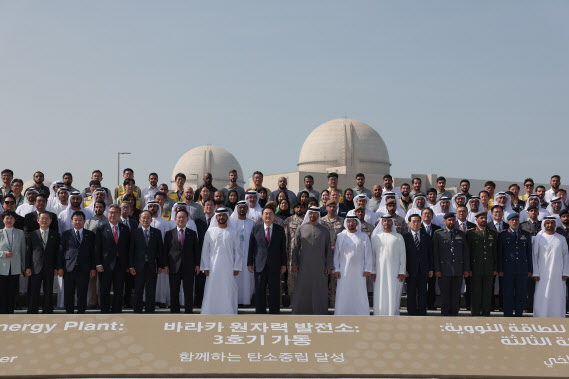 President Yoon Suk-yeol attended the inauguration ceremony of the Barakah Nuclear Power Plant Unit 3 during his state visit to the United Arab Emirates (UAE) on the 16th of last month. UAE President Mohammed bin Zayed Al Nahyan was also present at the event.
 [Photo by Yonhap News]
The meeting was arranged as President Yoon expressed his intention to "directly hear what impressed the client, the UAE." Khaldoon Al Mubarak, the Abu Dhabi Department of Administration chief who is known to have coordinated the UAE state visit behind the scenes last month, even came to the Davos Forum to declare before global CEOs that "for 14 years of nuclear partnership with Korea, the UAE has obtained everything it wanted," emphasizing Korea's promises and trust. This was a decisive turning point. The plan is to call the key figures behind Barakah's success back to the discussion table to share experiences for fostering the nuclear industry.
The Presidential Office also issued an official statement saying, "We expect that receiving important tips and keys to solving field difficulties will help us prepare to enter the global nuclear power business battlefield." The attendees explained to President Yoon the know-how that the success of cooperation with the UAE begins with respect for culture, as well as unexpected situations that occurred locally and the working conditions of local employees. A Presidential Office official added, "We reaffirmed that our greatest competitiveness lies in a strong partnership and a solid nuclear power ecosystem, and this will serve as an opportunity to strengthen Team Korea's unity, which is responsible for everything from A to Z in overseas nuclear power construction and operation, including KEPCO, KHNP, and construction companies."
In line with President Yoon's determination to strengthen the nuclear power business, government ministries and affiliated organizations are also moving quickly. They have begun investigating major countries' nuclear power policies and related legal systems, as well as establishing customized export strategies for countries with few nuclear reactors. The Korea Nuclear Cooperation Foundation, the only domestic specialized institution for nuclear cooperation, has started analyzing the administrative and legal systems of nuclear-utilizing countries and identifying related organizations. It has also selected target countries for initial investigation to gain an advantage in upcoming bilateral and multilateral consultations.
Korea Hydro & Nuclear Power (KHNP) is identifying key materials for nuclear power exports. There has also been discussion about monitoring the situations of countries with few nuclear reactors, such as Sweden. Additionally, benchmarking the 'France-China Power Partnership Association (PFCE)' is expected to be discussed. This approach involves forming specialized consultative bodies tailored to each country to establish customized export strategies. Earlier, on the 25th of last month, at a Cabinet meeting held immediately after his overseas trip, President Yoon said, "We will quickly restore the domestic nuclear power ecosystem, which is on the brink of collapse due to the nuclear phase-out policy, and lay the foundation for the nuclear industry to take off again." This reflects his intention to accelerate the 'nuclear power export propulsion' policy as part of restoring the nuclear ecosystem.
© The Asia Business Daily(www.asiae.co.kr). All rights reserved.

















