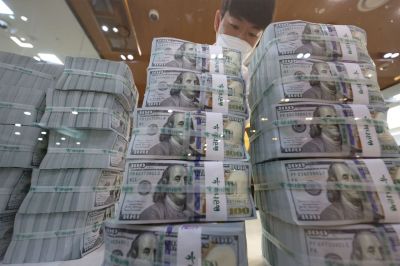
[Asia Economy Reporter Seo So-jung] Last month, South Korea's foreign exchange reserves increased by nearly $7 billion due to the weakening of the US dollar, continuing a three-month consecutive rise.
According to the foreign exchange reserves statistics announced by the Bank of Korea on the 3rd, as of the end of January, the foreign exchange reserves stood at $429.97 billion, an increase of $6.81 billion compared to the end of the previous month. The foreign exchange reserves have shown a rising trend for three consecutive months since November last year.
The Bank of Korea explained, "The increase in the US dollar equivalent of foreign currency assets in other currencies and foreign currency deposits of financial institutions led to the growth in foreign exchange reserves."
Last month, the US dollar depreciated by about 1.5% (based on the US Dollar Index), meaning that the foreign currency assets converted into US dollars increased accordingly. The won-dollar exchange rate fell to 1,220.3 won based on the previous day's closing price, reducing the need for exchange rate defense by the foreign exchange authorities, which also contributed to the increase in foreign exchange reserves.
Breaking down the foreign exchange reserves by asset type, securities such as government bonds and corporate bonds ($371.42 billion) increased by $1.73 billion compared to the previous month.
Deposits ($34.17 billion) rose by $4.82 billion, and Special Drawing Rights (SDR, $15.05 billion) and the IMF position, which is the drawing right of exchangeable currency with the International Monetary Fund (IMF) ($4.54 billion), also increased by $350 million and $110 million respectively.
Gold is recorded at the purchase price without reflecting market prices, so it remained at $4.79 billion, the same as the previous month. The Bank of Korea has not purchased gold for about 10 years since February 2013.
As of the end of December last year, South Korea's foreign exchange reserves ranked 9th in the world. Although South Korea's foreign exchange reserves increased, most other countries also saw increases, maintaining the same ranking as the previous month.
China had the largest reserves at $3.1277 trillion, followed by Japan ($1.2276 trillion), Switzerland ($924 billion), Russia ($582 billion), India ($562.7 billion), Taiwan ($554.9 billion), Saudi Arabia ($458.7 billion), and Hong Kong ($424 billion).
© The Asia Business Daily(www.asiae.co.kr). All rights reserved.
![Clutching a Stolen Dior Bag, Saying "I Hate Being Poor but Real"... The Grotesque Con of a "Human Knockoff" [Slate]](https://cwcontent.asiae.co.kr/asiaresize/183/2026021902243444107_1771435474.jpg)
















