Designation of Special Support for SMEs, Preemptive Industrial Crisis Response, and Large-scale Industrial Complex Renovation Projects
Securing 123.1 Billion KRW Budget This Year Boosts Steel Industry Reconstruction and Regional Economic Recovery R
[Asia Economy Yeongnam Reporting Headquarters Reporter Dongguk Lee] Pohang's steel industry, which has driven South Korea's economic development, is laying the groundwork for a leap forward that will revitalize industrial reconstruction and the regional economy.
Since last year, Pohang has been consecutively designated as a government ‘Special Support Area for Small and Medium Enterprises (SMEs),’ an Industrial Crisis Preemptive Response Area, and a Large-scale Industrial Complex Renovation Project area. Overcoming difficulties such as typhoon Hinamno damage and aging facilities, on the 2nd, Pohang’s Steel Industry Complexes 1 to 4 and Daesong-myeon Jenaeri semi-industrial area were designated as ‘Special Support Areas for SMEs’ by the Ministry of SMEs and Startups.
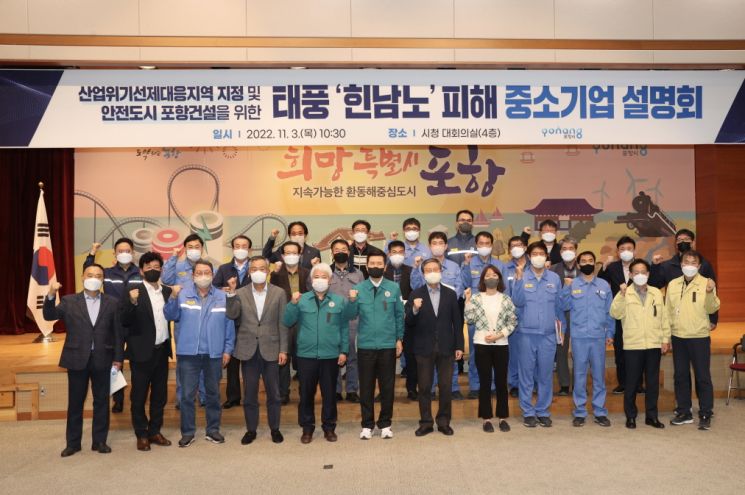 At the SME briefing session on typhoon damage held last November, the public and private sectors are joining forces to reaffirm their determination for a new leap forward.
The ‘Special Support Area for SMEs’ system is a program that designates areas where SME management is at risk due to changes in economic conditions and provides rapid support for business normalization for two years.
Most of the companies in the five industrial complexes designated in Pohang are related to the steel industry and have been suffering from severe business deterioration due to the prolonged steel market slump and damage caused by typhoon Hinamno.
The city analyzed conditions such as production performance, business activities, and worsening employment situations to actively support these companies, continuously consulting with the Ministry of SMEs and Startups and Gyeongbuk Province. After on-site inspections and review committees, the final designation was made.
With this designation, existing resident companies and newly entering SMEs can participate preferentially in public bids through restricted competitive bidding and private contracts using products they directly produce for the next two years. They will also receive customized support such as preferential financing, dedicated R&D, and business diversification.
Mayor Kang-deok Lee said, “This designation as a Special Support Area for SMEs is expected to greatly help stabilize the management of SMEs severely damaged by the typhoon in facilities, machinery, and raw materials. The city will continue to discover practical support measures to help companies normalize their management.”
In late October last year, Pohang was the first to be designated as an ‘Industrial Crisis Preemptive Response Area’ by the Ministry of Trade, Industry and Energy following the enactment of the related special law.
This was achieved after establishing a close cooperation system by continuously visiting government ministries, members of the National Assembly, and Gyeongbuk Province immediately after experiencing unprecedented damage from typhoon Hinamno, actively requesting support, and having ministers and vice ministers from various departments visit the site to recognize the severity of the damage.
To support the Industrial Crisis Preemptive Response Area, this year the government secured a budget of 123.1 billion KRW for six projects including restoration costs for disaster-affected companies’ facilities, reinforcement of infrastructure such as industrial complex retaining walls and flood barriers, easing the burden on steel complex companies and citizens affected by the typhoon, and boosting the resilience of this national key industry.
Additionally, Pohang was selected in April last year for the ‘Gyeongbuk Industrial Complex Large-scale Renovation (Pohang Area) Project’ led by the Ministry of Trade, Industry and Energy and the Ministry of Land, Infrastructure and Transport. From this year until 2025, a total of 30 projects with a total budget of 588.7 billion KRW will be invested to transform the steel and automobile industries into a ‘carbon-neutral smart industrial complex.’
The core goal is to build a green steel-based clean metal materials industry hub, strengthen the competitiveness of the aging industrial complex, create jobs, and invigorate the regional economy.
Mayor Kang-deok Lee stated, “The regional steel industry, which has driven South Korea’s economic development, will overcome the crisis and continuously secure innovative future technologies and competitiveness to achieve a leap forward. We will do our best to make this happen.”
© The Asia Business Daily(www.asiae.co.kr). All rights reserved.
![User Who Sold Erroneously Deposited Bitcoins to Repay Debt and Fund Entertainment... What Did the Supreme Court Decide in 2021? [Legal Issue Check]](https://cwcontent.asiae.co.kr/asiaresize/183/2026020910431234020_1770601391.png)
















