[Asia Economy Reporter Byeon Seon-jin] The Ministry of Food and Drug Safety (MFDS) has begun institutionalizing the expansion of the recognition of food ingredients to include future food ingredients applying new technologies such as cell-cultured foods.
On the 2nd, the MFDS held the 'Report Meeting on the Promotion Results of 100 Regulatory Innovation Tasks for Food and Drugs' and announced that the 'Enforcement Rules of the Food Sanitation Act,' which include these contents, were publicly notified for legislation from October 31 to December 12 last year, and that they plan to amend the Enforcement Rules of the Food Sanitation Act by April. Until now, foods applying new technologies had to submit safety data to the MFDS to be recognized as food ingredients, but the scope was limited to agricultural, livestock, and fishery products, making it difficult for future food ingredients to be recognized.
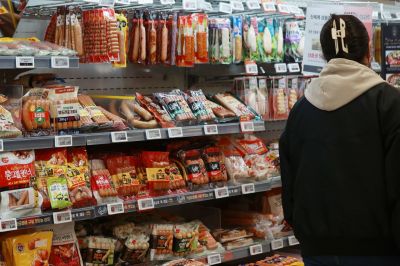
According to the Korea Rural Economic Institute, the alternative food market size, which was 57.1 billion KRW in 2016, is expected to grow at an average annual rate of 15.7% over 10 years and reach 240 billion KRW by 2026. The cell-cultured food industry expects that if future food ingredients are recognized as food ingredients this time, the speed of raw material development can be significantly increased. The MFDS explained, "First, 16 domestic cell-cultured food startups and other companies can now enter the market quickly."
MFDS: "34 out of 50 Food Sector Tasks Completed"
The MFDS has been promoting the '100 Regulatory Innovation Tasks for Food and Drugs' since August last year to become a global hub for bio and digital health. On this day, while introducing the achievements of food sector tasks, the MFDS announced, "Currently, 34 out of 50 food sector tasks have been completed."
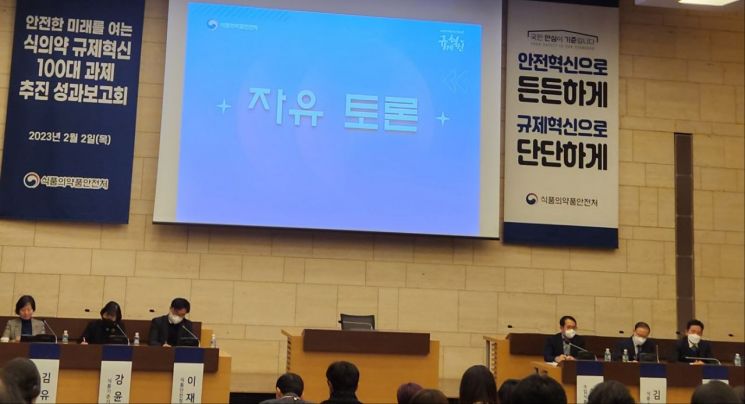 The Ministry of Food and Drug Safety held the '100 Major Tasks for Regulatory Innovation in Food and Medicine Performance Report Meeting' on the 2nd. Photo by Seonjin Byeon sj@
First, health functional foods, which were previously prohibited from being subdivided and sold, will be able to be sold customized according to consumers' lifestyle habits and health conditions. The amendment to the 'Health Functional Foods Act' containing this content was proposed on November 29 last year and will be revised in June 2024. Currently, under the regulatory sandbox demonstration exemption system, 18 companies operate 1,559 stores selling customized health functional foods; as of the end of last year, 78,811 consumers used these services, generating sales of 7.9 billion KRW.
By April, facility standards will be improved to allow dining areas to be installed away from the kitchens in group catering facilities. According to current regulations, kitchens and dining areas in group catering facilities must be installed in the same place. Because of this, in large industrial complexes with wide areas, there were many difficulties for users due to the long distance between work sites and dining facilities.
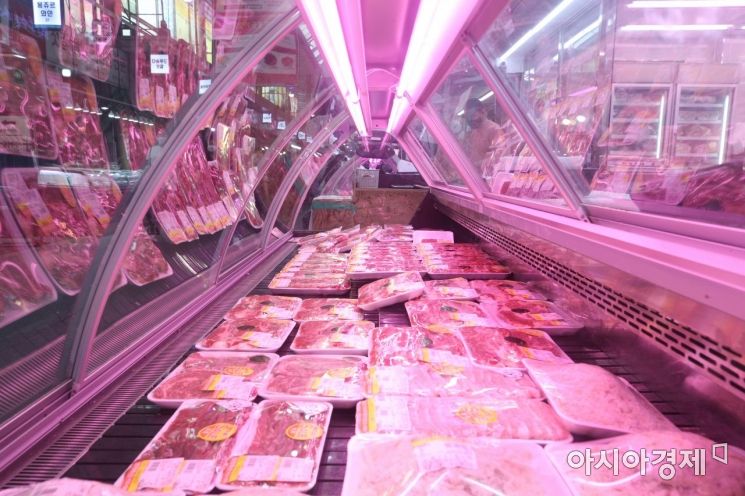
Starting next month, it will become easier to operate meat sales businesses and other businesses simultaneously in one store. For example, until now, if a restaurant selling meat also sold fresh meat, it had to be separated or partitioned by walls, but now it will be possible to operate with just a simple line separation. Storage warehouses for meat sales businesses had to store only livestock products such as packaged meat, but now sealed foods can also be stored simultaneously. Also, food sales stores such as side dish shops equipped with refrigeration and freezing facilities will be able to sell packaged meat without a separate meat sales business registration.
Outdoor cooking activities at restaurants were previously allowed only in tourist zones and tourist accommodation facilities, but by around April, outdoor cooking businesses will be permitted in general areas that are not adjacent to residential areas and have no fire risk, subject to the judgment of local government heads.
One of the regulatory innovation tasks was granting a one-year grace period for the implementation of the food consumption date labeling system starting this year. This was in response to concerns from related industries about the difficulty of changing packaging by the enforcement date and the cost burden and resource waste caused by discarding packaging labeled with the existing expiration date. MFDS Commissioner Oh Yu-kyung said, "Regulations must also change when the food environment changes, but the MFDS inevitably has limitations as it is not on the front lines. We will improve MFDS standards to fit the field so that the food industry can expand globally without obstacles."
© The Asia Business Daily(www.asiae.co.kr). All rights reserved.
![Clutching a Stolen Dior Bag, Saying "I Hate Being Poor but Real"... The Grotesque Con of a "Human Knockoff" [Slate]](https://cwcontent.asiae.co.kr/asiaresize/183/2026021902243444107_1771435474.jpg)













