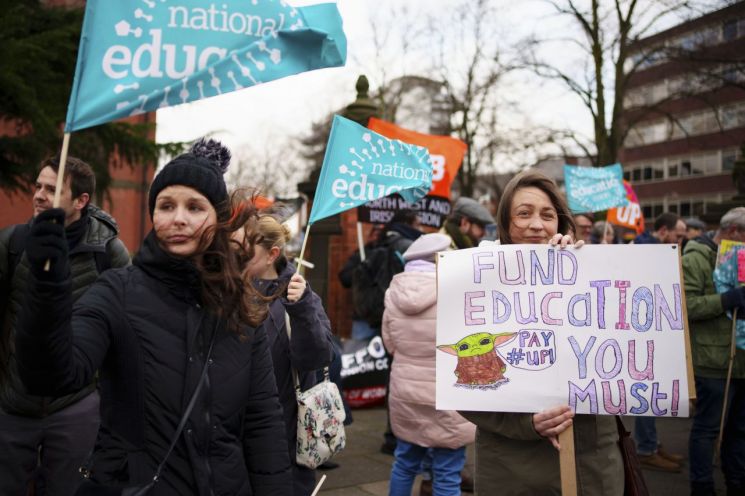
 On the 1st (local time), teachers are protesting for a wage increase in Manchester, UK. [Image source=Yonhap News]
[Asia Economy Reporter Lee Chun-hee] In the UK, up to 500,000 people including teachers, civil servants, and train drivers went on strike simultaneously, causing schools to close and trains to stop.
On the 1st (local time), the Trades Union Congress (TUC), the umbrella organization of sectoral unions in the UK, announced that about 300,000 teachers, 100,000 government department civil servants, university staff, railway drivers, and London bus drivers would go on strike. The TUC said this was the largest strike since the 2011 strike involving about one million participants.
Recently, in the UK public sector, strikes demanding wage increases in line with an annual inflation rate exceeding 10% have been occurring one after another. According to the National Education Union (NEU), the largest teachers' union, 85% of the approximately 23,000 public schools in England and Wales were either fully or partially closed on that day.
The Prime Minister's Office spokesperson said, "It will be very difficult for the public to carry out their daily lives," expressing concerns about significant disruptions to public services due to the large-scale simultaneous strikes and announced plans to deploy 600 soldiers to airports and other locations.
The UK think tank Centre for Economics and Business Research (CEBR) estimated that the cost of strikes in the UK over the recent eight months up to January this year reached 1.9 billion pounds (approximately 2.8868 trillion won). The cost of teacher strikes was calculated at 20 million pounds per day.
© The Asia Business Daily(www.asiae.co.kr). All rights reserved.
![User Who Sold Erroneously Deposited Bitcoins to Repay Debt and Fund Entertainment... What Did the Supreme Court Decide in 2021? [Legal Issue Check]](https://cwcontent.asiae.co.kr/asiaresize/183/2026020910431234020_1770601391.png)















