From Experience to Healing Space... Programs Linked with World Heritage Temples
Resumption of Foreign Visitors to Korea After COVID-19... Expansion of Templestay for Corporations
[Asia Economy Reporter Seo Mideum] The Buddhist community is actively promoting the revitalization of templestay programs, which are gaining attention as a way to find peace of mind.
The Korean Buddhist Cultural Foundation of the Jogye Order of Korean Buddhism announced its commitment to revitalizing templestays through its business plan for this year on the 1st. Since its successful establishment as part of solving accommodation issues during the co-hosting of the 2002 Korea-Japan World Cup, the templestay program will be used as a cultural framework to improve quality of life.
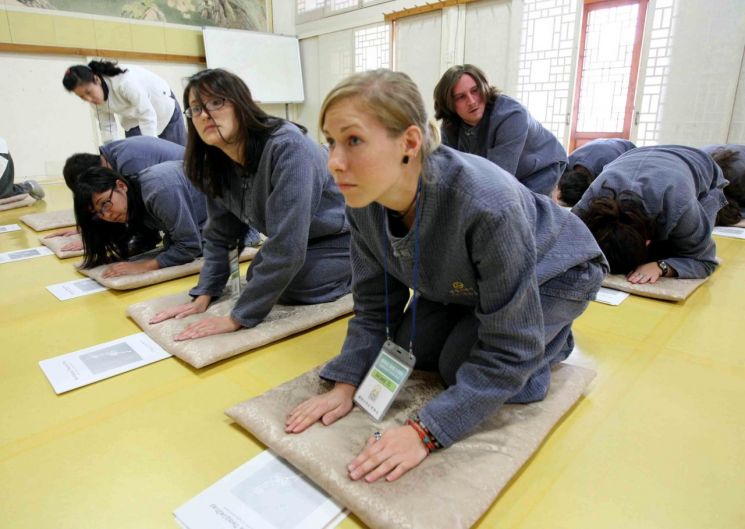
Wonmyeong, head of the Buddhist Cultural Foundation, stated at a meeting held at the templestay promotion center in Jongno-gu, Seoul, "Templestays have offered domestic and international participants a time to escape their busy daily lives and empty their body, mind, and thoughts." He added, "We will research and develop meditation, counseling, and healing programs that cultivate wisdom and compassion to enrich the lives of each participant."
First, the Jogye Order will undertake scientific verification of "the effects of templestays on immune system enhancement and healing." Clinical trial participants, up to 100 people, will be recruited from about ten temples nationwide to collect objective data. The results of this verification are expected to be announced within the year.
Efforts will also be intensified in program development. Existing meditation, counseling, and healing courses will be deepened to create new programs, which will then be disseminated to temples across the country. Training personnel necessary for on-site education will also be included.
Additionally, research on the "temple kitchen (gongyanggan) that contains the original form of Korean cuisine" will be conducted. Through this, the daily life and cultural value of practitioners will be highlighted, and a foundation for the operation of temple food will be established through systems such as the temple food master craftsman program. At the Korea-India 50th diplomatic anniversary event held in India from March 20 to 25, a special lecture on temple food and other opportunities to introduce the charm of Korean Buddhism will be provided.
Efforts will also be made to expand the base of templestay participants. Public interest and sharing-type templestays, previously conducted for low-income groups, people with disabilities, single-parent families, migrant workers, multicultural families, suicide bereaved families, injured police officers, and care workers, will continue while expanding private sector participation. Plans are underway to broaden the scope of templestays offered to employees as part of corporate welfare programs by some companies.
Moreover, storytelling-type templestays will be developed to provide the enjoyment of travel filled with stories. Traditional architecture such as Yangsan Tongdosa, Suncheon Seonamsa, and Haenam Daeheungsa, along with pilgrimage routes maintained and preserved by temples nationwide, will be linked to diversify travel resources.
The target number of visitors is 500,000. The Buddhist Cultural Foundation aims to attract visitors domestically and internationally to recover to pre-COVID-19 levels. The number of templestay participants, which was about 530,000 in 2019, dropped to about 240,000 in 2020 but recovered to around 430,000 last year. The government plans to support foreign visitor attraction by declaring "Visit Korea Year 2023-2024."
© The Asia Business Daily(www.asiae.co.kr). All rights reserved.

















