[Asia Economy Yeongnam Reporting Headquarters Reporter Hwang Duyul] Recently, research on optimizing international hydrogen supply chains considering economic feasibility and environmental aspects has attracted attention.
Professor Lim Hangwon's team at the Carbon Neutral Graduate School of UNIST conducted a study on "Optimization of Economic Feasibility and Environmental Aspects for International Overseas Hydrogen Supply Chains."
This study presented practical indicators for establishing hydrogen supply chains by considering the demand of hydrogen-importing countries such as Korea, Japan, and Germany, and the expected hydrogen-exporting countries totaling 16 nations including Australia and Chile.
First, the research team built an optimization model considering the expected hydrogen import and export data based on officially announced roadmaps by each country. Using the derived optimization model, they found answers for a competitive supply chain that satisfies the demand and supply of all hydrogen import and export countries while considering economic feasibility and environmental aspects.
Kim Ayeon, the first author and a researcher at UNIST, explained, "Although many studies on optimizing clean hydrogen supply chains are being conducted worldwide, they mostly focus on case analyses of individual countries. Through this study, we were able to propose an optimal supply chain considering global overseas hydrogen demand and supply from economic and environmental perspectives."
Since hydrogen has low energy density per volume during ship transportation, resulting in low economic feasibility, it is usually transported by converting it into liquid hydrogen carriers (H2 carriers).
Therefore, scenarios were devised considering recently spotlighted hydrogen carriers such as liquefied hydrogen, toluene-based liquid organic hydrogen carriers (LOHC), and ammonia.
Additionally, the research team predicted optimization values based on 10-year intervals from 2030 to 2050. They also set predicted values considering the prices and production volumes of renewable energy-based electricity and natural gas, which have high uncertainty.
Through this, various optimization scenarios according to a range of prices and production volumes were derived.
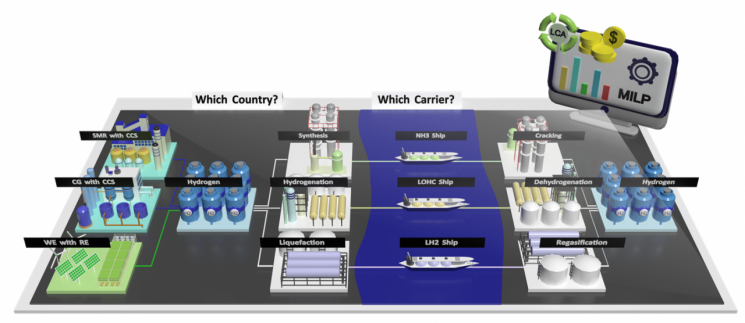 An overall schematic of the overseas hydrogen supply chain, including the hydrogen production process, conversion, transportation, and subsequent storage stages.
The study results confirmed that using ammonia as a hydrogen carrier is the most competitive option. According to the economic and environmental evaluations conducted, the hydrogen supply price, including carbon tax arising from greenhouse gas emissions, ranged between $2.15 and $3.43 per kilogram.
Based on these results, hydrogen-importing countries derived future necessary hydrogen supply chain optimization scenarios.
Professor Lim Hangwon of the Carbon Neutral Graduate School said, "This study shows optimization results that simultaneously consider all demand and supply based on officially announced roadmaps from various countries expected to become the largest hydrogen exporters and countries expected to become the largest hydrogen importers due to resource shortages."
He added, "An optimal supply chain based on economic feasibility and environmental aspects that simultaneously considers overall demand and supply should be derived, and this study laid the groundwork for that."
This research was conducted with funding from the Ministry of Science and ICT through the National Research Foundation of Korea (NRF) Hydrogen Energy Innovation Technology Development Project and support from the Korea Energy Technology Evaluation and Planning (KETEP) under the Ministry of Trade, Industry and Energy.
The research results were published in the international academic journal ACS Sustainable Chemistry & Engineering and were selected as an additional cover paper for the January 2023 issue.
© The Asia Business Daily(www.asiae.co.kr). All rights reserved.

















