"70% of Luxury Consumption Occurs Within China"
Brand Retailers Also Focus on Expanding into China
[Asia Economy Reporter Hyunwoo Lee] As China eases its COVID-19 lockdown measures and lifts restrictions on international travel, expectations for a rebound in consumption of overseas luxury brands are growing. While stock prices of some luxury brands have risen, experts point out that it is difficult to expect a recovery in consumption similar to the pre-COVID-19 period due to the deepening domestic orientation of China's luxury consumption market after the pandemic.
According to CNBC on the 1st (local time), the stock price of French luxury brand Louis Vuitton Moet Hennessy (LVMH) rose 12% after China announced the easing of COVID-19 lockdown measures last December. During the same period, Richemont, which owns the Cartier brand, rose 13%, and Dior also increased by more than 11%. This is interpreted as a continuation of double-digit stock price gains driven by expectations of a buying spree from Chinese consumers.
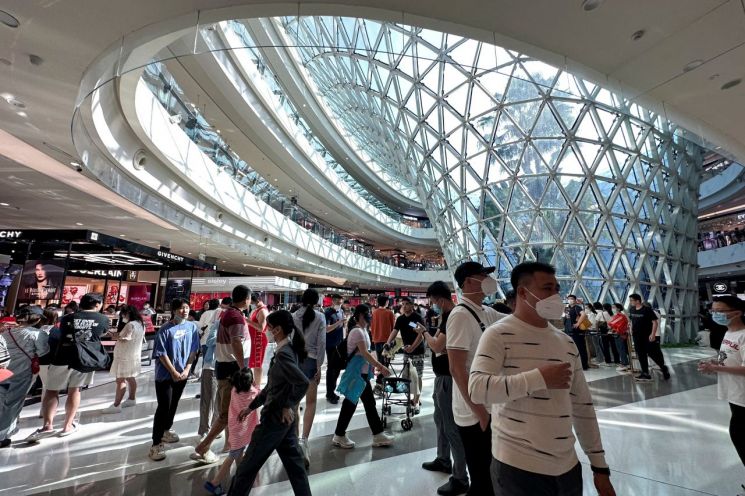 The international duty-free shop located in Sanya City, Hainan Province, China, after the lifting of COVID-19 lockdown measures on the 25th of last month. Sanya=Reuters·Yonhap News
However, contrary to these expectations, experts within China believe that Chinese consumers' overseas luxury consumption will not increase as much as anticipated. Jesse Zhang, an analyst at Chinese market research firm Daxue Consulting, told CNBC in an interview, "A spending pattern opposite to the pre-2017 pattern, when 70% of Chinese luxury consumption occurred overseas, may form. Luxury consumption will take place 70% within China, and luxury consumption by outbound tourists will account for only 30% of total luxury consumption. After 2025, the world's largest luxury market will rather be in-house shopping within China," he explained.
According to Chinese travel platform Trip.com, although purchases of international flight tickets increased by 200% earlier this month after travel restrictions were lifted, evaluations suggest that overseas luxury consumption is not as strong as before. During nearly three years of zero-COVID restrictions, Chinese consumers have become accustomed to luxury consumption locally, and with the successive opening of large international duty-free shops in Hainan Province, one of China's top tourist destinations, consumption patterns have changed significantly.
Jonathan Yan, an employee at consulting firm Roland Berger in Shanghai, pointed out, "While there are Chinese luxury consumers traveling abroad, the local luxury market in China is becoming more important."
Meanwhile, Chinese authorities have approved the opening of two large shopping malls in addition to the existing 10 duty-free shops under the goal of making Hainan Province the world's largest duty-free shopping destination.
Sales at Hainan duty-free shops increased by more than 120% year-on-year in 2020, followed by an approximately 85% increase in 2021. Since 2020, Chinese authorities have also raised the annual duty-free shopping limit at Hainan duty-free shops from 30,000 yuan (about 5.47 million KRW) per person to 100,000 yuan (about 18.2 million KRW), more than tripling the limit.
© The Asia Business Daily(www.asiae.co.kr). All rights reserved.

















