South Korea's Total Factor Productivity at 61.4% of the U.S.
FKCCI: "Need to Improve Regulatory Environment"
[Asia Economy Reporter Park Sun-mi] An analysis has emerged showing that South Korea's total factor productivity (TFP) significantly lags behind major countries (G5). Total factor productivity, a key element of economic growth, is an indicator representing the added value created by the 'invisible sector' such as management innovation and technological development, beyond direct input factors like labor and capital. To improve total factor productivity, efforts to enhance private sector vitality, including regulatory environment improvement, innovation enhancement, and human capital expansion, are necessary.
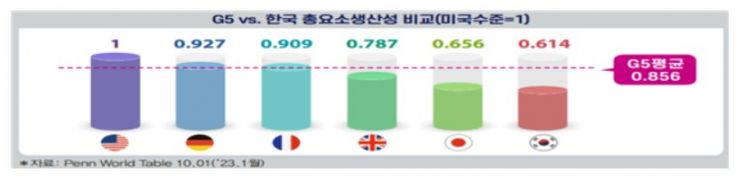
On the 1st, the Federation of Korean Industries (FKI) stated in its report "Current Status and Competitiveness Comparison of Total Factor Productivity" that when the United States' total factor productivity is set at 1, South Korea's is 0.614. This means South Korea's total factor productivity is at 61.4% of the United States'. By country, the order is the United States (1), Germany (0.927), France (0.909), the United Kingdom (0.787), Japan (0.656), and South Korea (0.614). The average for the major countries (G5) is 0.856.
The FKI selected five major indicators constituting total factor productivity?innovation, human capital, regulatory environment, social capital, and economic freedom?and compared competitiveness between South Korea and the G5 countries. The results showed that South Korea's competitiveness was insufficient in all comparison areas relative to the G5. When the G5 average competitiveness for each indicator is set at 100, South Korea's relative competitiveness was 74.2 in social capital, 76.9 in regulatory environment, 79.2 in innovation, 87.4 in human capital, and 98.7 in economic freedom. Except for economic freedom, the other four areas fell significantly below the G5 average level (100).
Excessive regulatory environment compared to major countries is a representative factor hindering South Korea's total factor productivity. According to the World Bank, South Korea's regulatory reform index stood at 1.10 in 2021, lower than the G5 average of 1.43. Additionally, South Korea ranked 34th out of 38 OECD member countries in corporate tax competitiveness as evaluated by the U.S. Tax Foundation in 2022. The FKI analyzed in the report that "South Korea lacks efforts for regulatory innovation to promote private economic activities compared to major countries," and "high corporate tax burdens place the overall business environment at a disadvantage."
Choo Kwang-ho, head of the FKI Economic Headquarters, said, "Since the Korean economy faces certain limits in growth through quantitative input of labor and capital, expanding growth potential through improving total factor productivity is an urgent task." He suggested that "efforts to enhance private sector vitality, such as improving the regulatory environment, boosting innovation, and expanding human capital, are essential" as methods to improve total factor productivity.
© The Asia Business Daily(www.asiae.co.kr). All rights reserved.

















