Military: "No official duty connection, treated as non-line-of-duty death"
Military Human Rights Center: "Death during mandatory service should be recognized as line-of-duty"
[Asia Economy Reporter Park Hyun-joo] Discussions continue over whether the late Corporal Byeon Hee-soo, who died after being forcibly discharged following gender reassignment surgery, should be recognized as having died in the line of duty. The military views Byeon’s death as unrelated to official duties and thus difficult to acknowledge as a line-of-duty death, while human rights organizations argue that the military’s non-line-of-duty classification is clear discrimination against transgender individuals.
On the 31st, the National Human Rights Commission recommended that the Ministry of National Defense reexamine its decision to classify the death of former Corporal Byeon, who died after being forcibly discharged following gender reassignment surgery, as a general death rather than a line-of-duty death.
Byeon underwent gender reassignment surgery in 2019. On January 23 of the following year, he was forcibly discharged due to mental and physical disability. Byeon filed an administrative lawsuit seeking to cancel this discharge. He was found dead at his home in 2021, just before his first hearing.
The Army and human rights groups have shown differing opinions regarding whether Byeon’s death should be recognized as a line-of-duty death.
The initial point of contention was Byeon’s “status” at the time of death. Since Byeon was forcibly discharged on January 23, 2020, he was a civilian at the time of his death, not a soldier. Accordingly, it was argued that his death could not be considered a military line-of-duty death. However, a court ruling in October 2021 ordered the cancellation of the forced discharge, which inevitably changed the judgment. Ultimately, the Army abandoned its appeal, canceled the forced discharge, and processed Byeon’s discharge as a normal discharge.
However, the conclusion reached by the Army on the 1st of last month was “non-line-of-duty” (general death). Although the change in status from “civilian who died immediately after discharge” to “general death while serving in the military” after the court ruling was seen as some progress, the Army’s Ordinary Meritorious Service Review Committee judged that Byeon’s death was not causally related to official duties and therefore could not be recognized as a line-of-duty death.
Subsequently, the debate shifted to the criteria for line-of-duty classification. According to the Military Personnel Act, a soldier’s death is classified as combat death, line-of-duty death, general death, or injury-related death. Among these, line-of-duty death is defined as death occurring “during the performance of duties or training.” The Army judged that Byeon’s case did not fall under line-of-duty deaths involving death during duty performance.
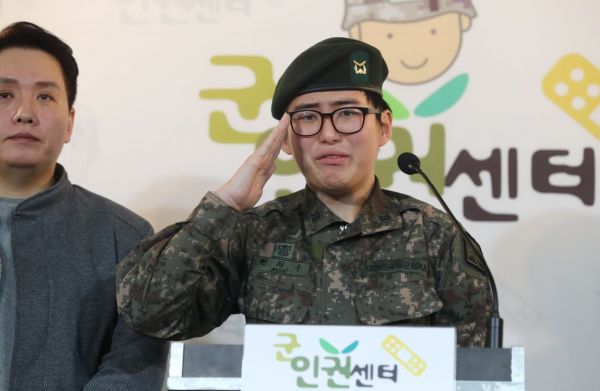
However, the judgment of the “Joint Countermeasure Committee for the Reinstatement and Honor Restoration of Corporal Byeon Hee-soo” (Joint Committee), which includes the Military Human Rights Center, differs. The Joint Committee argues that Byeon should be recognized as a line-of-duty death because he died during his mandatory service period.
Byeon was commissioned as a short-term non-commissioned officer on March 1, 2017, and his mandatory service period lasted until February 28, 2021. Although he could have applied for long-term service, he was forcibly discharged and thus deprived of that opportunity. Furthermore, the police determined that Byeon’s time of death was between 5:43 p.m. and 9:25 p.m. on February 27, 2021, one day before the end of his mandatory service period, so it should be considered that he died during his mandatory service.
According to Article 54-2, Paragraph 2 of the Military Personnel Act, if a soldier dies during the mandatory service period, they are classified as a line-of-duty death, unless the death was caused by intentional or gross negligence or illegal acts, in which case it can be classified as a general death.
The Joint Committee also views the military’s unfair discharge as the cause of Byeon’s extreme choice. Kim Hyung-nam, Secretary General of the Military Human Rights Center, said on last month’s YTN program “Issue Inside,” “Looking at Byeon’s medical records, there was a significant difference in his emotional state before and after the forced discharge. Doctors diagnosed that Byeon’s mental difficulties were due to the forced discharge.”
Kim added, “If a public official dies after being unfairly dismissed and the court later recognizes that the dismissal was unfair, it is very reasonable and natural to classify that official’s death as line-of-duty. The fact that Byeon was not recognized as a line-of-duty death can only be explained by the fact that he was transgender.”
In April of last year, the Presidential Military Death Accident Investigation Committee also demanded that the Ministry of National Defense review Byeon’s case as a line-of-duty death, stating that the unfair discharge was the main cause leading to his death.
In fact, with amendments to the Enforcement Decree of the Military Personnel Act and the regulations on handling meritorious service deaths, even cases of extreme choices during service can be recognized as line-of-duty deaths if the cause is found to be related to the military. If it is acknowledged that the military’s unfair discharge was behind Byeon’s death, there remains a possibility that his death will be recognized as line-of-duty.
※ If you or someone around you is struggling with difficult issues such as depression, you can receive 24-hour professional counseling through suicide prevention hotline ☎1393, mental health counseling ☎1577-0199, Hope Line ☎129, Lifeline ☎1588-9191, Youth Hotline ☎1388, the youth mobile counseling app “Da Deureojul Gae,” KakaoTalk, and other services.
© The Asia Business Daily(www.asiae.co.kr). All rights reserved.

















