Authentication Required Each Time Accessing from Different Locations
[Asia Economy Reporter Oh Su-yeon] The ban on Netflix account sharing is imminent in South Korea as well. When people who do not live together use a Netflix account together, they will have to authenticate their device each time.
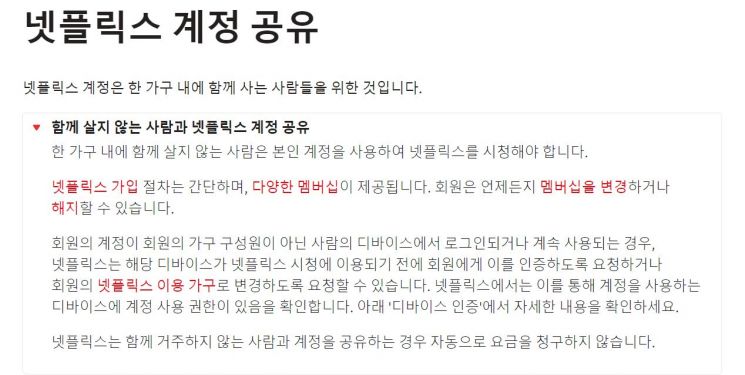
On the 1st, Netflix announced 'Netflix Account Sharing' on its homepage.
Netflix stated, "Netflix accounts are for people living together in one household," and "People who do not live together in one household must use their own accounts to watch Netflix."
If continuous access is made from a location outside the household of the primary account holder, or if logging in occurs on a device unrelated to the Netflix user household, authentication must be performed on that device before viewing. Authentication is not required when accessing from the primary account holder’s household.
A link will be sent to the primary account holder’s email or phone number, and opening the link will display a 4-digit authentication code. This code must be entered on the device requesting authentication within 15 minutes. Devices may need to be authenticated regularly.
Netflix determines this based on information such as the IP address of the logged-in device, device ID, and account activity.
The original notice included that temporary codes allowing 7 days of Netflix access during travel must be issued, and that once a month the device must connect to the Wi-Fi at the primary account location to watch Netflix content, but these details have since been removed.
Previously, up to four people could use one account regardless of access location or device, depending on the subscription plan.
Since sharing accounts with people outside the family leads to revenue loss, most online video services (OTT) including Netflix prohibit this in their terms but tolerated it to expand subscribers. However, as the OTT market became saturated, they changed their stance. In March last year, Netflix added a feature in South America allowing users to share accounts with non-family members for an additional monthly fee of $1.7 to $2.99 (approximately 2,101 to 3,696 KRW).
With Netflix introducing the ad-supported plan 'Ad-Supported Basic' in South Korea and many other countries last year, restricting account sharing domestically was only a matter of time. Netflix also introduced a 'Profile Transfer Feature' that allows users to transfer previous viewing history when creating a new account.
In South Korea, it is common not only for family and friends but also strangers to form so-called '4-person pods' through online communities and sharing platforms to split the subscription fee among four people. The ad-supported Basic plan costs 5,500 KRW per month, but if four people share the Premium plan (17,000 KRW per month), it costs only 4,250 KRW per month each. To encourage subscriptions to the ad-supported plan, cracking down on account sharing is essential.
Netflix announced in its earnings report last month that it will introduce a paid account sharing system starting from the end of the first quarter.
Wedbush analysts Alicia Lidz and Michael Pachter forecast that the ad-supported plan will compensate for user churn caused by account sharing restrictions, increasing Netflix’s revenue. They estimate an increase of 17 million new subscribers annually.
However, it is expected to be difficult to achieve positive effects domestically. Most account-sharing users tend to consider cancellation if charged. According to a report titled 'Analysis of Paid OTT Service Usage Behavior' by the Korea Information Society Development Institute (KISDI), 42.5% of users who share their Netflix accounts registered under their own name with others said they would stop using the service if additional fees were charged. Among those sharing accounts registered under others’ names, 46% said they would discontinue service. The proportion of Netflix users in South Korea using accounts registered under their own name is 42.8%.
A Netflix representative stated, "The timing and method of account sharing restrictions domestically and internationally have not yet been finalized."
© The Asia Business Daily(www.asiae.co.kr). All rights reserved.
![User Who Sold Erroneously Deposited Bitcoins to Repay Debt and Fund Entertainment... What Did the Supreme Court Decide in 2021? [Legal Issue Check]](https://cwcontent.asiae.co.kr/asiaresize/183/2026020910431234020_1770601391.png)
















