Investigation of Top 50 Companies by Emissions in Leaders Index
Increased by 6% Since 2018
[Asia Economy Reporter Moon Chaeseok] It has been revealed that the greenhouse gas emissions of major domestic conglomerates have increased since 2018, the base year for the Nationally Determined Contribution (NDC) target. According to the Carbon Neutrality Basic Act, emissions should be reduced by 40% compared to 2018 by 2030, but they have instead increased.
On the 1st, Leaders Index, a corporate analysis research institute, surveyed 50 companies with high greenhouse gas emissions and found that emissions in 2021 reached 272.77 million tons, a 5.9% increase from 257.65 million tons in 2018. Emissions per 100 million KRW in sales decreased by 5.5%, from an average of 28.5 tons in 2018 to 26.9 tons in 2021. Public power generation companies were excluded from the survey.
Among the 50 companies, 25 increased their absolute emissions compared to 2018, while 25 decreased. Emissions per 100 million KRW in sales decreased in 33 companies and increased in 17 companies.
By industry, Leaders Index explained that emissions increased in steel, semiconductors, chemicals, and refining sectors, while they decreased in automobile, display, telecommunications, and cement sectors.
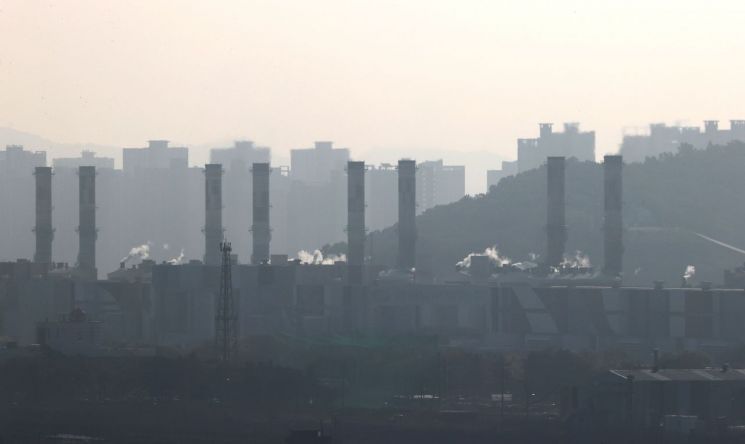
By company, POSCO had the highest emissions in 2021 at 78.48 million tons. This was followed by Hyundai Steel (28.49 million tons), Samsung Electronics (14.49 million tons), Ssangyong C&E (10.61 million tons), S-Oil (10.04 million tons), LG Chem (9.02 million tons), GS Caltex (8.45 million tons), Hyundai Oilbank (7.51 million tons), Lotte Chemical (7.06 million tons), and SK Energy (6.70 million tons).
Among these, Ssangyong C&E and SK Energy reduced their emissions by 3.3% and 9.5% respectively compared to 2018. The other eight companies saw increases. Their share of Korea’s total emissions also expanded by 4.4 percentage points, from 22.2% in 2018 to 26.6% in 2021.
POSCO’s emissions increased by 7.3%, from 73.12 million tons in 2018 to 78.48 million tons in 2021. Emissions per 100 million KRW in sales decreased by 8.6%.
Samsung Electronics’ emissions rose by 34.5%, from 10.77 million tons in 2018 to 14.49 million tons in 2021. Emissions per 100 million KRW in sales also increased by 17.3%. Hyundai Steel (26.5%), Hyundai Oilbank (21.5%), and Lotte Chemical (20.0%) also saw emissions increase by more than 20%.
The company that reduced emissions the most was OCI (-42.2%). LG Display (-28.6%), DB Metal (-21.6%), and SK Geocentric (-20.0%) also reduced emissions by more than 20%.
© The Asia Business Daily(www.asiae.co.kr). All rights reserved.

















