President Yoon Suk-yeol Orders "Heating Cost Support for Middle Class"
Delay in Party-Government Talks Due to Difficulty Securing Heating Funds
Opposition Seizes Heating Cost Issues with Supplementary Budget and Windfall Tax Proposals
[Asia Economy Reporter Hyunju Lee] The ruling party and government have found themselves in a dilemma over recent measures to support soaring heating costs. Following President Yoon Seok-yeol's directive to expand heating cost support from vulnerable groups to include low-income and middle-class households, the ruling party and government swiftly began preparing related measures. However, Lee Jae-myung, leader of the Democratic Party of Korea, has already taken the lead on this issue by proposing a supplementary budget (추경) for middle-class heating cost support and introducing a windfall tax on oil companies, intensifying his offensive against the government.
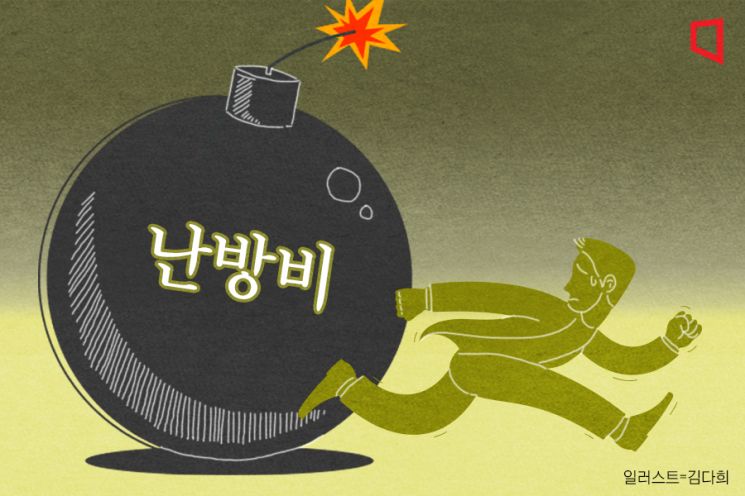
According to the People Power Party on the 1st, it is unlikely that the ruling party-government consultation on heating cost measures will be held this week. Ryu Seong-geol, the ruling party floor whip on the National Assembly's Planning and Finance Committee, told Asia Economy in a phone interview, "The government is currently unable to prepare a plan (for middle-class heating cost support), so it is difficult to hold the ruling party-government meeting."
Originally, the ruling party and government planned to hold consultations on heating costs on the 2nd, but the meeting was postponed due to delays in preparing measures for the middle class. On the previous day’s floor strategy meeting, People Power Party floor leader Joo Ho-young said, "President Yoon Seok-yeol has instructed to consider support measures for the middle class regarding the surge in heating costs," adding, "The ruling party-government meeting scheduled for the day after tomorrow was prepared, but it seems the government side is somewhat unprepared, so we plan to postpone it." There is also a possibility that the Economic Stabilization Special Committee (경안특위) scheduled for the 3rd will be postponed.
The delay in preparing measures amid worsening public sentiment due to soaring heating costs is reportedly due to financial constraints. Previously, the government approved 100 billion won in contingency funds to support heating costs for vulnerable groups, but expanding support to the middle class would sharply increase costs.
Moreover, the opposition party has claimed that a supplementary budget should be prepared to support the middle class struggling with high prices, including heating costs, and that a windfall tax should be introduced to secure the necessary funds. This preemption of the issue by the opposition has put the ruling party in a difficult position. A ruling party official said, "In a situation where the opposition is already demanding heating cost support for the middle class, it would be awkward for the government and ruling party to simply follow."
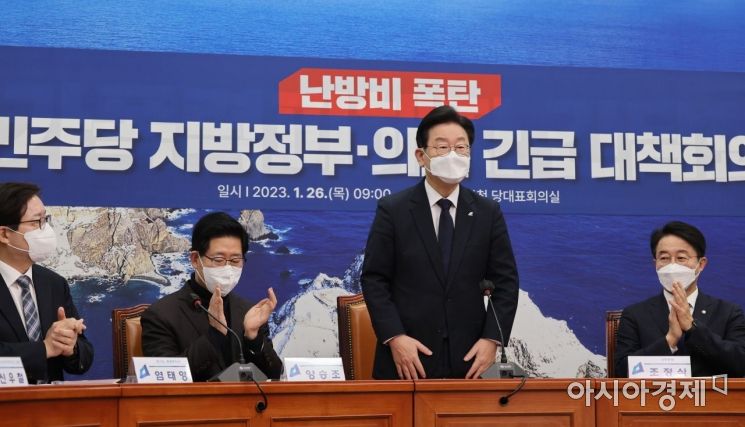 Lee Jae-myung, leader of the Democratic Party of Korea, is attending the "Emergency Countermeasure Meeting of Democratic Party Local Governments and Councils on Heating Cost Bomb" held at the National Assembly on the 26th. Photo by Dongju Yoon doso7@
The ruling party has already drawn a line against expanding heating cost support through a supplementary budget. While Lee Jae-myung, leader of the Democratic Party of Korea, proposed an emergency livelihood project through a '30 trillion won supplementary budget,' floor leader Joo dismissed it at the same day’s floor strategy meeting, saying, "The Democratic Party is already demanding another supplementary budget in February," and added, "They are citing soaring heating costs as a reason, but it seems intended to divert public attention from Lee’s legal risks."
Regarding the opposition’s so-called 'windfall tax' proposal to secure energy subsidies, Sung Il-jong, chairman of the People Power Party Policy Committee, criticized, "The windfall refers to the profits from Daejang-dong," and said, "Without any preparation for funding, they are recklessly demanding a 30 trillion won supplementary budget to cover legal risks, which leads to illogical ideas like the windfall tax."
The ruling party is reportedly considering using part of the 'Electric Power Industry Infrastructure Fund' to support heating costs for the middle class. A National Assembly official from the Industry, Trade, Energy, Small and Medium Enterprises Committee explained, "We have already allocated 100 billion won in contingency funds, but we need to review whether additional measures are possible," adding, "We have already drawn a line against a supplementary budget and need to prepare government measures rather than a windfall tax, so it will take time."
© The Asia Business Daily(www.asiae.co.kr). All rights reserved.


















