Expansion of Overcrowded Class Reduction and Commuting Convenience Support
[Asia Economy Yeongnam Reporting Headquarters Reporter Lee Seryeong] The Gyeongnam Office of Education will reduce classroom density in elementary schools this year.
On the 31st, the provincial Office of Education held the 2023 Administrative Bureau Work Briefing and announced plans to lower the class formation standards for elementary schools this year and resolve overcrowded classes.
For 1st grade elementary students, the quota will remain at 23 students as last year, and for grades 2 to 6, the number will be reduced by one student per class to 26 students.
The requirements for transfer-out and transfer-in schools applied to elementary schools with adjusted school districts will also be eliminated.
For elementary schools that adjusted school districts to support small schools, the transfer-out school criteria have been removed to ensure that commuting convenience support is not interrupted during the semester.
For middle schools, commuting convenience support will be provided to students whose public transportation commuting time is 30 minutes or longer.
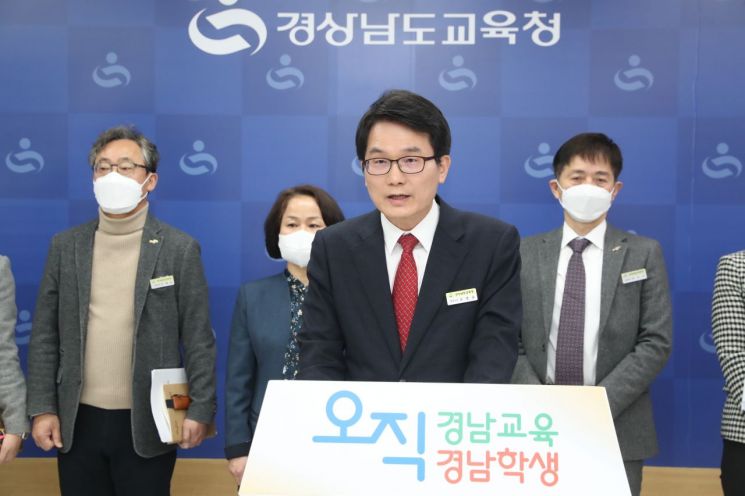 Jo Young-gyu, Director of the Administrative Bureau at Gyeongnam Office of Education, is presenting the main tasks of the Administrative Bureau for 2023.
 [Photo by Gyeongnam Office of Education]
The provincial Office of Education will invest 34.9 billion KRW this year to repair 432 restrooms in 117 schools that are over 20 years old.
On an 8,500㎡ site at Yangsan Water Quality Purification Park, 29 billion KRW will be spent to build the Eastern Region Student Safety Experience Education Center.
The Gyeongnam Office of Education Records Center, which will permanently preserve about 700,000 important records from educational administrative institutions and schools in the province, will also begin construction this year as the first of its kind among city and provincial offices of education.
For over 220 buildings older than 40 years, a total of 1.7413 trillion KRW will be invested to promote the Green Smart Future School initiative, converting them into future schools with smart classrooms and eco-friendly energy schools.
Efforts will be made to utilize closed schools for public interest purposes, and a detailed safety inspection of the Gyeongnam Office of Education building will be conducted.
Jo Young-gyu, Director of the Administrative Bureau, said, “We will do our best to provide a comfortable and safe educational environment centered on education consumers that fits the upcoming future education environment.”
© The Asia Business Daily(www.asiae.co.kr). All rights reserved.
![Clutching a Stolen Dior Bag, Saying "I Hate Being Poor but Real"... The Grotesque Con of a "Human Knockoff" [Slate]](https://cwcontent.asiae.co.kr/asiaresize/183/2026021902243444107_1771435474.jpg)
















