Held Director-General Level Talks, but Differences Remain on Compensation Solutions
February Munich Security Conference... Possible Contact Between South Korean and Japanese Foreign Ministers
Han Duck-soo "Ministerial Meeting Possible... Summit If Arranged"
[Asia Economy Reporter Jang Hee-jun] South Korea and Japan are expected to engage in high-level talks to find a solution for compensation related to forced labor. Although efforts have been made through director-general level consultations, differences remain between South Korea’s demand for a 'sincere response' and Japan’s insistence on 'waiving the right of recourse.'
A Foreign Ministry official said in a phone interview with Asia Economy on the 31st regarding the 'forced labor solution,' "Based on the matters discussed at the director-general level consultations, high-level talks between South Korea and Japan can also be held." However, the official added, "Nothing has been decided yet," and explained, "The leaders of both countries have instructed to accelerate the search for a solution to the forced labor issue, and accordingly, communication at various levels, including ministerial level, has been ongoing."
Previously, Seomin-jeong, Director-General of the Asia-Pacific Bureau at the Ministry of Foreign Affairs, met with Takehiro Funakoshi, Director-General of the Asian and Oceanian Affairs Bureau at Japan’s Ministry of Foreign Affairs, for a three-hour director-general level consultation. However, it is reported that both sides failed to narrow their differences over whether Japanese wartime companies would participate in compensation payments.
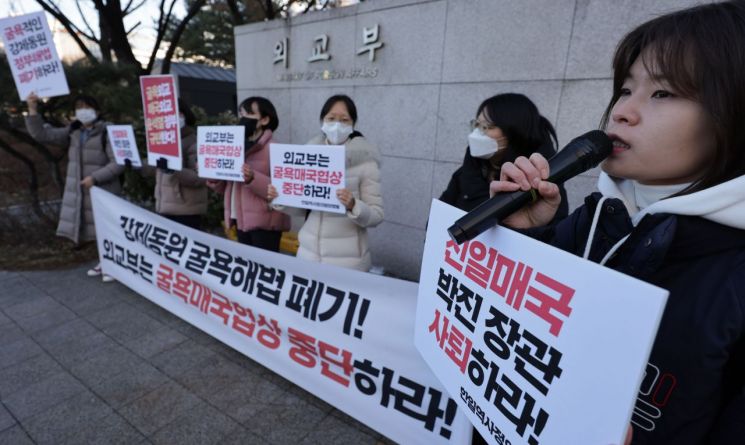 On the afternoon of the 30th, members of organizations such as the Korea-Japan History Justice and Peace Action and Gyeorehana held a press conference in front of the Ministry of Foreign Affairs in Seoul, criticizing the government's compensation solution for forced mobilization victims and urging the suspension of negotiations. [Image source=Yonhap News]
The Ministry of Foreign Affairs regards the participation of two companies, Mitsubishi Heavy Industries and Nippon Steel, as a 'key issue' in the compensation solution. Regarding Japan’s form of apology, consultations are ongoing over two approaches: one involving a 'direct apology from the Japanese government' as demanded by the plaintiffs, and the other inheriting the Murayama Statement, which contains 'deep remorse and heartfelt apology.'
Through the director-general level consultations held the previous day, it appears that the working-level teams have sufficiently confirmed the final positions of both countries. Since some consensus has been reached on Japan’s form of apology, separate from the compensation issue, it is expected that more weighty 'high-level communication' will take place to resolve the final contentious points centered on compensation.
In the near future, the Munich Security Conference (MSC), scheduled to be held in Germany from March 17 to 19, could serve as an opportunity for high-level contact. According to diplomatic sources, Foreign Minister Park Jin is currently considering attending the MSC, and Japanese Foreign Minister Yoshimasa Hayashi is also reportedly contemplating participation.
Some speculate that if a South Korea-Japan foreign ministers’ meeting is arranged at the MSC, a South Korea-Japan summit could be realized as early as March. This suggests that the search for a 'forced labor solution' between the foreign ministries of both countries could gain momentum through high-level consultations.
Prime Minister Han Deok-su also mentioned at a press briefing with reporters on the same day, "When the situation is appropriate, (for negotiations on the forced labor solution) meetings at the ministerial level can be held sufficiently, and once everything is settled, I think the leaders can meet."
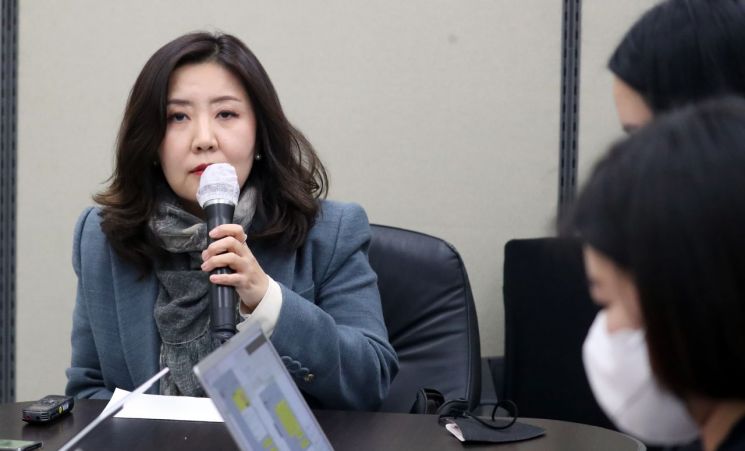 Director Seo Min-jung giving a back briefing after the Korea-Japan director-level talks [Image source=Yonhap News]
Japanese media have already reported that the outline of the final solution is taking shape. The Yomiuri Shimbun highlighted the Japanese government’s position that it does not oppose voluntary contributions beyond the defendant companies, emphasizing a donation plan through the Japan Business Federation, Japan’s largest business organization.
Regarding South Korea’s demand for a 'sincere response,' the Nihon Keizai Shimbun reported, "The Japanese government has stated it will maintain past statements, making efforts to convey 'sincerity,'" and noted that as the importance of South Korea-Japan cooperation based on security grows, there is a mood that the South Korean government’s compensation plan should be actively accepted.
Meanwhile, Takehiro Funakoshi, Director-General of the Asian and Oceanian Affairs Bureau at Japan’s Ministry of Foreign Affairs, who held consultations with Seomin-jeong the previous day, met with Kim Gun, Director-General of the Korean Peninsula Peace Negotiation Headquarters at South Korea’s Ministry of Foreign Affairs, as Japan’s chief representative for North Korea nuclear issues to discuss responses to North Korea’s nuclear threat.
During the 'South Korea-Japan Chief Representatives for North Korea Nuclear Issues Consultation' held at the Ministry of Foreign Affairs building that morning, both sides shared assessments of recent developments and prospects on the Korean Peninsula and reached a consensus on the importance of South Korea-Japan and South Korea-Japan-U.S. cooperation for a united international response to North Korea’s nuclear and missile threats. Furthermore, they agreed to strengthen bilateral and trilateral communication and cooperation to encourage North Korea to halt provocations and return to denuclearization negotiations.
© The Asia Business Daily(www.asiae.co.kr). All rights reserved.
![Clutching a Stolen Dior Bag, Saying "I Hate Being Poor but Real"... The Grotesque Con of a "Human Knockoff" [Slate]](https://cwcontent.asiae.co.kr/asiaresize/183/2026021902243444107_1771435474.jpg)

















