[Asia Economy Reporter Ryu Tae-min] The Moa Housing and Moa Town projects will see their systems further developed. It is expected that by refining the systems that need improvement and strengthening on-site support, the speed of the projects will increase.
 A panoramic view of the low-rise residential area in Beondong, Gangbuk-gu, to be developed into Moa Town
 [Photo by Yonhap News]
On the 31st, the Seoul Metropolitan Government announced that it has established the 'Moa Housing and Moa Town 2.0 Promotion Plan,' a second-phase project concept for the stable institutional settlement and sustainable promotion of Moa Housing and Moa Town, and will begin full-scale implementation. Following the first phase of the project, which laid the groundwork for the system such as preparing guidelines for Moa Town management plans, improving integrated reviews, and holding site competitions after announcing the supply of 30,000 Moa Housing units in January last year, the city plans to enter the second phase this year to strengthen execution by reinforcing standards and support measures.
First, the city will improve the system related to the Moa Housing and Moa Town competition criteria and strengthen on-site support. From now on, before the autonomous district applies for the Moa Town competition, a residents' briefing session targeting local residents must be held. To enhance project execution, the competition application sites must include 'at least three or more' associations or planned project sites. In particular, only if more than 30% of residents in each planned project site agree (excluding cases where an association has already been established) will the application for the competition be allowed.
Previously, applications for Moa Town target sites could be made as long as they met legal criteria such as total area (less than 100,000㎡) and aging rate (over 50%), which led to some sites applying without sufficient resident opinion gathering, causing resident conflicts and speculation concerns. Therefore, the competition requirements will be improved.
Additionally, the city plans to improve the application criteria so that applications can only be made if the target site includes three or more planned project sites, the total area of the target site is 50,000㎡ or more, and the total area of planned project sites is 30,000㎡ or more, thereby increasing project feasibility and reducing residents' concerns and anxiety.
Target Site Applications Changed to 'Anytime Application'... Resident Proposal Requirements Also Relaxed
Applications for target sites will also change to 'anytime application.' Previously, competitions were held once or twice a year during set periods to select target sites. To this end, the city plans to establish detailed competition plans and announce them in February.
Along with this, professional personnel (coordinators) will be supported for comprehensive management of Moa Town target sites to assist overall project promotion. Among the 65 sites selected as target sites last year, pilot project sites will be selected, and the Seoul Housing and Communities Corporation (SH) will manage the projects through the 'SH Participatory Public Management Moa Town Pilot Project.'
For areas selected as target sites through competitions, considering the low level of resident understanding of Moa Town and Moa Housing, Seoul City plans to dispatch professional personnel who will continuously communicate with residents and support project explanations and association establishment to facilitate smooth project progress.
In the 'Public Management Moa Town Pilot Project,' SH Corporation will act as a 'public coordinator,' providing administrative and technical support such as discovering public participation hub projects within the target site, supporting the establishment of private Moa Housing project associations, and conducting feasibility analyses.
The city also plans to relax the 'resident proposal' requirements to activate the project. Currently, for a resident proposal to be possible, at least two small-scale housing maintenance project associations must be established or there must be two or more planned project sites. Going forward, proposals will be allowed if at least one association is established or there is at least one planned project site.
However, the requirement to obtain consent from two-thirds or more of landowners in each planned project site will remain unchanged. If there is only one planned project site, the project scale must be between 10,000㎡ and less than 20,000㎡.
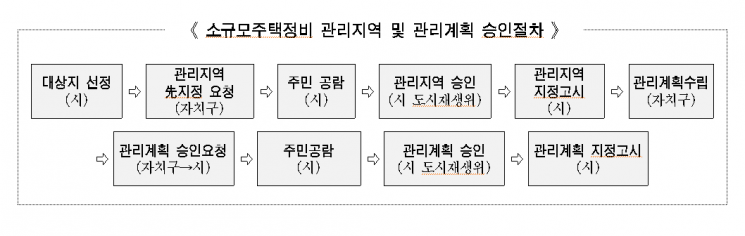
When promoting Moa Housing, relaxed criteria such as project area and aging rate will be applied, and even before the management plan is established, the Moa Town target site will be designated and announced as a 'management area' first. Through this, the relaxed criteria that could only be applied when designated as a 'management area'?such as project area expansion (from less than 10,000㎡ to less than 20,000㎡) and aging rate (from 67% or more to 57% or more)?will be applied first, enabling faster project progress such as association establishment.
If an autonomous district requests 'prior designation of a small-scale housing maintenance management area' for sites among project implementation (planned) sites where relaxed criteria should be applied promptly, the city will hold a committee meeting to designate the area as a management area first. Subsequently, when the district establishes a management plan and requests approval, the city will review and officially announce the designation.
Moa Town Project 'Guidelines' Established... Uniform Floor Restrictions Removed
Until now, there were no separate guidelines, and Moa Town association operations followed the standard articles of association for redevelopment and reconstruction maintenance projects. To ensure that operations are rational and fit the project scale and content, the city will also prepare 'Guidelines for Reducing Operating Costs of Small-scale Housing Maintenance Project Associations.'
The city plans to prepare guidelines suitable for the Moa Town project, such as joint office operation plans between adjacent associations and appropriate business promotion expenses according to project scale, and will provide guidance to autonomous districts and landowners wishing to participate in the project.
To create diverse low-rise residential landscapes, uniform floor restrictions will be removed. In collaboration with research institutes and academia, the city plans to continuously develop the Moa Housing system. Currently, for the 'Street Housing Maintenance Project' conducted in the Type 2 General Residential Area, the 'small-scale housing maintenance management area' designated as Moa Town has no floor restrictions, whereas the 'general area' is limited to a maximum of 15 floors. However, going forward, if the 'general area' meets Moa Housing standards, floor restrictions will not be imposed through integrated reviews.
The city plans to revise related ordinances and integrated review standards so that if the 'Moa Housing Project Implementation Plan Establishment Standards' are met, floor restrictions will not apply even in 'general areas' outside Moa Town.
Furthermore, Seoul City plans to hold a symposium this year with experts from various fields participating to promote the development and institutional settlement of Moa Housing and Moa Town policies. Through the ongoing 'Moa Town University Cooperation Course-linked Project' competition, the city also plans to discover innovative ideas and use it as a channel for communication with citizens.
Prior to this, the city plans to form an expert forum composed of researchers, academia, companies, and related officials within the first half of the year to collect opinions by field and hold policy discussions on the development of Moa Housing policies and revitalization of aging low-rise residential area maintenance.
Yoo Chang-soo, Director of the Housing Policy Office of Seoul City, said, “Last year, all 25 autonomous districts in Seoul participated in the Moa Housing and Moa Town competition, and it was selected as the number one 'Top 10 Policy of Seoul' chosen by citizens, showing great interest and response. As many citizens have high expectations, we will spare no support to ensure that the policy is stably established, improves the low-rise residential environment, and becomes a successful model that supplies quality housing.”
© The Asia Business Daily(www.asiae.co.kr). All rights reserved.


















