Park Yong-geun, EY Hanyoung CEO, "Reviewing Corporate Response Strategies for the Era of Extreme Polarization"
[Asia Economy Reporter Lee Seon-ae] Global accounting and consulting firm EY Hanyoung held the 2023 EY Hanyoung New Year Economic Outlook Seminar on the morning of the 31st under the theme "The Great Divide II Era, Corporate Response Strategies." The seminar, conducted online, was attended by executives from major domestic companies and figures from the economic sector.
Former Financial Services Commission Chairman Lim Jong-ryong, who delivered the keynote speech on the 2023 domestic and international economic outlook, forecasted, "Economic growth worldwide, centered on advanced countries, will significantly weaken, and global trade will also shrink considerably this year." He also analyzed, "Although the global economy is contracting, countries are pursuing different monetary and fiscal policies of tightening and easing depending on their situations," adding, "This is very different from the 2008 financial crisis when the whole world cooperated to stimulate the economy."
Regarding the domestic economy this year, former Chairman Lim projected growth in the 1% range influenced by the global economy and stated, "An economic trend of low in the first half and high in the second half (Sangjeohago, 上低下高) is expected." He particularly emphasized, "Since there is a high possibility of deepening economic sluggishness and increased volatility in price variables in the first half, wise and swift responses are necessary."
Especially, former Chairman Lim expressed that to overcome economic fluctuations and uncertainties, "Businesspeople should adopt the attitude of Yeokpung Jangbeom (逆風張帆), meaning to set sails against the headwind, and prepare for the future with resolute will in the face of difficulties, turning crises into opportunities for growth."
Focusing on the sluggishness and volatility of domestic and international economic trends, especially geopolitical factors, EY Hanyoung CEO Park Yong-geun presented the theme "The Great Divide II Era, Corporate Response Strategies." The Great Divide II era refers to a new Cold War era where the economic crisis that began with the pandemic has evolved into a geopolitical crisis, dividing the world into economic blocs.
CEO Park said, "The world is once again facing a new concept of the Great Divide," and added, "In a situation where uncertainty is prolonged, it is necessary to carefully review future economic prospects and examine corporate response strategies aligned with geopolitical scenarios."
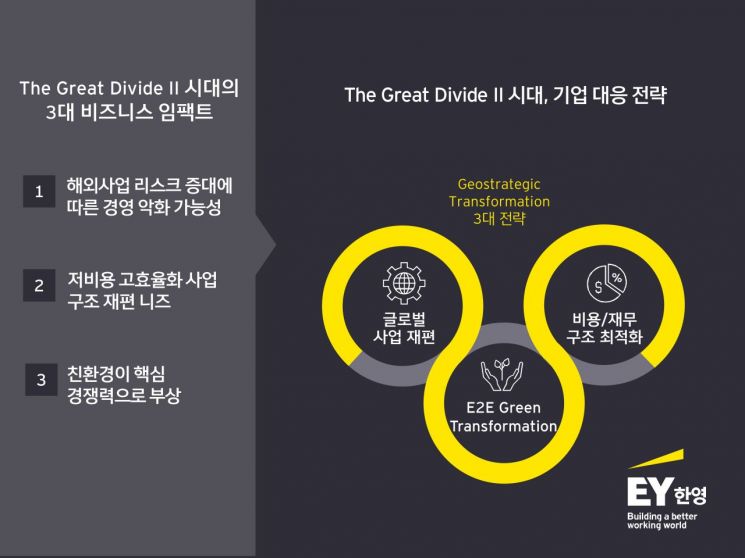
Following this, Junyoung Byun, EY-Parthenon APAC Strategy Consulting Leader and EY Hanyoung Industry Research Director, who presented on "The Great Divide II Era, Corporate Response Strategies in the Face of Geopolitical Crisis," introduced megatrends and business impacts in the new Cold War era caused by geopolitical conflicts. The megatrends of the new Cold War era were classified as ▲the spread of geopolitical conflicts between blocs ▲increased government intervention in supply chains ▲green policies becoming trade barriers ▲weaponization of resources ▲strengthening of technological protectionism ▲inflation and recession.
Byun explained, "The six megatrends of the new Cold War era will ultimately have significant impacts on business in three ways." He said, "First, as overseas business risks increase, corporate performance may deteriorate," and explained, "With the global economy becoming bloc-oriented, a comprehensive reestablishment of overseas industrial strategies is inevitable." He also analyzed, "There is a rising need to restructure business models toward low-cost, high-efficiency operations. In particular, business model innovation, cost reduction, and liquidity management are important." Lastly, he emphasized, "Green initiatives will emerge as a core corporate competitiveness, requiring strategies that focus company-wide capabilities on environmental sustainability."
The second presenter, Suyeon Kim, Executive Director at EY Consulting, proposed three major corporate response strategies that companies should proactively adopt: ▲global business restructuring ▲cost and financial structure optimization ▲end-to-end green transformation. Kim explained, "For global business restructuring, it is necessary to reestablish global business strategies, divest or sell inefficient businesses, and review the restructuring of overseas production bases according to country-specific policies." She also emphasized, "To optimize cost and financial structure, business model innovation, enhancement of cost competitiveness, and securing liquidity are essential." Lastly, she suggested, "In line with the trend where green initiatives become core competitiveness, companies should diagnose carbon emissions across the entire value chain and establish a net zero roadmap and environmental performance management system."
© The Asia Business Daily(www.asiae.co.kr). All rights reserved.
![Clutching a Stolen Dior Bag, Saying "I Hate Being Poor but Real"... The Grotesque Con of a "Human Knockoff" [Slate]](https://cwcontent.asiae.co.kr/asiaresize/183/2026021902243444107_1771435474.jpg)











