Creating an Eco-Friendly Complex by Securing Ample Green Spaces Within the Complex
Establishing a Pedestrian-Centered, Safe, and Convenient Living Environment
Expecting Rapid Redevelopment Projects Based on Residents' Will
[Asia Economy Reporter Onyu Lim] Banghwa 2 District in Gangseo-gu, Seoul, will be transformed into a multi-family housing complex with up to 16 floors and approximately 740 units through a rapid integrated planning process. Due to height restrictions and resident conflicts, the project has faced ups and downs, but the redevelopment plan is expected to be finalized within this year.
Seoul City announced on the 30th that it has finalized the rapid integrated planning proposal for Banghwa 2 District. Since being included in Banghwa New Town in 2003, redevelopment efforts have been underway since 2012. However, the project was halted in 2015 due to height restrictions related to Gimpo Airport and resident conflicts, causing long-term difficulties in advancing the project. Nevertheless, after being selected as a private redevelopment candidate site in December 2021, the redevelopment project has gained momentum through flexible urban planning applications via rapid integrated planning.
Over the past year, Seoul City formed a team with local governments, residents, and experts, conducting ten rounds of intense discussions, plan adjustments, and active communication with residents to finalize the rapid integrated planning proposal.
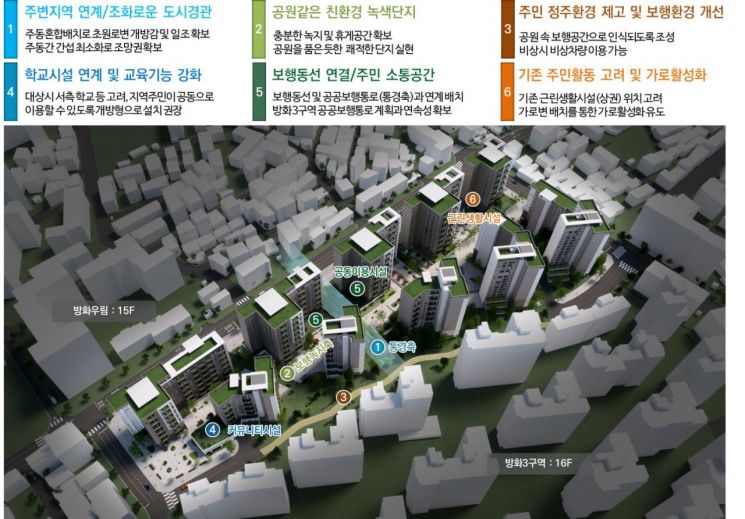
According to the finalized rapid integrated planning proposal, Banghwa 2 District will be reborn as a pleasant residential complex harmonizing with the surrounding area, featuring up to 16 floors and around 740 households. To achieve this, four planning principles were established under the goal of creating a "park-like residential complex that blends into the city and coexists with the community."
First, the plan includes securing ample green spaces within the complex through the creation of pedestrian green corridors and three-dimensional greening to respond to climate change, aiming for an eco-friendly green complex. Second, pedestrian safety and connectivity will be enhanced by linking pedestrian paths with surrounding areas and minimizing vehicle routes within the complex.
Third, various facilities will be arranged in connection with school routes, commuting roads, living streets, and public pedestrian pathways, planning resident-customized outdoor spaces centered around pedestrian green corridors that encourage communication and interaction. Lastly, considering Banghwa Elementary School and low-rise residential areas on the west side of the site, a mid-to-low-rise layout and multiple sightline corridors will be established to create a harmonious urban landscape. Taking into account the Gimpo Airport height restriction (elevation 57.86m), planning guidelines were set to allow a gradual skyline from mid-to-low-rise buildings on the west side to mid-to-high-rise buildings on the east side within the maximum 16-floor limit.
Considering the limited site conditions, the city focused on inducing efficient land use plans that prioritize securing essential infrastructure such as roads, while creating a green, eco-friendly complex where the atmosphere and scenery of a park can be enjoyed throughout the entire site. Additionally, open spaces accessible to local residents and a public pedestrian pathway in the center of the complex were established to ensure sufficient green and resting areas needed by the community.
With the rapid integrated planning proposal for Banghwa 2 District finalized, Seoul City expects the redevelopment plan decision (or amendment) to be completed within this year, starting with the initiation of the redevelopment plan drafting process. By applying the streamlined procedures of rapid integrated planning, the project duration is anticipated to be significantly shortened through integrated reviews by the Urban Redevelopment Committee’s delegated subcommittee and the project implementation plan.
Jo Nam-jun, Director of the Seoul City Urban Planning Bureau, stated, “Banghwa 2 District has faced long-term difficulties in project advancement due to Gimpo Airport height restrictions and poor development conditions. We will support the smooth progress of the redevelopment project, which has been a long-standing wish of the residents, and actively assist in transforming this area into a pleasant, eco-friendly residential complex that provides vitality and rest to the community.”
© The Asia Business Daily(www.asiae.co.kr). All rights reserved.
![Clutching a Stolen Dior Bag, Saying "I Hate Being Poor but Real"... The Grotesque Con of a "Human Knockoff" [Slate]](https://cwcontent.asiae.co.kr/asiaresize/183/2026021902243444107_1771435474.jpg)
















