Since Taking Office in 2017 and Through a "Special Reappointment"
"I Felt It Was Worth Trying"
Industry Innovation and Government Support for Pharmaceutical Sovereignty Are Key
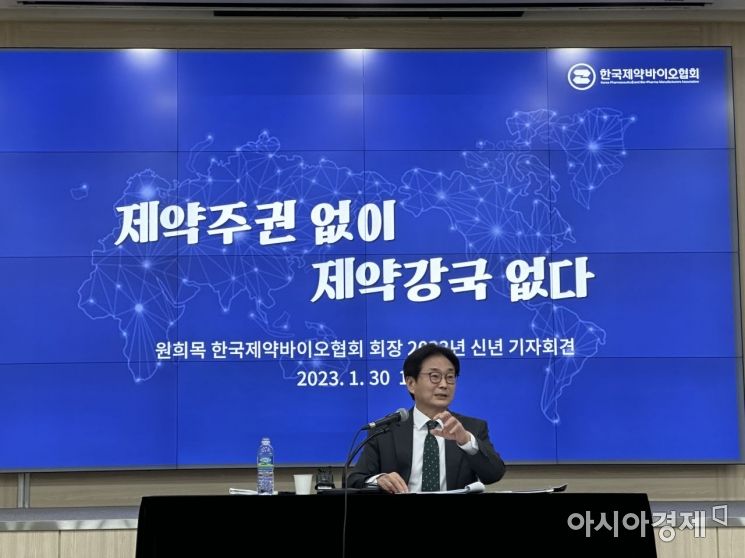 Won Hee-mok, Chairman of the Korea Pharmaceutical and Bio-Pharma Manufacturers Association, is speaking at the New Year's press conference held on the 30th.
 [Photo by Lee Chun-hee]
[Asia Economy Reporter Chunhee Lee] "Over the past six years, I have felt that 'it's worth trying.' Now, at a turning point where it is time to advance further, the tasks we have pursued will be carried forward continuously by the new president and staff."
Won Hee-mok, president of the Korea Pharmaceutical and Bio-Pharma Manufacturers Association, expressed his reflections on the past six years at a New Year press conference held on the 30th at the association's office in Seocho-gu, Seoul, under the theme "There is no pharmaceutical powerhouse without pharmaceutical sovereignty." He said, "Although there are not many clear tangible results yet, the image of the pharmaceutical and bio industry has changed significantly over the past six years," adding, "The biggest change is that the public, government, and industry have changed their perceptions of the industry, and actions related to this have begun to emerge." He also stated, "The results have not yet come out, but the situation is like water at 90 degrees just before boiling," and "If the government presents support measures that can be felt, it will reach 100 degrees and make a quantum leap."
President Won, a pharmacist by training, served as a member of the 18th National Assembly and as president of the Korean Pharmaceutical Association before taking office as president of the Pharmaceutical and Bio-Pharma Manufacturers Association in 2017. However, in January of the following year, he had to resign after the Government Ethics Committee for Public Officials decided to restrict his employment due to the close relevance of his legislative activities promoting the pharmaceutical industry during his time as a lawmaker. Nevertheless, he returned as president within 10 months with strong industry support and was re-elected in 2019. Although the original term is two years with one possible reappointment, through a 'special reappointment' system approved by the board of directors, he succeeded in serving the maximum six-year term as president of the association until February.
Since there was no separate farewell press conference, the press conference held that day effectively served as his farewell. President Won stated that the content reflected the consensus of the association and its 267 member companies, reviewing the current market situation and presenting demands to the industry and government to overcome challenges and establish pharmaceutical sovereignty. He emphasized, "The content announced today was discussed and organized in consultation with the board of directors to ensure continuity for the association."
He identified key tasks including ▲ increasing the self-sufficiency rate of pharmaceuticals ▲ building an open innovation ecosystem ▲ establishing a global foundation ▲ and creating an environment for industrial advancement, strongly urging the government’s role in these areas. He stressed that establishing pharmaceutical sovereignty should be the top national agenda, calling for the prompt establishment of the Pharmaceutical Bio-Pharma Innovation Committee, which was a campaign pledge in the presidential election, and emphasized the need for investment in the pharmaceutical and bio industry, which is currently facing adverse conditions such as high interest rates, high exchange rates, and low growth.
Regarding the government’s drug pricing policy, President Won did not hold back criticism. Recently, the government has been implementing a re-evaluation policy to drastically reduce domestic prices of generics, claiming they are excessively high compared to overseas. However, he raised his voice, saying, "To protect pharmaceutical sovereignty, we need to consider global drug prices but also our own circumstances." Unlike the U.S. and Australia, which import raw materials and finished drugs from low-cost countries like India and significantly lower generic drug prices, Korea produces domestically, so fundamentally the costs are different and this must be taken into account.
He further mentioned that proper pricing should be applied not only to generics but also to new drugs to encourage active research and development (R&D) investment. President Won explained, "Without innovation in the drug price compensation system, it is impossible to achieve global success cases," adding, "We need to look at the entire industry and set drug prices while considering the bigger picture of pharmaceutical sovereignty."
He also emphasized direct government support. President Won said, "Although government-level plans to foster the pharmaceutical and bio industry are being developed, they are often not felt on the ground," and "especially, government R&D support capabilities should be concentrated on clinical phases 2 and 3, which have high commercialization potential but require significant costs." He argued that government support policies, currently focused on early stages, should be expanded to later stages to actively support the commercialization of innovative drugs.
He also stressed the necessity of the long-delayed 'control tower,' the Pharmaceutical Bio-Pharma Innovation Committee. He said, "With the Ministry of Science and ICT, Ministry of Trade, Industry and Energy, and Ministry of Health and Welfare vertically segmented, inefficient work processes and budget execution are occurring," adding, "A control tower directly under the Prime Minister should be promptly established and operated to effectively coordinate pharmaceutical and bio policies dispersed across ministries."
Meanwhile, it is reported that the next president of the Korea Pharmaceutical and Bio-Pharma Manufacturers Association will be No Yeon-hong, former head of the Ministry of Food and Drug Safety. A former bureaucrat who served as director of the Health and Medical Policy Bureau at the Ministry of Health and Welfare and as health and welfare secretary at the Blue House, he ended his public service career as the senior secretary for employment and welfare under the MB administration and is currently serving as an advisor at Kim & Chang law firm. He is expected to be officially appointed as the next president at the board of directors meeting scheduled for the 14th of next month.
© The Asia Business Daily(www.asiae.co.kr). All rights reserved.
![Clutching a Stolen Dior Bag, Saying "I Hate Being Poor but Real"... The Grotesque Con of a "Human Knockoff" [Slate]](https://cwcontent.asiae.co.kr/asiaresize/183/2026021902243444107_1771435474.jpg)
















