Consideration of Introducing Non-Consent Rape Law Focusing on Consent Instead of Assault or Threats Withdrawn Amid Opposition
Criticism Grows from Opposition Parties and Women's Groups
As Controversy Escalates, Ministry of Gender Equality Clarifies It Was Only Explaining the Promotion Process
[Asia Economy Reporter Yoon Seul-gi] The Ministry of Gender Equality and Family (MOGEF) appears to be facing ongoing repercussions after withdrawing its consideration of introducing the 'non-consensual intercourse crime' just nine hours after announcing it. On the 26th, MOGEF announced the 3rd Basic Plan for Gender Equality Policy (2023?2027) and stated it would consider introducing the non-consensual intercourse crime, but withdrew the plan due to opposition from the Ministry of Justice and the ruling party.
The core of the non-consensual intercourse crime is to allow punishment under rape laws for sexual intercourse conducted 'without consent.' The discussion gained momentum following the 2018 sexual assault case involving former Chungnam Governor Ahn Hee-jung. Under current law, rape is established when sexual intercourse is forced through violence or threats, but criticisms arose that this framework is inadequate for protecting sexual violence victims, leading to calls for consent to be a key element in defining rape.
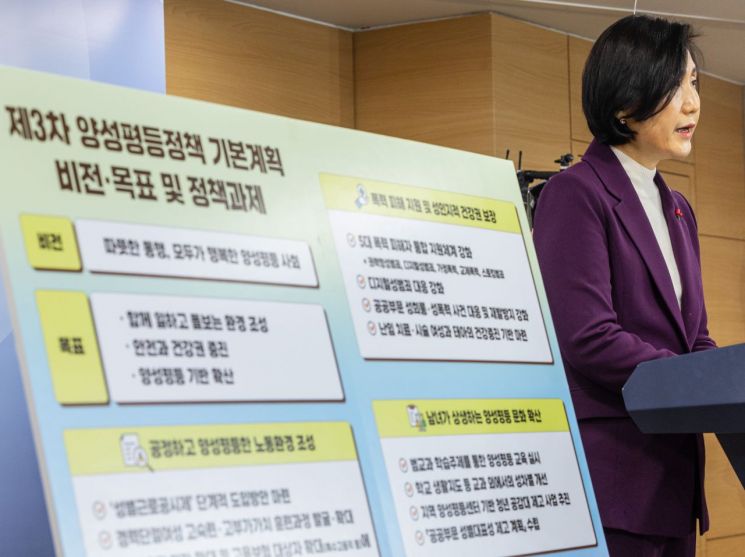 Lee Gi-soon, Vice Minister of Gender Equality and Family, is announcing the 3rd Basic Plan for Gender Equality Policy on the morning of the 26th at the Government Seoul Office in Jongno-gu, Seoul. Photo by Yonhap News
However, opinions emerged emphasizing the need for a cautious approach, citing difficulties in confirming or judging consent. The Ministry of Justice stated, "Regarding MOGEF's discussion on establishing the non-consensual intercourse crime, we have presented a cautious review opinion opposing it, noting that it concerns the fundamental system of sexual crimes and requires comprehensive review through sufficient discussion across various sectors of society."
People Power Party lawmaker Kwon Seong-dong also opposed the measure, citing the possibility of false accusations. On January 26, he wrote on Facebook, "Even if the relationship was consensual, there is a possibility of false accusations depending on the other party's will afterward," and pointed out, "If the victim's subjective will alone is the element for establishing the crime, proving it is extremely difficult."
There were also concerns that in reality, sexual relations often occur under tacit consent, and introducing the non-consensual intercourse crime could label men as potential criminals. People Power Party lawmaker Cho Kyung-tae raised his voice against the non-consensual intercourse crime, saying, "It is driving a nail into men as potential sexual offenders."
In a press release on January 27, Cho stated, "Asking for consent before sexual intercourse and only allowing it after consent is practically impossible in real life," and argued, "State intervention in the intimate, most private relationship between men and women should be minimized."
On the other hand, criticism arose from opposition parties and women's organizations after MOGEF withdrew the consideration of the non-consensual intercourse crime within half a day. Former co-chair of the Democratic Party's Emergency Committee Park Ji-hyun wrote on Facebook, "If non-consensual sexual intercourse is not rape, then what is it?" and called it "an atrocity that regresses women's rights."
Women's groups also criticized the effective collapse of the non-consensual intercourse crime introduction as going against global trends. The 'Coalition for Rape Law Reform,' a coalition of over 200 women's rights organizations including the Korea Sexual Violence Counseling Center, Korean Women's Associations United, and Korea Women's Hotline, issued a statement saying, "The non-consensual rape crime is a global trend to resolve sexual violence," and urged, "Implement the non-consensual rape crime."
Democratic Party lawmaker Kwon In-sook, chair of the National Assembly's Gender Equality and Family Committee, also wrote on Facebook on January 28, "The establishment of the non-consensual intercourse crime is the most critical issue in sexual violence agendas worldwide," adding, "It is already a universal standard in Western societies, and the UN Committee on the Elimination of Discrimination against Women has recommended the Korean government to revise the law. Countries such as the UK, Germany, Sweden, Ireland, Canada, and Spain have introduced the non-consensual intercourse crime to align with international human rights standards."
Meanwhile, as the controversy continued, MOGEF explained the background of including the 'consideration of establishing the non-consensual intercourse crime.' Ministry spokesperson Cho Min-kyung said on January 30 that from September last year to January this year, several rounds of interdepartmental consultations were held, and the Ministry of Justice submitted one opinion.
When asked if the introduction was seriously considered, spokesperson Cho said, "I hope you understand it simply as 'consideration,'" and added, "Regarding the detailed implementation plan, it was mentioned that it would be included in the implementation plan, but that was an explanation of the general procedure for advancing basic plan tasks."
© The Asia Business Daily(www.asiae.co.kr). All rights reserved.
![Clutching a Stolen Dior Bag, Saying "I Hate Being Poor but Real"... The Grotesque Con of a "Human Knockoff" [Slate]](https://cwcontent.asiae.co.kr/asiaresize/183/2026021902243444107_1771435474.jpg)

















