Opening of the National Assembly Plenary Session to Submit the Grain Management Act Proposal
No Voting Took Place in the Plenary Session
Only the Opposition Party Voted After the People Power Party Lawmakers Walked Out
[Asia Economy Reporters Naju-seok and Kim Young-won] On the 30th, the National Assembly passed the bill to amend the Grain Management Act, which was directly submitted by the Agriculture, Forestry, Livestock, Food, and Maritime Affairs Committee, solely by the opposition party. With the passage of the bill to amend the Grain Management Act, it can now proceed to a voting process in the plenary session.
On the day, the National Assembly voted anonymously on the bill to amend the Grain Management Act, resulting in 157 votes in favor, 6 against, and 2 invalid votes, thus passing the bill. Members of the People Power Party who opposed the plenary submission of the Grain Management Act left their seats as the vote began.
The Grain Management Act passed the Agriculture, Forestry, Livestock, Food, and Maritime Affairs Committee plenary meeting on October 19 last year, but the Legislation and Judiciary Committee, which has the authority to review the system and wording, refused to submit it citing procedural issues such as unilateral handling by the opposition party. Accordingly, the Agriculture, Forestry, Livestock, Food, and Maritime Affairs Committee directly submitted the bill to the plenary session on the 28th of last month, based on the National Assembly Act which states that if the Legislation and Judiciary Committee does not review a bill from another standing committee within 60 days, the bill can be submitted to the plenary session with the consent of three-fifths of the total members through agreement between committee secretaries or anonymous voting.
After the direct submission by the Agriculture, Forestry, Livestock, Food, and Maritime Affairs Committee, on the 16th of this month, the Legislation and Judiciary Committee referred the bill to the second subcommittee on legislation, citing that the bill was still pending.
With the passage of the bill in this plenary session, it is now possible for the bill to be approved in a future plenary session. However, there remains the possibility of compromise through negotiations between the floor leaders of the ruling and opposition parties or through the ruling party’s proposal of amendments.
Immediately after the bill was passed in the plenary session, National Assembly Speaker Kim Jin-pyo said, "Regarding the amendment to the Grain Management Act, there are opinions in favor from the perspective of stabilizing the rice market and opposing views due to concerns about financial burden and long-term price decline." He added, "Considering these opinions comprehensively, I urge the Agriculture, Forestry, Livestock, Food, and Maritime Affairs Committee to carefully deliberate on what is truly for the farmers and for both parties to prepare a reasonable alternative."
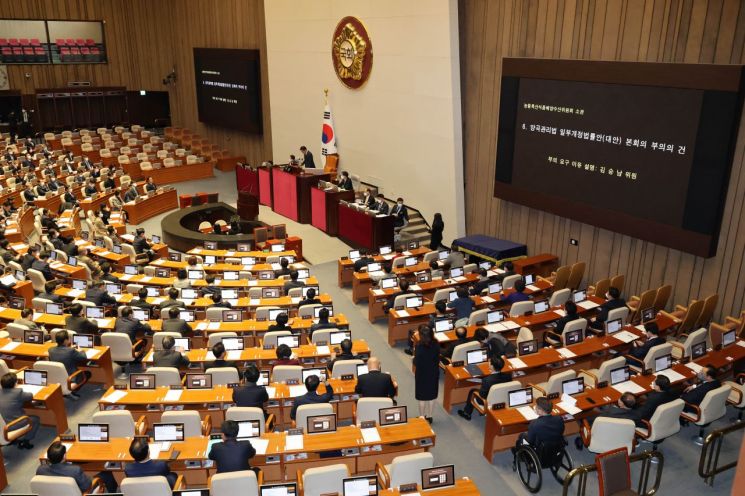
During the plenary session, four members from both ruling and opposition parties engaged in debate over the bill. Choi Chun-sik of the People Power Party opposed the bill, stating, "The Grain Management Act amendment was forcibly passed by the Democratic Party through the standing committee’s subcommittee and plenary meeting." Choi criticized, "The per capita rice consumption is 155g, down 100g from 250g in 2000. Although rice consumption is decreasing every year, the Democratic Party is pushing a plan to solidify the overproduction structure of rice."
Ahn Byung-gil of the People Power Party criticized, "According to the Democratic Party’s logic, shouldn’t there also be a mandatory purchase for Korean beef?" He added, "Many fishermen struggle when mackerel prices fall, so will the Democratic Party also create a mandatory purchase law for mackerel?" Ahn warned, "According to the Korea Rural Economic Institute’s analysis, if this law passes, the annual rice purchase amount is estimated to reach 1.5 trillion won. This law, which aims to control rice prices, will ultimately only harm Korean farmers."
Lee Won-taek of the Democratic Party criticized, "The Legislation and Judiciary Committee did not conduct a single review of the system and wording of the Grain Management Act amendment during the 60 days stipulated by the National Assembly Act." He also pointed out the referral of the Grain Management Act to the second subcommittee on legislation on the 16th of this month as "an act of tyranny."
Yoon Joon-byung of the Democratic Party explained, "The government did not keep its promise to implement market isolation if rice prices fell last year. Democratic Party members have been pushing for amendments to the Grain Management Act to prevent government discretion abuse and to ensure that market isolation effectively contributes to normalizing and stabilizing rice prices." Yoon stated, "I have expressed very negative views on the amendment to the Grain Management Act and hinted at the possibility of veto. The Grain Management Act does not help farmers, and the so-called unlimited purchase under the Grain Management Act is rather undesirable for our agriculture." He added, "This statement reveals the president’s ignorance regarding the Grain Management Act amendment." He criticized, "Even if market isolation is made mandatory, the government will only be obligated to purchase when market isolation conditions are met, as it fails to properly adjust rice production through support for non-rice crop cultivation. To defend this ignorance of the president, the government and ruling party keep parroting baseless claims."
© The Asia Business Daily(www.asiae.co.kr). All rights reserved.

















