Expansion of Special Guarantee Products for Lowest Credit Borrowers
Providing Customized Debt Adjustment Considering Borrower Situations
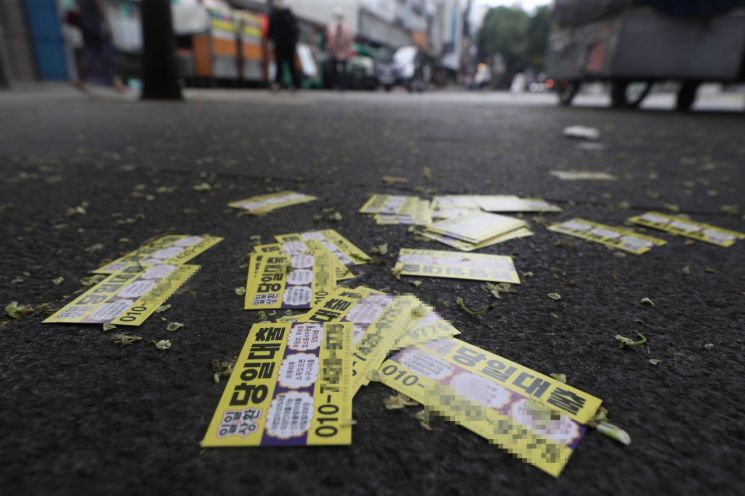 On the 29th, as the COVID-19 pandemic continues to persist, illegal loan business card-type flyers from private loan companies are scattered across the Insadong street in Jongno-gu, Seoul. Photo by Mun Ho-nam munonam@
[Asia Economy Reporter Sim Nayoung] The Financial Services Commission has decided to introduce an 'Emergency Living Expense Loan' in March to provide up to 1 million KRW in rapid support to low-credit and low-income vulnerable borrowers. This includes low-credit defaulters and no-income individuals who were previously excluded from the policy-based financial support. On the 30th, the Financial Services Commission announced this plan as part of the 2023 major business promotion plan during the presidential work report held at the Blue House State Guesthouse in Jongno-gu, Seoul.
The Emergency Living Expense Loan targets vulnerable groups at risk of illegal private loan damage. Support is provided regardless of delinquency status or income. However, considering limited resources, the loan is restricted to those with credit scores in the bottom 20% and an annual income of 35 million KRW or less, meeting the low-credit and low-income criteria. The loan limit is up to 1 million KRW, with an initial loan of 500,000 KRW; if the borrower repays faithfully for more than six months (and is not delinquent at the time of additional use), an additional 500,000 KRW loan is possible.
In principle, the loan is provided with a single limit (initial 500,000 KRW), but if funds are needed for medical, housing, or education expenses, loans up to 1 million KRW can be obtained. The loan interest rate is fixed at 15.9%. For a 1 million KRW loan, the monthly interest payment is 13,250 KRW. For borrowers who repay faithfully, the interest rate is reduced by 2 percentage points for additional loans, and by 0.5 percentage points upon completion of financial education.
The funds will be raised to 100 billion KRW this year through donations from Korea Asset Management Corporation (KAMCO) (50 billion KRW) and the banking sector (50 billion KRW). Loans can be obtained directly from the Korea Inclusive Finance Agency.
The annual supply scale of policy-based financial services for the underprivileged will be expanded to 10 trillion KRW per year. This is an increase of 2 trillion KRW over four years from 8 trillion KRW in 2019.
Special guarantee products for the lowest credit borrowers will also be expanded. The supply plan for this year was 140 billion KRW but has increased to 280 billion KRW. This targets the lowest credit borrowers with credit scores in the bottom 10% and annual income of 45 million KRW or less, who have a history of loan delinquency and thus find it difficult to use policy-based financial products such as Saessal Loan 15.
The loan limit is up to 10 million KRW. At the initial loan, support is provided within 5 million KRW based on the screening results, and after six months of faithful repayment, additional loans are possible within the maximum limit of 10 million KRW. The interest rate is basically 15.9%. For faithful repayment, the rate will be reduced annually during the loan period, with a final rate of 9.9%.
To support the recovery of vulnerable borrowers, customized debt adjustment considering the borrower's situation will also be provided. The interest reduction and repayment deferral support program (which reduces interest rates by 30-50% even before 30 days of delinquency) currently applied to low-credit vulnerable youth borrowers will be expanded to all age groups of vulnerable borrowers for one year. For example, this includes those with credit scores in the bottom 20%, unemployed or on leave, long-term hospitalized patients, and disaster victims.
For borrowers with significantly insufficient repayment capacity, such as basic livelihood security recipients and the elderly, debt adjustment support including principal reduction will be expanded even before 90 days of delinquency. The support plan includes full exemption of interest and delinquency interest equivalent to personal workout (after 90 days delinquency) and principal reduction of up to 30%.
Meanwhile, the measure to increase the loan limit of the Worker Saessal Loan to 20 million KRW will also be extended through this year. A Financial Services Commission official stated, "For faithfully repaying youth, even if they are undergoing debt adjustment, we will increase support for Saessal Loan Youth and the guarantee limit for Saessal Loan Card." The maximum limit will increase from the existing 2 million KRW to 3 million KRW.
He added, "We will promote the enactment of the 'Personal Debtor Protection Act' to strengthen debtor protection, including alleviation of delinquency and collection burdens and introduction of debtor's right to request debt adjustment," and "We plan to launch the Youth Leap Account in June."
© The Asia Business Daily(www.asiae.co.kr). All rights reserved.

















