Gimhae City Conducts Excavation Survey to Identify Remaining Cultural Layers
Archaeological Investigation Results to Be Used for Future Maintenance and Restoration
An excavation survey to assess the damage to the Gusan-dong dolmen (megalithic tomb) in Gimhae-si, Gyeongnam, which was damaged due to poor management last year, will be conducted. On the 30th, the Cultural Heritage Administration announced that on the 18th, the Subcommittee on Buried Cultural Heritage under the Cultural Heritage Committee reviewed and approved the excavation survey proposal for the 'Gusan-dong Dolmen Site within the Maintenance Project Area in Gimhae' submitted by Gimhae-si. Based on the joint investigation results by the Cultural Heritage Administration and the police, the exact extent, depth, and area of the dolmen site damage will be confirmed.
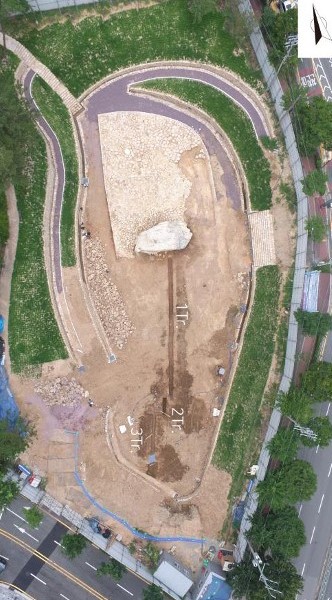
The Gusan-dong dolmen in Gimhae-si was discovered in 2006 during a residential district development project. The burial site’s paving stone facilities (敷石施設) and a massive capstone (蓋石) were identified. The burial site covers an area of 1,615㎡, and the capstone weighs approximately 350 tons, making it presumed to be the largest dolmen in the world. Gimhae-si, which has been pursuing designation as a historic site, selected a cultural heritage restoration specialist company as the contractor and began the maintenance project in December 2020. However, the project was halted after it was confirmed that the site was damaged without official permission. Significant portions of the cultural layer (a stratum indicating specific cultural characteristics of an era) in the area where the capstone’s surroundings, water reservoir, pipelines, and boundary walls were installed and buried were lost or destroyed.
According to the National Gaya Cultural Heritage Research Institute, morphological changes (the shape and characteristics of objects) were observed throughout the burial site. Cutting into the ground to level it ('cut and fill') and raising the ground by adding soil ('embankment') have been ongoing for a long time. The institute explained, "At least about 20 cm, and in severe cases, a significant part of the cultural layer was destroyed during the excavation process." In fact, the ground near the east wall of the water reservoir is deeply excavated. Construction equipment was scattered in various places. The situation near the south side of the water reservoir and the boundary wall is similar. The institute stated, "It is understood that after excavating the burial site and the underlying cultural layer, the water reservoir and pipelines were installed," adding, "The height of the cultural layer around the capstone, especially on the south side, differs by about 30 cm, requiring further review."
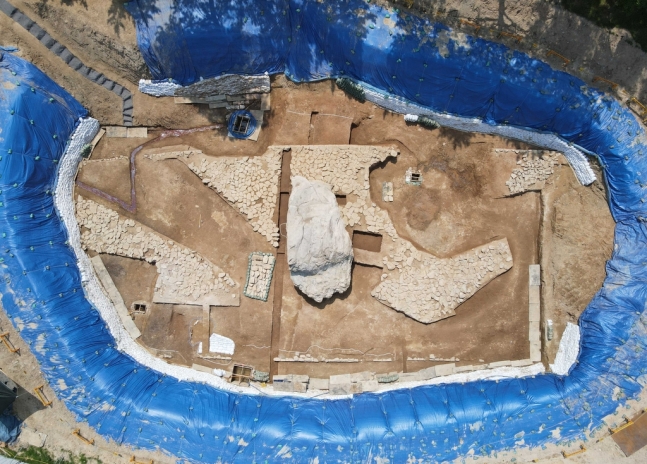
An excavation survey is inevitable to accurately determine the extent of morphological changes and the remaining areas of the cultural layer. Gimhae-si plans to carry out the survey next month through Samgang Cultural Heritage Research Institute, a cultural heritage investigation organization. The survey will cover an area of 1,666㎡ over 49 days (based on actual investigation days) from the start date. A Cultural Heritage Administration official stated, "After assessing the current status of the dolmen site’s damage in terms of extent, depth, and area, we plan to proceed with an archaeological investigation following review by related agencies," adding, "The survey is expected to continue until April this year." They also added, "The survey results will be used for future maintenance and restoration plans."
Meanwhile, the Cultural Heritage Administration has filed a complaint with the police against Gimhae-si under the 'Act on the Protection and Investigation of Buried Cultural Heritage.' According to current law, anyone who excavates buried cultural heritage without permission or changes the condition of an area where buried cultural heritage has been confirmed or is being excavated can face imprisonment of up to 10 years or a fine of up to 100 million won. According to a recent audit report by the Gyeongnam Provincial Audit Committee, Gimhae-si dismantled and moved paving stones (thin, flat stones) after the permission period for condition changes had expired and damaged the burial site of the buried cultural heritage without permission. The provincial audit committee disciplined six related public officials, issued warnings to three, and gave cautionary measures to two.
© The Asia Business Daily(www.asiae.co.kr). All rights reserved.
![Clutching a Stolen Dior Bag, Saying "I Hate Being Poor but Real"... The Grotesque Con of a "Human Knockoff" [Slate]](https://cwcontent.asiae.co.kr/asiaresize/183/2026021902243444107_1771435474.jpg)

















