The Bank of Korea's Report on 'Productivity Changes After COVID-19'
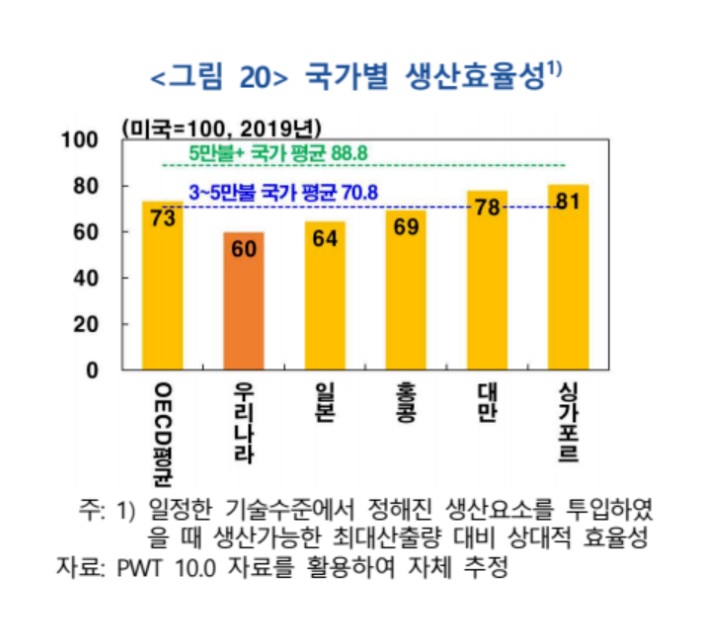
[Asia Economy Reporter Seo So-jeong] It has been revealed that South Korea's production efficiency is significantly lower than that of major Asian countries such as the United States, Singapore, Taiwan, and Hong Kong. Since the global financial crisis, South Korea's productivity growth has slowed, leading to a decline in its potential growth rate. With concerns over weakened growth potential following the COVID-19 pandemic, there are calls for active efforts not only in technological innovation but also in restructuring and regulatory improvements.
On the 30th, the Bank of Korea stated in its report titled "Key Characteristics and Implications of Productivity Changes After COVID-19" that "South Korea's production efficiency is significantly below the average level of major countries."
According to the Bank of Korea, in 2019, South Korea's production efficiency level was 59.9% compared to the United States, falling short not only of the OECD member countries' average of 73.2% but also below the average of countries with similar economic sizes (nominal GDP per capita of $30,000 to $50,000), which stood at 70.8%.
Jung Sun-young, head of the Macroeconomic and Fiscal Team at the Bank of Korea's Research Department, said, "Since the gap in the speed of technological innovation among major countries is relatively small, it is judged that efforts to improve productivity solely through technological innovation such as research and development (R&D) investment, without efforts to improve production efficiency, will make it difficult to achieve additional productivity improvements or effectively close the productivity gap with advanced countries."
South Korea's productivity showed a typical cyclical pattern during crises, rapidly rebounding immediately after the pandemic but then stagnating. The report found that after a temporary rebound following the pandemic shock, the slowdown intensified, causing a slight decline in the long-term productivity trend. The report analyzed that the deepening productivity slowdown was mainly due to unstable external conditions, the disappearance of inter-industry reallocation effects, and the absence of a cleansing effect during the recession.
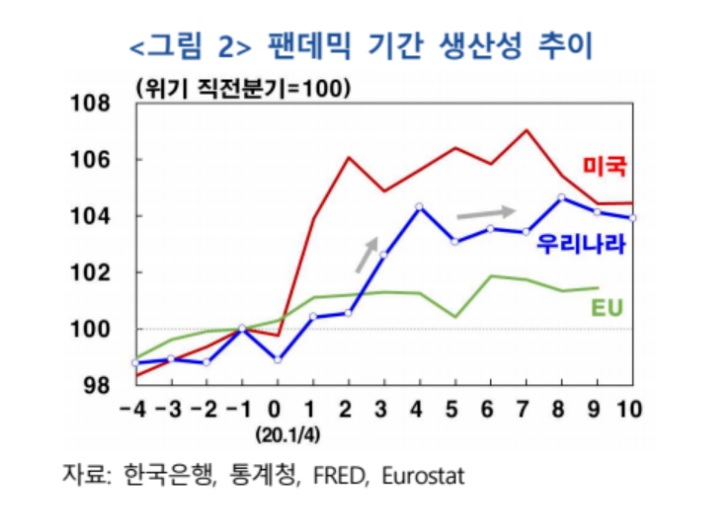
Despite a recovery in the labor market, South Korea's growth recovery has been delayed due to the prolonged pandemic beyond expectations and the instability of external conditions such as Russia's invasion of Ukraine. Another issue is that the inter-industry reallocation effect caused by changes in labor input, which temporarily boosted productivity immediately after the crisis due to vaccine distribution and easing of quarantine policies, disappeared after 2021.
In particular, indicators reflecting structural inefficiencies in the market, such as the proportion of marginal firms and the productivity gap between manufacturing and service sectors, worsened during the crisis period. However, the report evaluated that the cleansing effect, which improves market efficiency by eliminating inefficient firms during recessions, did not accompany this crisis.
Furthermore, the pandemic shock widened the productivity gap within the service sector depending on the utilization of digital technologies. The digital-intensive sectors maintained a high growth rate in labor productivity by quickly recovering production capacity without a recovery in labor input, compared to other service sectors.
The report explained that there are concerns about increased downward pressure on productivity due to the accumulation of market inefficiencies in the future, such as long-term unemployment caused by the scarring effect left by the pandemic, rising production costs due to global supply chain fragmentation, and delays in restructuring marginal firms. However, it also anticipated that the pandemic has accelerated digital transformation by significantly expanding demand for digital goods and services, and that the Big-blur phenomenon?where barriers between industries disappear?could enhance corporate dynamism and act as a new growth engine overcoming existing productivity slowdown factors.
Jung emphasized, "In the post-COVID era, a two-track strategy is necessary to expand productivity: maximizing the positive effects of technological innovation such as digital transformation, and strengthening production efficiency through economic structural improvements like restructuring and regulatory reforms." She explained that companies need to overcome the limitations of physical inputs by expanding human capital and intangible asset investments and reorganize existing organizations and business structures into more efficient and flexible forms to timely reflect changes in the future economic environment.
She added, "The government should not delay restructuring chronic marginal firms with low recovery potential and should enhance resource allocation efficiency and market dynamism through regulatory improvements reflecting changes in economic conditions. While preparing for the new normal, it should focus on strengthening the competitiveness of innovative industries and securing new growth engines through market leadership, as well as implement policy responses to minimize negative impacts such as market concentration and polarization intensification caused by digital transformation."
© The Asia Business Daily(www.asiae.co.kr). All rights reserved.


















