Remove Restrictions on Loans for Returning Rental Deposits
Special Supply of BoGeumJaRi Loans for Genuine Homebuyers
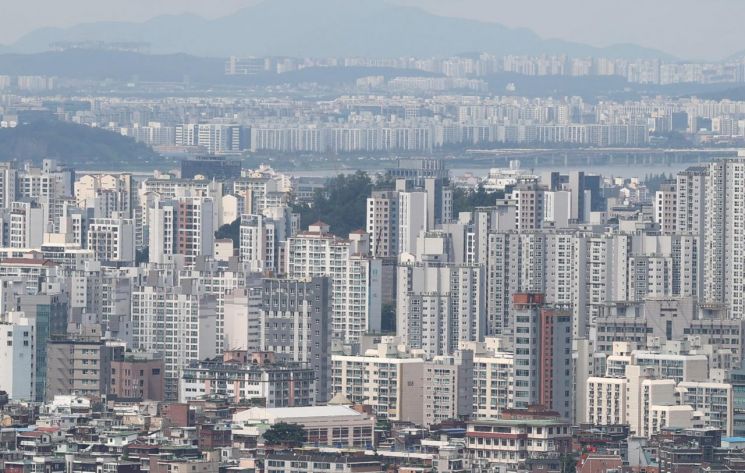
[Asia Economy Reporter Sim Nayoung] Financial authorities have announced measures to reduce tenants' housing costs and ease landlords' difficulties in returning rental deposits to address the instability in the Jeonse market. They plan to supply fixed-rate Jeonse loan products and expand the guarantee coverage for Jeonse loans. Various restrictions on loans for the purpose of returning rental deposits have also been abolished.
On the 30th, the Financial Services Commission stated in the presidential work report, "We will strengthen policy guarantee support from the Korea Housing Finance Corporation to encourage banks to expand the supply of fixed-rate Jeonse loan products at lower interest rates."
The guarantee ratio by the Korea Housing Finance Corporation will be raised from 90% to 100%, and the guarantee fee rate will be reduced by 0.1 percentage points. Preferential treatment will also be provided for calculating annual recognized income to determine the guarantee amount. A Financial Services Commission official said, "Through this, banks can be encouraged to lower fixed-rate Jeonse loan interest rates," adding, "We expect Jeonse tenants to benefit from relatively low interest rates and be able to use Jeonse loans without the risk of additional interest rate hikes."
Jeonse loan guarantees will also be provided to one-homeowners with a combined spousal income exceeding 100 million KRW and one-homeowners with a market price exceeding 900 million KRW, who were previously excluded from the guarantee coverage. However, to prevent market instability such as the expansion of gap investment, guarantee restrictions for multi-homeowners and one-homeowners with apartments over 300 million KRW in speculative and overheated speculation areas will be maintained.
Financial authorities have also decided to remove various restrictions on loans for the purpose of returning rental deposits. The loan limit (currently 200 million KRW) for apartments exceeding 1.5 billion KRW in speculative and overheated speculation areas will be abolished, and the loan-to-value (LTV) ratio limit will be applied. The move-in obligation for houses over 900 million KRW in regulated areas and the obligation for multi-homeowners in regulated areas to dispose of other homes will also be abolished.
The repayment burden of mortgage loans for actual homebuyers will be eased. A special Bogeumjari Loan (worth 3.96 trillion KRW) with no income restrictions, a loan limit of 500 million KRW, and a house price limit of 900 million KRW or less will be supplied for one year starting from the 30th. The base interest rates are 4.25-4.55% for the general type and 4.15-4.45% for the preferential type.
To facilitate mortgage refinancing loans, the timing of applying the debt service ratio (DSR) will also be adjusted. To reduce the repayment burden of mortgage loans, banks will be temporarily (for one year) allowed to apply the DSR from the time of the existing loan for refinancing loans. A Financial Services Commission official explained, "For borrowers whose loan limits have decreased due to rising interest rates and stricter DSR regulations, we decided to apply the DSR from the time of the existing loan."
The housing price requirement for subscribing to the housing pension will also be expanded from a publicly announced price of 900 million KRW to 1.2 billion KRW. The amendment to the Korea Housing Finance Corporation Act containing these details is currently pending in the National Assembly.
© The Asia Business Daily(www.asiae.co.kr). All rights reserved.

















