Interpretation of Remarks on 'Independent Nuclear Armament' and 'North Korea as an Enemy'
"North Korea-China Ties Not Strong... May Reach Out to South Korea"
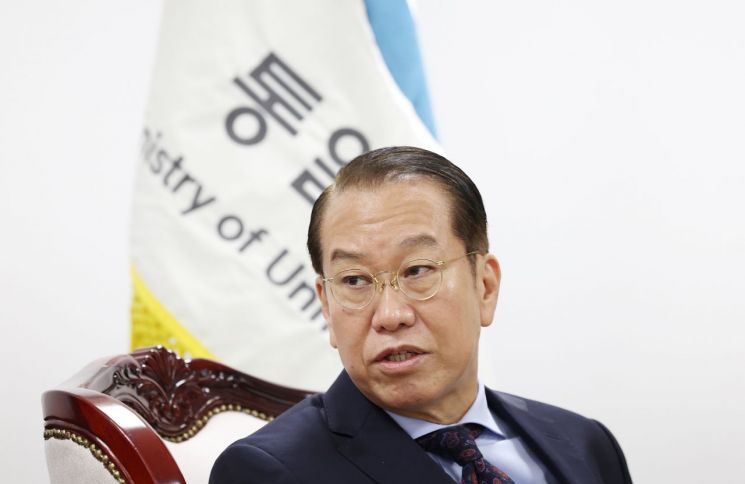
[Asia Economy Reporter Jang Hee-jun] Kwon Young-se, Minister of Unification, stated that President Yoon Suk-yeol's strong remarks on security issues are "an effort to restore the security awareness that was neglected during the previous administration."
On the 30th, Minister Kwon said on KBS Radio's 'Choi Kyung-young's Strongest Current Affairs,' "The previous administration's core was excessively conciliatory and pursued a 'peace through dialogue' that is now almost illusory, which led to a neglect of security awareness."
Earlier, on the 15th (local time) during his visit to the United Arab Emirates (UAE), President Yoon visited the Korean Army's Ark Unit deployed there and stated, "The most threatening country to the UAE is Iran, and our enemy is North Korea."
In response to the host's remark that "As the president, not even the Minister of National Defense, isn't this a strong statement that provokes North Korea?" Minister Kwon explained, "There have been past presidents who referred to North Korea as an enemy," adding, "North Korea has a dual nature, and in terms of defense, it is the main threat."
Regarding President Yoon's mention of 'independent nuclear armament,' Minister Kwon said, "Not only the Ministry of Unification but also the president believes that humanitarian cooperation and dialogue should be actively pursued even amid military and political tensions," cautioning against overinterpretation by saying, "We should not assume that only confrontational aspects are being considered."
Minister Kwon assessed the possibility of resuming dialogue with North Korea as having two paths: internal 'situational difficulties' within North Korea and 'strategic judgments' on the diplomatic level. He also hinted at the possibility that pressure through sanctions and persuasion by the international community could trigger regime collapse within North Korea.
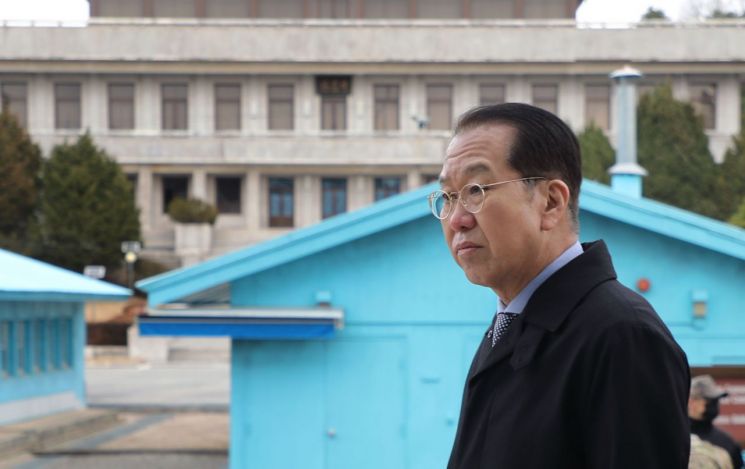
He said, "Since North Korean society has never experienced freedom and civil rights, I do not think popular uprisings like those in the former Eastern Bloc will easily occur," but added, "However, I believe the economic contradictions inside North Korea are significant. When a certain threshold is reached, the North Korean regime will need to worry about its own people."
He continued, "Meaningful dialogue can occur when North Korea truly needs and urgently desires it," and predicted, "Even if dialogue is initiated for strategic or tactical reasons rather than economic difficulties, as dialogue accumulates, North Korea will come to trust us."
He particularly introduced an anecdote from former U.S. Secretary of State Mike Pompeo's recently published memoir, which claimed that "Chairman Kim Jong-un perceived China as a threat," and observed, "As North Korea's trust in us builds step by step, it is more likely to reach out to us than to China."
He added, "From my experience as ambassador to China, North Korea and China are not that solidly allied," explaining, "Temporarily, a 'North Korea-China-Russia versus South Korea-U.S.-Japan' structure similar to the Cold War is forming, so North Korea is approaching China more in that context, but I do not think this is necessarily a good situation."
© The Asia Business Daily(www.asiae.co.kr). All rights reserved.


















