Opening Remarks at the Public Institution Steering Committee Meeting
[Asia Economy Sejong=Reporter Kim Hyewon] The government plans to introduce job-based pay to 200 public institutions by 2027. The four major science and technology institutes, including the Korea Advanced Institute of Science and Technology (KAIST), are discussing the possibility of being excluded from the public institution category.
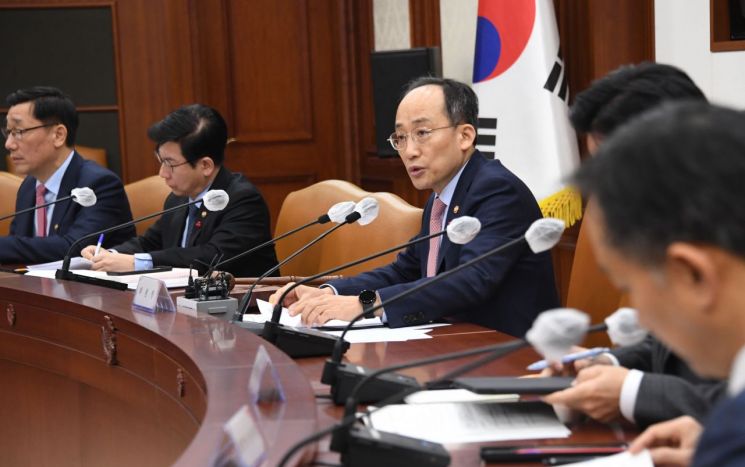
On the 30th, Deputy Prime Minister and Minister of Economy and Finance Choo Kyung-ho announced this during his opening remarks at the Public Institution Management Committee meeting held at the Government Seoul Office.
Deputy Prime Minister Choo stated, "We will expand and establish a fair compensation system and organizational personnel management based on job roles and performance," adding, "We will actively promote increasing the number of institutions adopting job-based pay from 35 as of the end of 2021 to 100 by 2024, and over 200 by 2027."
He explained, "We will strengthen incentives such as total labor cost increases and management evaluation bonus points for public institutions transitioning to a job-based pay system, and expand the proportion and differential range of performance-based pay within public institution salaries to reinforce performance-centered compensation management."
He continued, "We will promote the transition from the existing seniority-based system to a job-centered personnel management system based on expertise and efficiency, and identify improvement tasks for job-centered personnel management such as job-based recruitment, evaluation, promotion systems, and expanding open positions to the private sector."
Regarding this year's designation of public institutions, he said, "We will apply the revised classification criteria for the first time and change 43 existing public enterprises and quasi-governmental institutions to other public institutions." Accordingly, the number of public enterprises and quasi-governmental institutions directly managed and supervised by the Ministry of Economy and Finance will decrease from 130 to 87, while the number of other public institutions that can be autonomously managed by the relevant ministries will increase from 220 to 260.
The government had previously announced that the classification criteria for public enterprises and quasi-governmental institutions, which currently stand at 50 employees, 3 billion KRW in revenue, and 1 billion KRW in assets, will be changed to 300 employees, 20 billion KRW in revenue, and 3 billion KRW in assets.
The four major science and technology institutes (KAIST, GIST, DGIST, UNIST) are scheduled to discuss the possibility of being deregistered as public institutions on the same day. Deputy Prime Minister Choo explained, "We will discuss deregistration reflecting the unique characteristics of institutions that have both research and higher education functions."
© The Asia Business Daily(www.asiae.co.kr). All rights reserved.

















