Additional Implementation in 4 Regions
Targeting Bottom 50% Income Group
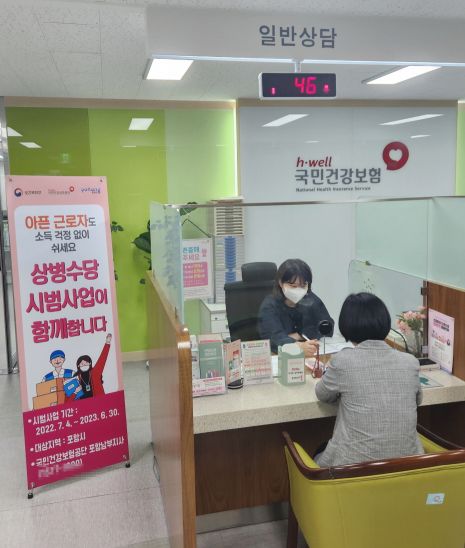
[Asia Economy Reporter Lee Gwan-joo] The Ministry of Health and Welfare announced on the 30th that from July this year, the second phase of the sickness allowance pilot project will be additionally implemented in four regions.
The sickness allowance is a system that guarantees the "right to rest when sick." It ensures income so that workers can focus on treatment when they are unable to engage in economic activities due to illness or injury unrelated to work. The first phase pilot project has been underway since July last year in six regions including Jongno-gu, Seoul, receiving a total of 3,856 sickness allowance applications over six months in the pilot areas, with 2,928 cases paid. The average number of payment days was 18.4 days, and the average payment amount was 815,000 KRW.
Looking at the employment status of recipients in the first phase sickness allowance pilot project, workplace subscribers accounted for the largest number with 2,116 people (72.3%). This was followed by self-employed workers with 528 people (18.1%) and employment/industrial accident insurance subscribers with 284 people (9.7%). Many occupations such as self-employed workers, construction workers, delivery workers, and substitute drivers, who inevitably experience income reduction during treatment periods, were also included. By age, the order was 50s with 1,144 people (39.1%), 40s with 711 people (24.3%), and 60s with 591 people (20.2%).
The second phase pilot project to be promoted this year will focus on supporting workers in the lower 50% income bracket intensively and will compare and analyze the results of the first phase pilot project, which is continuously operated for all workers, to verify various models for the introduction of the main system. First, four regions for the second phase pilot project will be selected through a public contest. In the second phase, coverage will be provided for all illnesses; however, cases such as cosmetic surgery for aesthetic purposes, treatments not aimed at essential functional improvement, or cases with only simple symptoms without examination or surgery will be excluded from payment.
The pilot project model will be operated by dividing into two models according to the waiting period: ▲ inability to work model ▲ medical utilization days model. First, the inability to work model pays sickness allowance for the period during which the worker cannot work due to illness or injury. The waiting period is 7 days, and the coverage period is up to 120 days within one year. The medical utilization days model recognizes workers who are hospitalized as eligible, with the waiting period reduced to 3 days. In this model, the sickness allowance is paid for the hospitalization and related outpatient treatment days, with a coverage period of up to 90 days within one year. Eligible recipients will be paid 46,180 KRW per day, which is 60% of this year's minimum wage, during the benefit payment period.
Jung Yoon-soon, Director of the Health Insurance Policy Bureau at the Ministry of Health and Welfare, said, "We will prepare thoroughly for the introduction of the main sickness allowance system to guarantee the 'right to rest when sick,' which was emphasized during the COVID-19 pandemic.
© The Asia Business Daily(www.asiae.co.kr). All rights reserved.