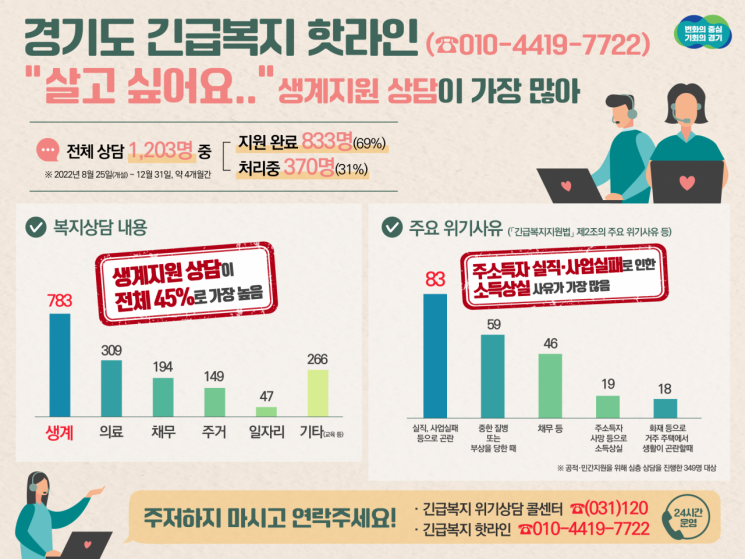
 Gyeonggi-do Emergency Welfare Hotline Civil Petition Application Status Data provided by Gyeonggi-do
[Asia Economy (Suwon) = Reporter Lee Young-gyu] The most common complaint received by the 'Emergency Welfare Crisis Counseling Call Center' (hotline), operated by Gyeonggi Province since the second half of last year, was found to be 'livelihood support.'
Gyeonggi Province announced on the 30th that an analysis of 1,203 callers to the Emergency Welfare Crisis Counseling Call Center and hotline from August 25 to the end of December last year revealed that the biggest request from applicants was for 'livelihood support' to meet immediate living needs, rather than medical care, debt, or jobs.
Following the 'Suwon Three Mothers Incident' last year, the province established and has been operating the Emergency Welfare Crisis Counseling Call Center (031-120) along with the Emergency Welfare Hotline (010-4419-7722) directly under Governor Kim Dong-yeon's office.
Requests for help received through the hotline and call center, categorized by field (multiple responses allowed), showed 'livelihood support' as the highest with 783 cases. This was followed by medical care with 309, debt with 194, housing with 149, jobs with 47, and others (such as education) with 266. Out of the 1,203 calls and messages received, support was completed for 833 individuals.
The number of applicants by month was 87 (7%) in August, 302 (25%) in September, 247 (21%) in October, 299 (25%) in November, and 268 (22%) in December. By region, Suwon had the highest number with 77, followed by Bucheon with 60, Ansan with 55, Siheung with 49, and Seongnam with 48. By age group, 40s accounted for 288, 50s for 264, and 60s for 217. Even teenagers accounted for 7 cases.
Among 349 individuals who underwent in-depth counseling for public and private support, the most common crisis reason identified was income loss due to job loss or business failure, with 83 cases. This was followed by serious illness or injury (59), debt (46), and death of the main income earner (19).
Out of the 1,203 individuals, 173 were discovered through reports from friends, relatives, and the local community. Among them, family and relatives accounted for 93 (54%), and acquaintances and neighbors accounted for 80 (46%).
The province plans to strengthen publicity and other efforts, recognizing that community interest and participation are crucial for discovering households in crisis.
Recently, the province sent letters of appreciation signed by Governor Kim Dong-yeon to about 50 informants who contributed to discovering neighbors in crisis through reports to the 'Emergency Welfare Crisis Counseling Hotline.'
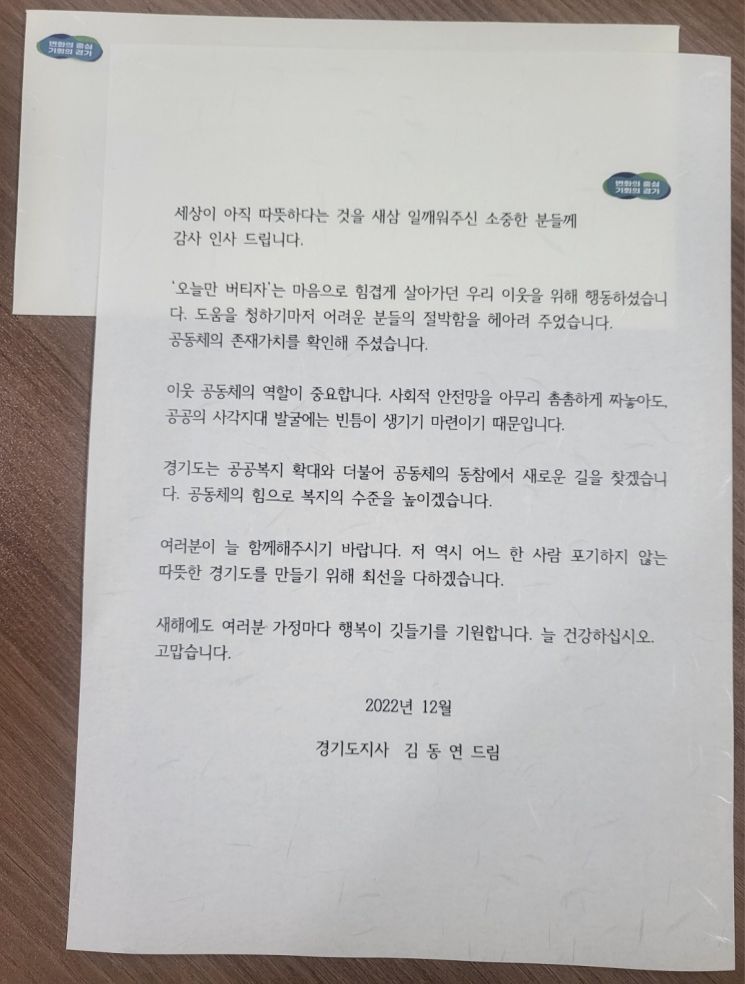 Governor Kim Dong-yeon of Gyeonggi Province's Letter of Appreciation to Residents Who Contributed to Identifying Vulnerable Households
In the letter, Governor Kim said, "I would like to express my gratitude to those precious individuals who reminded us anew that the world is still warm. You acted for our neighbors who were struggling to survive with the mindset of 'just endure today.'" He promised, "I will also do my best to create a warm Gyeonggi Province that does not give up on anyone."
The province plans to award the 'Governor's Commendation' to key informants and widely publicize the reporting methods and cases of support provided to neighbors in crisis through reports.
Currently, after receiving crisis counseling requests through the Emergency Welfare Crisis Counseling Hotline (call center), the province connects applicants to specialized counselors and then links them to welfare officers in city, county, and township offices to provide available welfare services. Additionally, for households in crisis facing difficulties with existing welfare support, private resources are also connected.
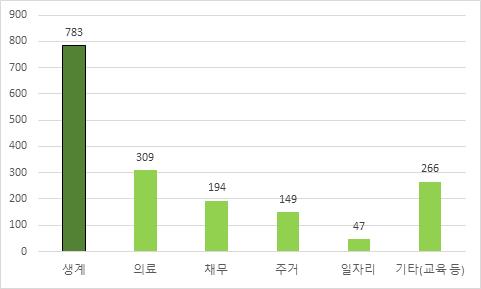 Emergency Welfare Crisis Counseling Call Center Reception Civil Complaints Welfare Demand Status in Gyeonggi-do Data provided by Gyeonggi-do
Kim Neung-sik, Director of the Welfare Bureau of the province, said, "We are continuously striving to discover welfare blind spots through big data utilization and operation of the Emergency Welfare Crisis Counseling Call Center, but residents' participation is essential." He urged, "If you find neighbors in crisis around you, please do not hesitate to contact the Emergency Welfare Crisis Counseling Hotline, call center, or the administrative welfare centers in your town, township, or neighborhood."
© The Asia Business Daily(www.asiae.co.kr). All rights reserved.
![Clutching a Stolen Dior Bag, Saying "I Hate Being Poor but Real"... The Grotesque Con of a "Human Knockoff" [Slate]](https://cwcontent.asiae.co.kr/asiaresize/183/2026021902243444107_1771435474.jpg)


















