[Asia Economy Yeongnam Reporting Headquarters, Reporter Hwang Dooyul] A research team at UNIST has developed an ultra-high-resolution imaging technique that can directly observe and control instantaneous changes occurring within 'one quadrillionth of a second.'
Professor Oh-Hoon Kwon's team in the Department of Chemistry at UNIST utilized Korea's only '4D ultrafast transmission electron microscope' to directly capture the extremely rapid metal-insulator phase transition process of vanadium dioxide (VO2) nanoparticles in real space and time with femtosecond (10^-15 seconds) level accuracy.
Vanadium dioxide exhibits a metal-insulator phase transition phenomenon at 68 degrees Celsius and is attracting attention as a next-generation core material for optical sensors and high-speed switching devices.
However, since this phase transition occurs within an extremely short time frame of femtoseconds, it was impossible to directly observe it at the nanoparticle level using conventional imaging techniques.
The ultrafast transmission electron microscope generates photoelectron femtosecond pulses from a photocathode and accelerates them to high energy, reaching wavelengths at the picometer scale (10^-12 m), which is shorter than atomic size, thereby achieving high simultaneous spatial and temporal resolution.
However, each electron in the photoelectron pulse carries a negative charge and repels each other. As a result, the photoelectron pulse spreads out spatially and temporally while passing through the microscope column, causing a decrease in resolution.
To overcome the limitations of the transmission electron microscope and capture the phase transition process of vanadium dioxide, the research team utilized an energy filter, commonly used, in a different way than before.
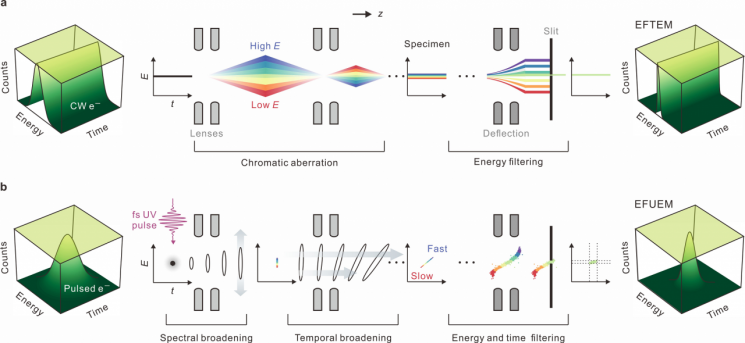
First, they filtered out part of the photoelectron pulse that had spread spatially and temporally before reaching the microscope’s camera using the energy filter. Then, they reconstructed the image from the filtered photoelectrons to clearly capture the phase transition occurring within the femtosecond timescale.
This result was achieved by applying the physical law that photoelectrons with the same energy exist at the same space-time after acceleration.
By using the energy filter, it is possible to simultaneously capture the different ultrafast phase transition processes of individual nanoparticles that make up the vanadium dioxide nanoparticle clusters.
In particular, the research team provided the first direct evidence that vanadium dioxide nanoparticles formed on a graphene substrate have a different structure from the conventional ones and can pass through a 'metastable state' during the intermediate stage of the phase transition.
Dr. Yejin Kim, the first author, said, “Great efforts have been made to improve the time resolution of ultrafast transmission electron microscopy,” and added, “This study proved that it is possible to clearly capture material changes occurring at the femtosecond level at the nanometer scale without complex equipment modifications.”
Professor Oh-Hoon Kwon said, “This is the first advanced imaging research to experimentally implement femtosecond imaging techniques based on well-known general physics knowledge,” and added, “By capturing the ultrafast phase transition phenomenon of vanadium dioxide in real time for the first time, it will contribute to enhancing the understanding of physical property control and the utilization of the material.”
This research was supported by the Samsung Future Technology Development Foundation, and the results were published on the 27th at 2 p.m. in ‘Science Advances,’ a sister journal of Science.
© The Asia Business Daily(www.asiae.co.kr). All rights reserved.

















