[Asia Economy Reporter Choi Dae-yeol] An analysis has revealed that South Korea's service trade deficit has exceeded 300 trillion won since 2000. This indicates a lack of global competitiveness in the service industry.
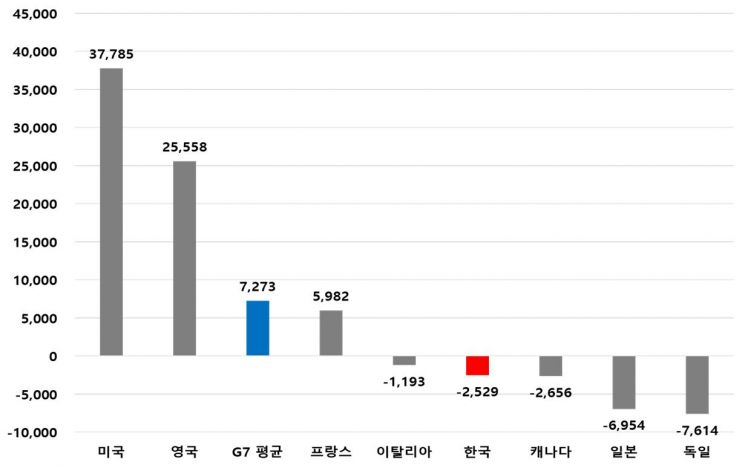
According to a report released on the 29th by the Korea Employers Federation, South Korea's cumulative service trade deficit from 2000 to 2021 amounted to 252.9 billion dollars (approximately 311 trillion won). Considering that the average surplus of the Group of Seven (G7) countries was 727.3 billion dollars, this figure is significantly lower.
Countries with larger deficits than South Korea include Canada (265.6 billion dollars), Japan (695.4 billion dollars), and Germany (761.4 billion dollars). The United States (3.7785 trillion dollars surplus), the United Kingdom (2.5558 trillion dollars), and France (598.2 billion dollars) recorded surpluses, while Italy (119.3 billion dollars deficit) had a smaller deficit than South Korea.
The service trade balance is calculated by subtracting the money spent from the money earned in service trade by country. Representative examples of service exports include maritime transport income and foreign tourists visiting South Korea, while money spent by South Korean nationals traveling abroad counts as service imports. South Korea has developed manufacturing industries and has maintained a surplus in goods trade by buying and selling goods, but has experienced a large deficit in service trade. Recently, due to rising prices of raw materials such as oil and gas, the goods trade balance has also turned to a deficit.
The Korea Employers Federation stated, "This contrasts with the goods trade surplus of 1.2377 trillion dollars during the same period," and analyzed that "(the service deficit) is the main factor limiting the expansion of the current account surplus."
When considering the economic scale of each country, the cumulative service trade balance as a percentage of gross domestic product (GDP) was -0.71% (negative indicates deficit) for South Korea. This was lower than all other G7 countries except Canada (-0.85%) and Germany (-1.01%).
The scale of service trade was also lower than that of the G7. As of 2021, the proportion of services in total exports was 15.7%, with only Italy (15.0%) having a lower figure. The proportion of service imports was 17.8%, which was among the lowest except for the United States.
By sector, travel recorded the largest deficit at 186.3 billion dollars. Other sectors with significant deficits included other business services, processing services, intellectual property royalties, and insurance. Conversely, construction and transportation sectors such as shipping and aviation recorded surpluses of 169.5 billion dollars and 83.5 billion dollars respectively, making them representative foreign currency earning industries.
The Korea Employers Federation pointed to excessive service market regulations compared to other countries as a reason for the large cumulative service deficit. They also cited low labor productivity and difficulties in attracting investment due to insufficient environment and infrastructure as causes. Ha Sang-woo, head of the Economic Research Department at the Korea Employers Federation, said, "Measures to strengthen service competitiveness, such as deregulating the service market, improving service technology, and supporting investment activation, as well as legal and institutional reforms, are necessary."
© The Asia Business Daily(www.asiae.co.kr). All rights reserved.
![Clutching a Stolen Dior Bag, Saying "I Hate Being Poor but Real"... The Grotesque Con of a "Human Knockoff" [Slate]](https://cwcontent.asiae.co.kr/asiaresize/183/2026021902243444107_1771435474.jpg)

















