[Report] Visiting the Vibrant Nuclear Power Industry Site
Samhong Machinery, a Nuclear Power Partner in Changwon, Gyeongnam
Employees Voluntarily Return 15% Wage Cut Request
"Let's Endure Together"
Energy Ministry, KHNP, Doosan Enerbility, and Other Early Movers Bring Vitality
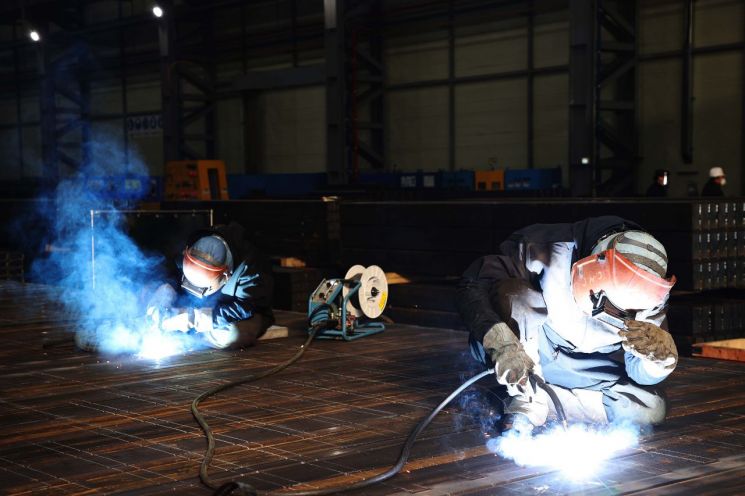 On the 19th, field technicians are manufacturing nuclear power plant components at Samhong Machinery located in Masanhappo-gu, Changwon-si, Gyeongnam.
[Asia Economy (Changwon= Reporter Jeong Dong-hoon)] "When I said I would work without pay, people around me said, 'Are you out of your mind?' and even insulted me, asking if I was the CEO's son. I thought if employees left due to the company's financial difficulties, it would cause even greater losses to the company. So, I decided to give up my salary as the production manager."
◆Employees Voluntarily Returning Salaries, Partner Companies Enduring the Brink of Bankruptcy=Joo Sung-man, production manager at Samhong Machinery, a nuclear power plant parts manufacturer in Changwon, Gyeongnam, worked without pay for seven months starting July 2021. To CEO Kim Hong-beom, he said, "If the company doesn't exist, how can there be a salary? Please pay me when the company gets better." During the unpaid period, Joo canceled his savings account and sold assets such as stocks to cover living expenses.
In 2021, Samhong Machinery faced overlapping adversities with the nuclear power policy retreat and the spread of COVID-19, resulting in poor financial conditions. The company was unable to pay employee wages on time. CEO Kim Hong-beom had to request about a 15% salary return from employees for a year from 2021 to early last year. "Besides Manager Joo, another employee also returned 30% of their salary, saying 'Let's endure this together.' I was so grateful that I hugged and cried with those two," he said.
When colleagues said, "I'll look for another job" or "I'm leaving the company," Manager Joo persuaded them, saying, "I am returning 100% of my salary. Would I do this if there was no future?" Many employees who were psychologically anxious trusted him and gave up their plans to resign. However, the number of employees, which once exceeded 140, dropped to 100. But the mutual trust and endurance began to shine last year.
In June last year, Samhong Machinery was selected as a promising nuclear power company and received a 2 billion KRW investment from the government's Energy Innovation Growth Fund. The first thing CEO Kim did was to return the unpaid salaries.
Currently, welding sparks fly in the 12,540㎡ (about 3,793 pyeong) Samhong Machinery factory. The factory workers feel at ease when they see those sparks. Just a year ago, only the sound of machines idling could be heard in the factory, with no sparks in sight.
Even without work orders, machines were run to prevent rust. Since June last year, about ten new employees have been hired. They are preparing to recruit new employees this year as well.
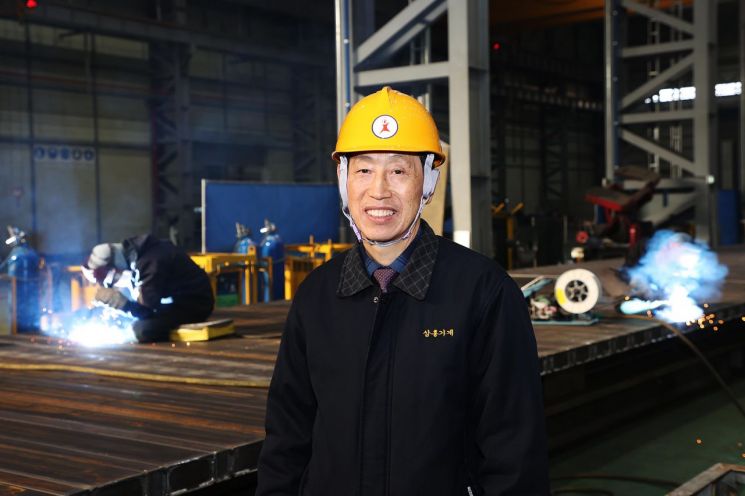 On the 19th, Kim Hong-beom, CEO of Samhong Machinery located in Masanhappo-gu, Changwon-si, Gyeongnam, is smiling as he guides through the site that has regained its vitality.
◆Welding Sparks and New Hires... Revitalizing the Nuclear Power Ecosystem=Sunlight is shining on nuclear power companies. Small and medium nuclear power companies, which were dying due to the previous government's nuclear policy retreat, are coming back to life.
Many companies are hiring new employees in their 20s and 30s and training them in technology. Early order placements and financial support from the Ministry of Trade, Industry and Energy and Korea Hydro & Nuclear Power have served as the 'primer' for ecosystem restoration. Leading nuclear power companies like Doosan Enerbility are helping the revival of partner companies through early orders. Samhong Machinery received early orders worth 1.9 billion KRW from KHNP and 1 billion KRW from Doosan Enerbility last year. Its nuclear power sector performance last year (2.9 billion KRW) increased nearly fivefold compared to 2021 (about 600 million KRW).
Wonbidu Technology, a company specializing in nuclear power main equipment fabrication and welding, has also regained vitality. Wonbidu Technology, which manufactures reactor coolant system pipes for Shin Hanul Units 3 and 4, saw its factory come alive last December thanks to advance orders. Park Bong-gyu, CEO of Wonbidu Technology, said, "The fact that we received orders for Shin Hanul Units 3 and 4 gives hope for business management, and we overcame financial difficulties by extending loans based on the contract."
Another nuclear power parts company, Goryeo Precision Industry, was able to support wage payments and material purchases by receiving a low-interest loan of about 800 million KRW through the Win-Win Growth Cooperation Loan for nuclear power partner companies in November last year.
At one time, South Korea's nuclear power industry competitiveness was the best in the world. This was thanks to the ecosystem built not only in design but also in construction and manufacturing. In the Changwon and Busan areas of Gyeongnam, small and medium partner companies capable of supplying various nuclear power-related parts such as pipes, pumps, valves, and tanks are densely located.
The strength of the Korean nuclear power industry, 'On time On budget' construction, is a result created by these SMEs teaming up with KHNP, Doosan Enerbility, and others. Korea proved its competitiveness by constructing the UAE nuclear power plant, won in 2009, at half the cost of France and the US within the scheduled period.
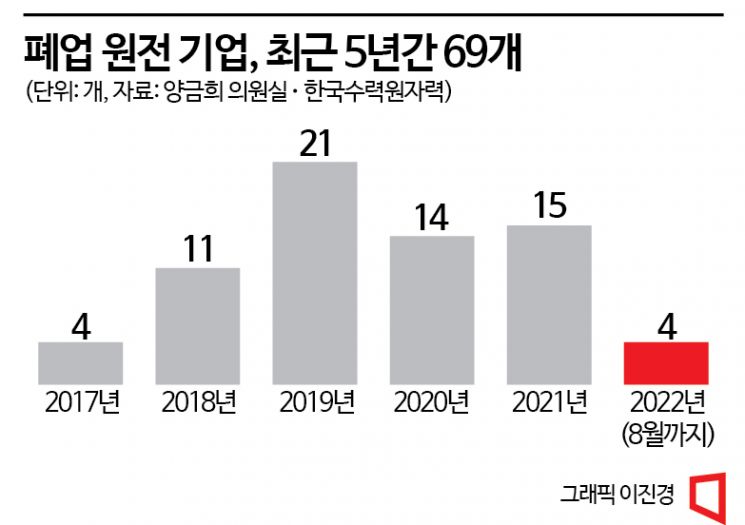
◆Energy Transition Era, Expectations for Nuclear Power Export and Next-Generation SMR Manufacturing=However, due to changes in nuclear policy such as the suspension of domestic nuclear power plant construction and early closure of existing plants, this ecosystem faced the risk of disappearing. The sales of domestic nuclear power supply companies decreased by 28.5%, from 5.5 trillion KRW in 2016 to 3.93 trillion KRW in 2019. During the same period, the workforce in nuclear power supply companies decreased by 13%. From 2017 to August last year, 69 small and medium nuclear power companies closed. Over five years, 14.7% of all nuclear power SMEs shut down (Korea Nuclear Industry Association data).
Since the second half of last year, the domestic nuclear power ecosystem has been recovering. However, experts say it is only the beginning and the future cannot be overly optimistic. Jeong Dong-wook, president of the Nuclear Society (professor of Energy Systems Engineering at Chung-Ang University), said, "For the nuclear power industry to be sustainable, it must go global." He explained, "Nuclear power export is like the World Cup, a national competition, and the government must work as a team with Korean exporters to secure export routes." Last year, KHNP won the El Dabaa nuclear power plant project in Egypt, the first in 13 years after the UAE project. This year, discussions on nuclear power exports are underway with Poland and the Czech Republic.
Nuclear power is regarded as a new growth engine in the energy transition era. The era of fossil fuel power generation emitting carbon is over, and solar and wind power alone cannot meet energy demand. Nuclear power, which emits less carbon, is emerging not as a dangerous energy but as an eco-friendly energy source. The European Union classified nuclear power as 'Green Taxonomy' last year, and advanced countries such as the US and Japan are expanding nuclear power investments.
New nuclear power technologies such as Small Modular Reactors (SMR) are gaining attention as next-generation energy sources. Kim Hong-beom, CEO of Samhong Machinery, said, "We take pride in the nuclear power manufacturing technology centered on Doosan Enerbility as the best in the world. Like TSMC in the semiconductor field, the domestic nuclear power industry can become an SMR foundry for large-scale exports."
Jeong Yong-hoon, professor of Nuclear and Quantum Engineering at KAIST, also emphasized that nuclear power is the biggest alternative to fossil fuels. He said that active utilization of new nuclear power plants and SMRs is necessary to achieve carbon neutrality. He added, "South Korea has no neighboring countries to rely on. Nuclear power is also very important for energy security."
© The Asia Business Daily(www.asiae.co.kr). All rights reserved.
![Clutching a Stolen Dior Bag, Saying "I Hate Being Poor but Real"... The Grotesque Con of a "Human Knockoff" [Slate]](https://cwcontent.asiae.co.kr/asiaresize/183/2026021902243444107_1771435474.jpg)













