Democratic Party Announces Grain Act Passage in Plenary Session on 30th
People Power Party: "Bypassing Legislation Committee... Rice Prices Will Instead Fall"
[Asia Economy Reporter Park Hyun-joo] The Democratic Party of Korea has announced that it will process the Grain Management Act amendment bill at the National Assembly plenary session on the 30th, and the confrontation between the ruling and opposition parties over the bill's processing is expected to continue.
Lee Jae-myung, leader of the Democratic Party, expressed his determination to promptly process the Grain Management Act amendment bill pending in the National Assembly. On the 27th, attending the Supreme Council meeting held in Iksan, Jeonbuk, Lee said, "Following last year's rice price collapse, the recent vegetable price turmoil has overlapped," adding, "I feel a deep responsibility for the farmers' distress."
Lee continued, "The issue of agriculture should be approached not from a laissez-faire market logic or comparative advantage logic, but from the perspective of national security and food sovereignty," emphasizing, "I hope the government, which is threatening farmers by mentioning veto power, will actively cooperate in processing the bill."
The Grain Management Act amendment bill is Lee's number one livelihood bill. The bill stipulates that if rice is overproduced by more than 3% of demand or if the harvest season price falls by more than 5% compared to last year, the government must compulsorily purchase rice. The Democratic Party sees the stabilization of rice prices as necessary to prevent a decrease in farmers' income.
On the other hand, the People Power Party is opposing the bill, even mentioning the possibility of the president exercising veto power. They argue that the amendment will encourage overproduction of rice, leading to an increase in surplus rice and a decline in rice prices.
The Grain Management Act was enacted on October 9, 1948, to manage grains and maintain supply-demand control and appropriate prices. However, it has been criticized as unsuitable for the current situation where rice consumption decreases annually due to changes in dietary habits. According to the '2022 Grain Consumption Survey Results' announced by Statistics Korea on the same day, the per capita rice consumption last year was 56.7kg, a 0.4% (0.2kg) decrease from the previous year. Compared to the per capita rice consumption of 67.2kg in 2013, it has decreased by 10.5kg over ten years.
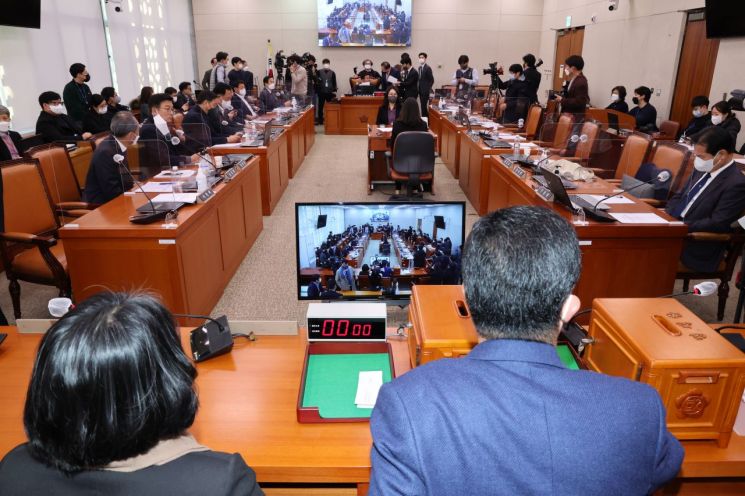
In particular, the People Power Party pointed out procedural issues. They claim that the Democratic Party, which holds the majority of seats in the National Assembly, is pushing the bill despite opposition from the ruling party, a so-called 'Legislation and Judiciary Committee (Legislation Committee) bypass.' The Democratic Party unilaterally approved the amendment bill at the full meeting of the National Assembly Agriculture, Forestry, Livestock, Food, and Maritime Affairs Committee (Agriculture Committee) on October 19 last year. Subsequently, they held a full meeting of the Agriculture Committee and unilaterally approved the direct referral of the Grain Management Act to the National Assembly plenary session.
In response, the Democratic Party denies any legal procedural problems. On the 28th of last month, the Democratic Party unilaterally approved the direct referral of the Grain Management Act amendment bill, which had been pending in the Legislation Committee for over two months, to the plenary session with the support of 12 out of 19 committee members. This is based on Article 86 of the National Assembly Act, which allows a standing committee to refer a bill to the plenary session if a specific bill has been pending in the Legislation Committee for 60 days without discussion and if more than three-fifths of the standing committee members approve it, even without bipartisan agreement. They claim this process was lawful.
The Ministry of Agriculture, Food and Rural Affairs, the relevant government department, has expressed opposition to the Grain Management Act amendment bill. They are concerned that if the amendment passes, it will encourage overproduction of rice, worsen fiscal problems, and prevent farmers from switching to other crops.
Jung Hwang-geun, Minister of Agriculture, Food and Rural Affairs, said on the 26th on CBS Radio's 'Park Jae-hong's One-on-One Match,' "While rice consumption has significantly decreased, production has not decreased, causing a gap that leads to price drops and entrenched overproduction problems," adding, "If the government compulsorily orders purchases in this situation, those who intended to switch to other crops will not be able to, and those who have already switched may return."
Minister Jung continued, "Overproduction will worsen, and the government will need more money to dispose of it. This creates a vicious cycle," adding, "If even I, the Minister of Agriculture, oppose it, you can imagine how serious it is."
The Grain Management Act amendment bill is expected to be discussed at the National Assembly plenary session on the 30th.
© The Asia Business Daily(www.asiae.co.kr). All rights reserved.

















