Commercial Bank Interest Rates Drop to 3% Range
Cut by Over 1 Percentage Point in One Month
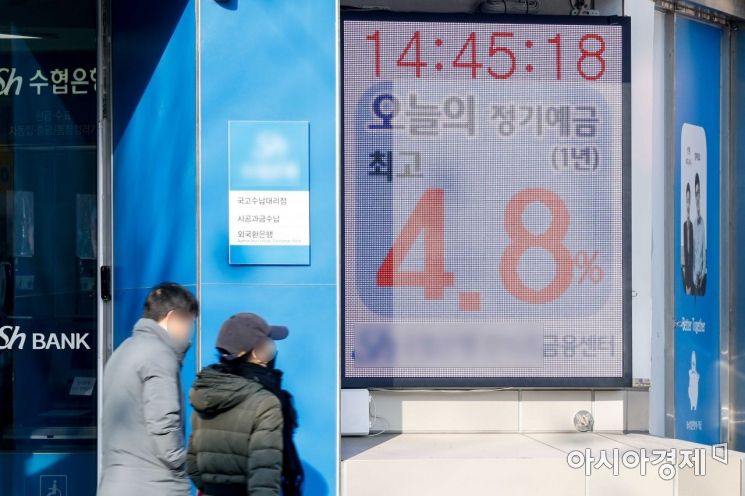 On the 9th, when major commercial banks lowered their fixed deposit interest rates from the 5% range to the 4% range, the fixed deposit interest rates were displayed on the electronic board at the entrance of a bank in Seoul. Photo by Jinhyung Kang aymsdream@
[Asia Economy Reporter Sim Nayoung] Last year, regular savings and fixed deposits at commercial banks surged like high tide, but since the new year, they have been flowing out like low tide. The concentration phenomenon seen when the interest rates for regular savings and fixed deposits at commercial banks rose close to 5% at the end of last year has disappeared. According to the Bankers Association disclosure on the 30th, the interest rates for the main one-year fixed deposit products at the five major banks remained in the 3% range (as of the 27th), even when applying the highest preferential rates.
KB Star Fixed Deposit was 3.68% (KB Kookmin), Solpyeonhan Fixed Deposit 3.73% (Shinhan), Hana’s Fixed Deposit 3.85% (Hana), WON Plus Deposit 3.79% (Woori), and NH Waltz Revolving Deposit 3.57%. This was about 1 percentage point lower than the average interest rate of the same products handled the previous month.
The waning popularity of bank savings and fixed deposits is evident from the figures. As of the 25th, the balance of fixed deposits at the five major banks was approximately KRW 815.6 trillion, and regular savings were about KRW 37.1 trillion. Compared to the end of December last year (KRW 818.4 trillion and KRW 37.2 trillion respectively), fixed deposits decreased by KRW 2.8 trillion, and regular savings by about KRW 100 billion.
The drop in deposit interest rates is due to market interest rates and regulatory influence. One-year fixed deposits are mainly priced by reflecting the one-year bank bond rates. When bond yields fall, it means that banks can raise loan funds at a lower cost in the market. Therefore, banks no longer need to raise interest rates to attract more deposits.
On December 1 last year, the one-year bank bond (AAA) rate was 4.758%, but it fell to 3.731% on the 26th. As the one-year bank bond rate dropped, deposit interest rates also decreased by a similar margin.
After the Lego Land incident last year, when the tightening of funds caused the fixed deposit interest rates at banks to rise close to 5%, financial authorities pressured banks to refrain from raising fixed deposit interest rates, saying "banks should not sweep up market funds." This was also a major reason for the lowered rates. Even after the Bank of Korea raised the base rate on the 13th, this stance continued, and banks did not increase deposit interest rates.
A commercial bank official explained, "As the previously halted issuance of bank bonds became possible again, the demand for fund raising through bank deposits decreased. Also, if deposit interest rates rise, loan interest rates also increase, so the authorities expressed concerns about this, leading to the decline in deposit interest rates."
© The Asia Business Daily(www.asiae.co.kr). All rights reserved.

















