160 Billion KRW for Training 1,600 Smart Farmers
190 Billion KRW to Boost Consumption of Eco-Friendly Agricultural Products
[Asia Economy Yeongnam Reporting Headquarters Reporter Koo Dae-seon] Gyeongbuk Province will invest about 290 billion KRW this year to smarten the agricultural food distribution system.
Gyeongbuk Province announced on the 27th that it will invest 290.5 billion KRW (124 billion KRW national funds, 47.9 billion KRW provincial funds, 87.6 billion KRW city/county funds, 142.6 billion KRW others), a 20% increase from the previous year, in the agricultural food distribution sector in 2023 to transition from traditional farming methods to smart agriculture based on digital information.
Despite difficult conditions last year due to the prolonged COVID-19 pandemic and rapid price increases caused by the Ukraine war, the province aggressively expanded the Baro Market Gyeongsangbuk-do branch and conducted online marketing through Saiseo.
Through diversified export policies, it achieved groundbreaking results in agricultural product sales, including surpassing 1 trillion KRW in agricultural food exports for the first time.
In the new year, it plans to establish a win-win distribution platform that directly connects producers and consumers by securing a demand-centered new concept distribution network in cooperation with regional public delivery apps such as Meokkebi and Daeguro.
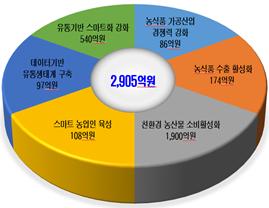 Gyeongbuk Province's Investment Plan for Smartization of Agricultural and Food Distribution.
It intends to actively promote more than 80 projects in six areas, including the expansion of smart APCs based on digital information.
Additionally, to cultivate smart farmers equipped with digital information capabilities and successfully implement the province’s key policy, ‘Gyeongbuk Agricultural Great Transformation,’ the Gyeongbuk Farmers’ Academy will expand and reorganize educational courses such as smart farms, smart livestock, youth farmer development, carbon reduction agriculture, and subtropical crop cultivation for about 1,600 people across 64 courses.
It will also spend 10.8 billion KRW on supporting startup costs for agricultural high school graduates, providing farming settlement education for current students, establishing a foundation for regional agricultural CEOs, and supporting agricultural meister universities, which are future core talents.
For 260,000 elementary, middle, and high school students, 190 billion KRW will be invested to activate operations such as eco-friendly agricultural products for school meals, free meals, support for school meal center transport vehicles, support for establishing regional food plans to build a local food circulation system, support for public meal planning and production systems, and dietary education to promote eco-friendly agricultural product consumption.
It will invest 17.4 billion KRW to expand permanent sales outlets for Gyeongbuk agricultural food products in the U.S., China, and Southeast Asia with high growth potential, diversify export markets, support the cultivation of export-specialized companies with global competitiveness, foster export-specialized fresh agricultural product complexes, focus on cultivating export star items such as Shine Muscat and kimchi, and expand participation in online and offline fairs and consultation meetings to stabilize domestic agricultural product supply and demand.
Gyeongbuk Province plans to secure a demand-centered new concept distribution network by cooperating with regional public delivery apps (Meokkebi, Daeguro) to build a data-based win-win distribution ecosystem.
It will diversify new distribution channels to increase sales, such as directly connecting producers and consumers, supporting live commerce sales of agricultural specialty products using influencers, and partnering with agricultural specialty product shopping malls like Saiseo, Lotte ON, Coupang, and SK Store.
It plans to invest 9.7 billion KRW in activating agricultural product sales marketing, including operating the Baro Market Gyeongsangbuk-do branch Suseong branch for the fourth year, supporting direct transactions at Daegu-Gyeongbuk urban-rural win-win direct stores, and providing distribution services for vulnerable farms facing sales difficulties.
To build an innovative agricultural food distribution system responding to changes in the distribution environment, it will invest 54 billion KRW in smartening agricultural food distribution infrastructure, including expanding the installation of smart APCs based on digital information, modernizing production area distribution facilities, strengthening item-centered marketing to improve distribution structure, expanding shipments of the province-wide integrated fruit brand ‘daily,’ promoting producer organization and scaling, and modernizing public wholesale market facilities.
To stabilize management through high-quality raw material supply, it will invest 8.6 billion KRW to activate contract farming between agriculture and agricultural food companies and strengthen linkage, create jobs in agricultural product manufacturing and processing through support for agricultural food company startups, support brand development and promotional marketing, hold the Gyeongbuk Agricultural Food Industry Expo, and strengthen traditional liquor promotion to enhance competitiveness in the agricultural food processing industry.
Kim Ju-ryeong, Director of the Gyeongsangbuk-do Agriculture, Livestock, and Distribution Bureau, said, “Due to rapid changes in the distribution environment and consumption patterns, the advancement of agricultural food distribution is urgently required. We will do our best to smarten agricultural food distribution from farms to consumers using digitalized information.”
© The Asia Business Daily(www.asiae.co.kr). All rights reserved.
















