The 2nd National Data Policy Committee Meeting Held
All Data Opened... Creating a Private Sector-Centered Ecosystem
[Asia Economy Reporter Oh Su-yeon] The government will invest 712.9 billion KRW in core artificial intelligence (AI) projects to achieve tangible results in the AI industry and introduce services supporting vulnerable groups, thereby promoting the normalization of AI in daily life. It will open all data held by our society to lead new industry growth and expand the ecosystem.
On the 26th, the government held the 2nd National Data Policy Committee meeting at AI company Hyperconnect located in Gangnam-gu, Seoul, chaired by Prime Minister Han Duck-soo, where it finalized the basic plan for promoting the cross-government data industry and the plan for AI normalization.
The National Data Policy Committee is an organization chaired by the Prime Minister, with the Minister of Science and ICT and the Minister of the Interior and Safety serving as joint secretaries, responsible for deliberating on overall national data policies.
At this meeting, the committee focused on discussing the follow-up plans in the data and AI sectors of the 'Digital Strategy of the Republic of Korea' announced last September, namely the '1st Basic Plan for Data Industry Promotion' and the 'Plan for AI Normalization and Industrial Advancement.' Additionally, four agenda items were discussed, including the 'Plan to Expand Employment Administration Data Opening' and the 'Plan to Activate Data Fusion and Utilization Using Statistical Registers' to promote data opening and utilization in fields such as employment and national statistics.
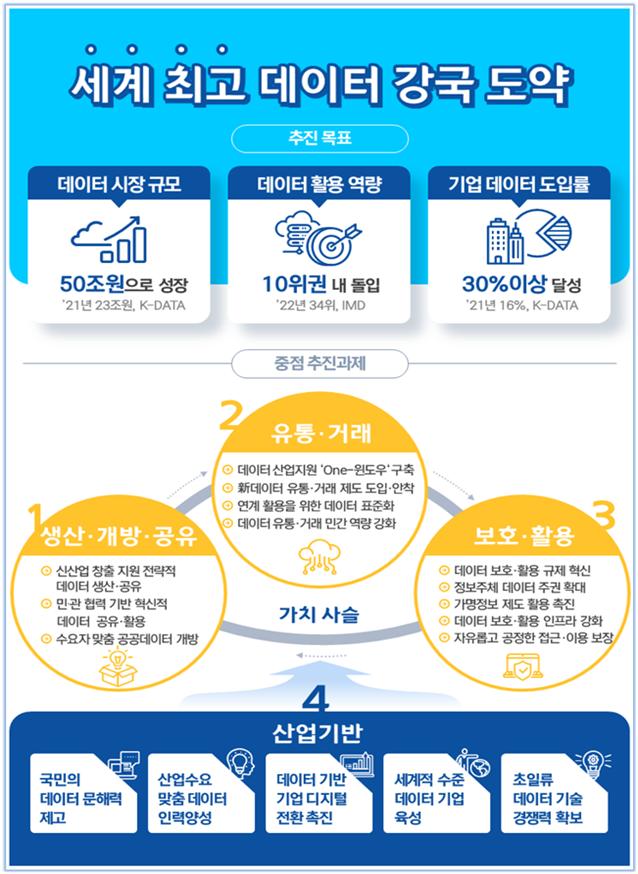 Vision and Goals of the 1st Basic Plan for Data Industry Promotion
 [Photo by Ministry of Science and ICT]
The committee first discussed the '1st Basic Plan for Data Industry Promotion,' which will determine the national data policy direction for the next three years (2023?2025).
So far, the data market has accelerated initial market formation under government leadership. However, quality data remains insufficient, and private sector market participation is slow. Systems to promote data utilization, such as MyData, are inconvenient to use, and more specialized personnel and leading technologies need to be expanded.
The government plans to overcome these limitations by promoting proactive data sharing and opening through public-private cooperation, bold institutional innovation, and preemptive investment.
To this end, it will ▲ promote innovative production, opening, and sharing of all data ▲ establish a private-sector-centered data distribution and trading ecosystem ▲ create a safe and innovation-promoting data utilization foundation ▲ and fully implement national digital transformation.
It will strategically produce 150 types of data required by new industries such as AI and share new data including overseas data and research data. By building a 'one-window' system accessible to everyone, it will create a private-sector-centered ecosystem where data can be easily found and utilized. In particular, by 2025, it plans to expand data trading and analysis companies to 3,500 and nurture 1,000 data traders.
It will increase AI and data education lead schools in elementary, middle, and high schools, foster youth and regional companies, secure leading technologies, and drive national digital transformation.
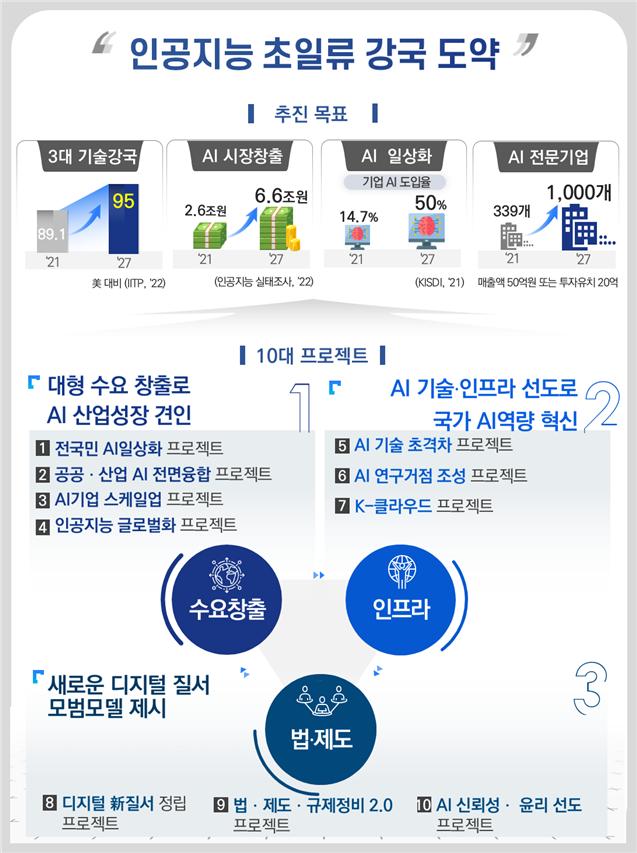
The next agenda item reviewed the plan for AI normalization and industrial advancement to share AI achievements with the public and realize a super-gap in AI industry and technology.
Domestic AI technology has reached a considerable level, but its utilization in companies and daily life is still in the early stages. To achieve tangible results in the AI industry, the government will invest about 712.9 billion KRW this year in ten core AI projects.
Specific implementation measures include ▲ spreading AI across daily life, public services, and industry ▲ securing super-gap AI technology ▲ establishing a new digital order and AI laws and systems.
To care for vulnerable groups such as elderly living alone and people with disabilities and to solve livelihood issues, the government will promote 'nationwide AI normalization.' AI utilization in public services will also be expanded.
This year, 280.5 billion KRW will be spent to open new training data and provide AI infrastructure such as ultra-large AI models. It will secure super-gap technologies including next-generation AI and AI for solving difficult problems and promote 'K-Cloud' based on domestic AI semiconductors.
The third agenda item discussed plans to expand the opening of employment administration data to resolve job mismatches and drive growth in the private employment service market.
In the first half of the year, 25 basic employment administration statistical datasets will be opened, and in the second half, raw data such as individual and workplace identification keys, employment insurance subscriber acquisition and loss, vocational training, and unemployment benefit history will be opened. This is expected to enable the development of industry-specific job transition support services.
The final agenda item reviewed plans to activate data fusion and utilization using statistical registers to break down data silos between agencies.
Policy-tailored statistical registers will be established, including population and household statistical registers, corporate statistical registers, employment activity statistical registers, as well as child (under 18) centered child household statistical registers and youth (ages 15?34) population youth statistical registers.
Um Yeol, AI Policy Officer at the Ministry of Science and ICT, said, "The National Data Policy Committee plans to systematically and swiftly implement follow-up measures for the agenda items of this meeting. Through five specialized subcommittees, the progress of each task will be continuously monitored, and major tasks necessary for the mid- to long-term comprehensive plan will be separately agendized for committee deliberation and thorough review from the design stage."
© The Asia Business Daily(www.asiae.co.kr). All rights reserved.


















