Domestic Sales Stagnant Since 2020
Preference for Large Cars and Aging Key Models Cited
Hyundai Kona Leads, Korean GM Trax 'Launches'
Facelift Models Also Scheduled for Release
[Asia Economy Reporter Oh Gyumin] Competition in the domestic small sports utility vehicle (SUV) market, which had slowed down, is expected to intensify. Hyundai Motor Company is launching the new Kona after five years, and Korea GM will release the second generation Trax. Due to the economic downturn, preference for lower-priced vehicles is increasing.
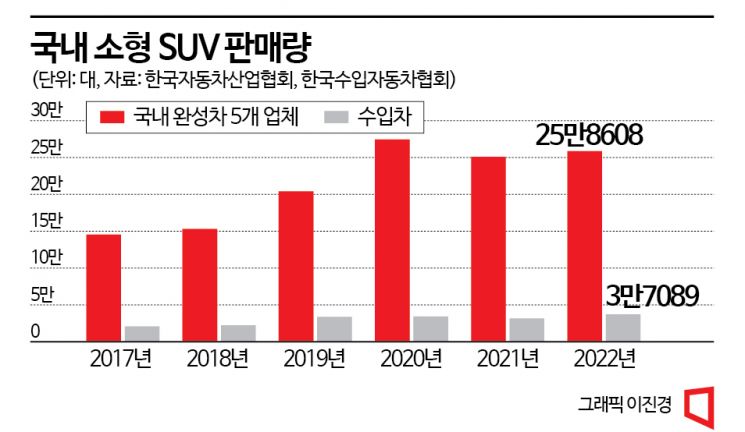
Domestic small SUV sales steadily increased until 2020 but have stagnated since then. Sales volume rose about 78% from 166,117 units in 2017 to 295,697 units last year. The Korea Automobile Manufacturers Association reported that domestic sales of small SUVs by five domestic automakers (Hyundai, Kia, Renault Korea, SsangYong, Korea GM) increased from 145,378 units in 2017 to 258,608 units last year. Specifically, sales were 274,300 units in 2020 but dropped to 251,006 units in 2021. According to data from the Korea Imported Automobile Association, new registrations of SUVs with engine displacement under 2000cc were 20,739 units in 2017 and 34,324 units in 2020. In 2021, it was 31,654 units, and last year it slightly increased to 37,089 units compared to 2020.
The popularity of camping and car camping (cha-bak) increased preference for larger vehicles, contributing to the sluggish sales of small SUVs. Among the top 10 best-selling models domestically last year, SUVs included Sorento (2nd), Carnival (5th), Sportage (7th), and Palisade (8th), all of which are mid-size or larger. Aging and discontinuation of major models are also among the reasons for weak small SUV sales. SsangYong's Tivoli has only undergone trim adjustments since its launch in 2016 without a full redesign. Renault's Captur and Kia's Stonic and Soul have been discontinued.
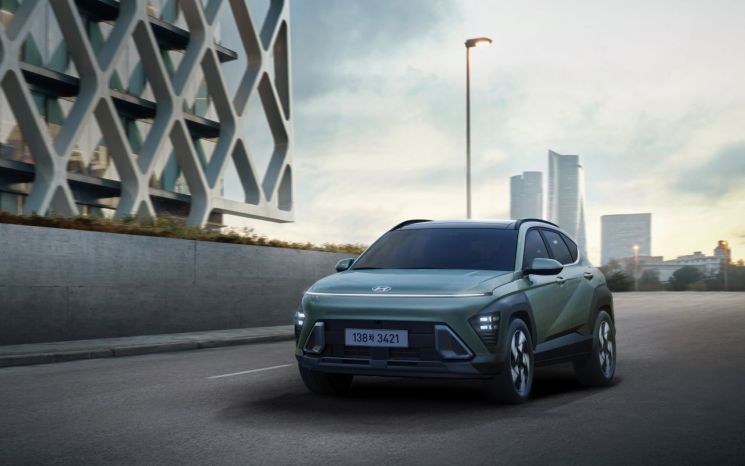
However, this year various small SUVs will enter the market. The first is Hyundai's new Kona, which will start delivery after the Lunar New Year holiday. It is the second-generation fully redesigned model released 5 years and 7 months after the first launch in 2017. The domestic sales target for this year is set at 37,000 units. The company expects about 40% of sales to be hybrid models. Designed based on Hyundai's third-generation electric vehicle platform, the front upper part features Hyundai's next-generation signature lighting design, the horizontal LED lamp (Seamless Horizon Lamp). Compared to the previous Kona, the overall length (4,350 mm) and wheelbase (2,660 mm) have increased by 145 mm and 60 mm respectively, expanding the second-row legroom and shoulder room.
Korea GM plans to launch the second-generation Trax in the first half of this year. They are investing 900 billion KRW in the Changwon plant to produce 250,000 units annually. The Trax's wheelbase is 2,700 mm, longer than the competing Kona. BMW Korea started pre-orders for the new iX1 through the BMW Shop online from the 26th and will officially launch it in April. It is the first pure electric model introduced in the third-generation X1. The iX1 xDrive30 offers all-wheel drive with a maximum output of 313 horsepower and can travel 417 to 440 km on a single charge based on the European WLTP standard.
Facelift models with partial design changes are also appearing. Hyundai is expected to release the facelifted Venue model, which was launched in the Indian market last year, domestically as well. Audi Korea began selling the new Q2 35 TDI model from the 19th. As a facelift model, its overall length (4,215 mm) is 17 mm longer than the previous model. Some design elements, including the headlights, have also been improved.
Kia plans to continue the momentum of the Seltos, which sold 43,095 units last year after a facelift. Renault Korea Motors is focusing on the XM3 hybrid model launched in the second half of last year. Domestic sales of this model increased about 15 times from 83 units in October to 1,287 units in December.
© The Asia Business Daily(www.asiae.co.kr). All rights reserved.
![From Hostess to Organ Seller to High Society... The Grotesque Scam of a "Human Counterfeit" Shaking the Korean Psyche [Slate]](https://cwcontent.asiae.co.kr/asiaresize/183/2026021902243444107_1771435474.jpg)

















