Supercooled Water That Doesn't Freeze Below Freezing Point
Rapid Solidification Upon Impact... The Secret of Slush Soju
'Cold Proof Shots' That Heated Up SNS Transforming into Ice
[Asia Economy Reporter Yoon Seul-gi] As the severe cold continues due to the 'Arctic cold wave,' various online communities and social networking services (SNS) have been flooded with so-called 'cold proof shots.' A video showing water poured from a PET bottle into a water purifier inside an office instantly turning into ice was released and attracted attention.
The informant told MBC that the video was filmed at 6 a.m. in Itaewon, Seoul, saying, "I poured water to drink coffee after coming to work in the morning, and it froze immediately."
However, this phenomenon is not simply caused by cold weather but is a type of supercooling. Supercooling refers to a state where a liquid remains in its original state without turning into ice even below the freezing point. Considering that the morning low temperature in Seoul at the time of filming dropped to minus 19.9 degrees Celsius, it is presumed that the water inside the PET bottle was in a supercooled state.
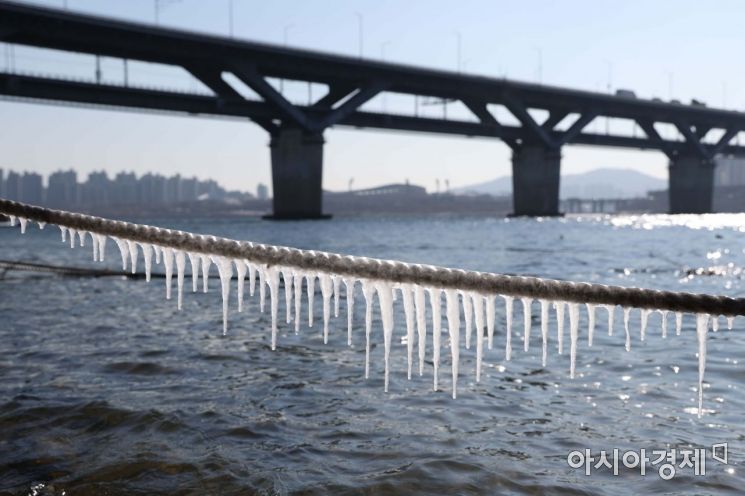 On January 11, 2022, when a cold wave advisory was issued for most regions nationwide, ice formed at Ttukseom Hangang Park in Gwangjin-gu, Seoul.
Normally, when the temperature drops, liquid water changes into solid ice. However, if there is no nucleus to facilitate the molecular transition from liquid to solid, the water does not freeze even below the freezing point.
There is research showing that water does not freeze even at temperatures as low as minus 48 degrees Celsius. According to a 2011 paper titled 'Structural Transformation of Supercooled Water' published in the international journal Nature, researchers revealed through simulations that the limit temperature at which supercooled water can exist is around minus 48 degrees Celsius.
However, supercooled water is very unstable and quickly turns into ice with even a small shock. External impact acts as a nucleus, causing the molecular state to change.
The once popular slushy soju also utilized the supercooling phenomenon. When a bottle of soju in liquid form is taken out of the freezer after about two hours and the bottom of the bottle is struck, the soju rapidly solidifies, becoming slushy soju.
The principle of supercooling also applies to meteorological phenomena. Freezing rain on days when the temperature drops below zero is a representative example. Freezing rain refers to the phenomenon where rain rapidly freezes upon hitting cold objects or the ground.
Generally, precipitation appears as rain when warm and snow when cold. However, in the case of freezing rain, snow formed in the warm middle and upper atmosphere falls into the lower atmosphere, melts into rain in the above-freezing layer, and then freezes upon contact with subzero objects on the ground.
© The Asia Business Daily(www.asiae.co.kr). All rights reserved.
![From Hostess to Organ Seller to High Society... The Grotesque Scam of a "Human Counterfeit" Shaking the Korean Psyche [Slate]](https://cwcontent.asiae.co.kr/asiaresize/183/2026021902243444107_1771435474.jpg)
















