Ministry of Gender Equality Announces 3rd Basic Plan for Gender Equality Policy
Parental Leave Extended from 1 Year to 1.5 Years
[Asia Economy Reporter Yoo Byung-don] The 'Gender Labor Disclosure System,' which requires companies to disclose gender ratios externally from hiring to retirement of workers, will be introduced gradually. In addition, measures are being pursued to prevent sex offenders wearing location-tracking electronic devices (electronic anklets) from working in industries such as delivery riders or substitute drivers.
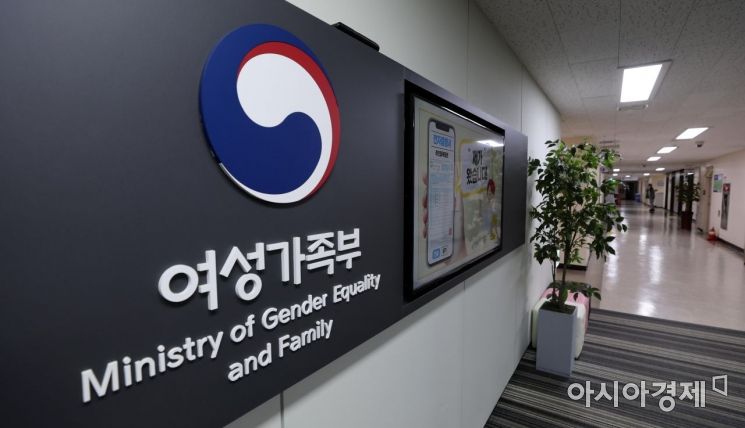
On the 26th, the Ministry of Gender Equality and Family announced that it had deliberated and approved the '3rd Basic Plan for Gender Equality Policy' (2023?2027) containing these details. Since the enactment of the Framework Act on Gender Equality in 2015, the Ministry of Gender Equality and Family has been establishing basic plans for gender equality policy every five years in consultation with related ministries.
While the previous 2nd Basic Plan (2018?2022) focused on guaranteeing women's employment and social participation, work-life balance, and raising awareness of gender equality, the current 3rd plan includes tasks such as closing the gender wage gap, alleviating the increased caregiving burden due to COVID-19, and eradicating five major types of violence.
First, the Gender Labor Disclosure System, a pledge of the Yoon Seok-yeol administration, will be promoted on a voluntary basis by companies. This system requires each company to disclose gender data externally on key items from employee recruitment, employment, to resignation stages.
At the recruitment stage, the gender ratio from document screening passers to final successful candidates is disclosed; at the employment stage, the gender ratio by department, promotion recipients, and users of parental leave is disclosed. The Ministry of Gender Equality and Family explained that the Ministry of Employment and Labor is currently preparing detailed implementation measures and plans to introduce the system gradually starting with the public sector this year.
To enhance women's competitiveness in future industry jobs, digital education courses will be organized in the Polytech women's reemployment program, and vocational training courses in promising future fields such as bio and artificial intelligence (AI) will be expanded from 66 courses last year to 74 this year.
To spread a culture of shared caregiving, the parental leave period will be extended from the existing one year to one and a half years, and support for activating telecommuting and remote work in small and medium-sized enterprises will be provided. The scope of evaluation related to supporting work-life balance expansion for partner companies will be expanded in the 'Win-Win Growth Comprehensive Evaluation' for large corporations.
The Ministry of Education will introduce the Elementary Neulbom School to eliminate blind spots in elementary care, extending the use time of care classrooms until 8 p.m., and increase government support hours and beneficiary households for childcare services.
To strengthen childcare support for dual-income families, government support hours for childcare services will be increased from the current 840 hours per year to 960 hours this year. The number of supported households will also increase by 10,000 from 75,000 last year to 85,000 this year.
To protect women who are in blind spots of illegal distribution of abortion drugs, the Ministry of Gender Equality and Family will work with the Ministry of Justice, Ministry of Health and Welfare, and the Ministry of Food and Drug Safety to revise related laws and systems. This is a measure following evaluations that health rights have been infringed due to the lack of substitute legislation after the Constitutional Court's 2019 ruling of constitutional inconsistency on abortion laws.
According to a 2021 survey by the Ministry of Health and Welfare, the abortion rate among women aged 15 to 44 is 3.3%, with socioeconomic reasons being the main cause. The Ministry of Food and Drug Safety will strengthen crackdowns on illegal distribution of abortion drugs, and the Ministries of Health and Welfare and Gender Equality and Family will expand counseling for pregnancy conflict situations.
Laws and systems regarding the five major types of violence (power-based sexual crimes, digital sexual crimes, domestic violence, dating violence, stalking crimes) will also be revised. A plan is underway to include delivery riders and substitute drivers in the list of restricted industries for those wearing electronic anklets. Additionally, plans include expanding one-on-one electronic supervision, assigning dedicated probation officers, and 24-hour intensive management and supervision in cooperation with the Ministry of Justice.
Measures to protect victims of sexual harassment and sexual violence by heads of institutions will be made mandatory, and a new obligation to prohibit disadvantageous treatment of sexual harassment victims and reporters will be introduced. The submission period for recurrence prevention measures to the Minister of Gender Equality and Family in cases of sexual violence by institution heads will be shortened from the current three months to one month, and institutions failing to submit will be penalized with fines and other sanctions.
Special provisions for treatment and custody will be newly established for offenders of pedophilia, the semi-prosecution system for stalking crimes will be abolished, and amendments to the Act on the Punishment of Stalking Crimes to expand punishment for online stalking and others will be supported.
© The Asia Business Daily(www.asiae.co.kr). All rights reserved.

















