[Asia Economy Yeongnam Reporting Headquarters Reporter Hwang Dooyul] Domestic researchers have discovered a new protein that regulates the repair activity of damaged DNA and is involved in the cell's defense system.
This is expected to effectively control chromosomal instability, a major cause of malignant cancer occurrence, and further aid in overcoming malignant cancer.
Ulsan National Institute of Science and Technology (UNIST) announced on the 26th that Professor Kim Hongtae's team discovered the ZNF212 protein, which binds to TRAIP, an enzyme known to play a crucial role in pathway selection during the repair process of DNA interstrand crosslinks (ICL).
DNA interstrand crosslinking is a phenomenon where a covalent bond forms between the two strands of DNA. This blocks DNA replication and transcription and causes DNA breaks, leading to cell death.
Platinum-based anticancer drugs, widely used in chemotherapy, utilize the mechanism of inducing DNA interstrand crosslinks to trigger cancer cell death. Therefore, research on the repair of DNA interstrand crosslinks can be used to improve the efficacy of anticancer drugs in the future.
According to previous studies, TRAIP protein acts as an important regulator determining the repair of crosslinks in frog egg extracts, but the mechanism of crosslink repair in human cells has not been clearly elucidated.
To clarify the function of TRAIP protein in human cells, the research team used the 'yeast two-hybrid system' and discovered the binding protein ZNF212.
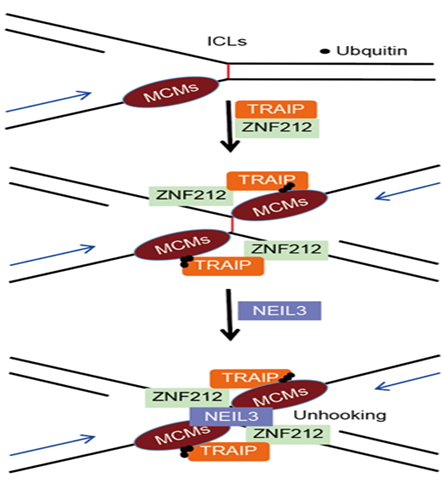
The research results confirmed that when the expression of ZNF212 protein was reduced, chromosomal instability in cells increased and cell viability significantly decreased.
Additionally, to study further functions of ZNF212 protein, the team utilized the 'microbeam radiation technique,' which allows observation of protein movement to DNA damage sites in living cells.
Using this technique, they observed that ZNF212 protein rapidly moves to DNA damage sites together with TRAIP, and confirmed that ZNF212 protein directly binds to NEIL3 protein, playing an important role in guiding NEIL3 protein to the damage location.
Professor Kim Hongtae of the Department of Life Sciences said, "This study demonstrated the role of a previously unknown protein, ZNF212, involved in the DNA interstrand crosslink repair process," adding, "It will greatly aid future research for cancer treatment and new drug development for genetic diseases."
This research was conducted jointly with Professor Myung Kyungjae of UNIST and Professor Kim Yonghwan's team at Sookmyung Women's University, supported by the National Research Foundation of Korea, the Institute for Basic Science (IBS), and university-focused research institutes.
The research results were published online on January 3 in the journal Nucleic Acids Research, a scholarly journal in the field of biochemistry and molecular biology.
© The Asia Business Daily(www.asiae.co.kr). All rights reserved.

















