US Mount Rainier 12-Month Snowfall Down 3110 cm
Seoul Snowy Day ↓ "Snow Accumulation Likely to Continue"
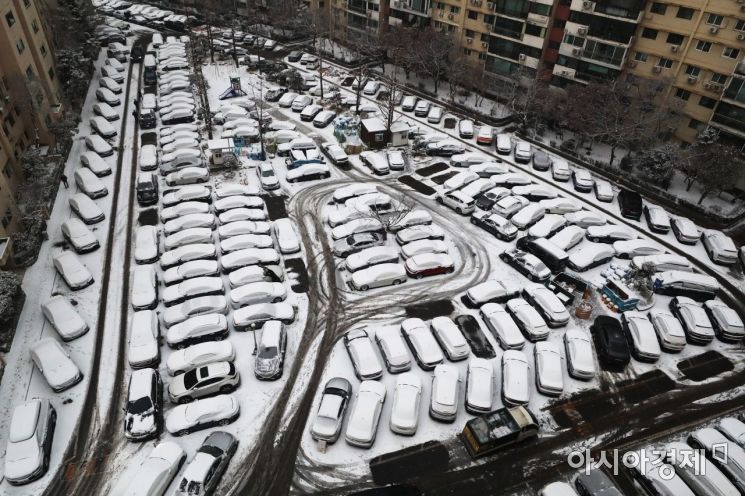 On the 26th, when a heavy snow warning was issued for Seoul and the central region, passenger cars that had given up driving were lined up covered in snow in an apartment complex in Seoul./Photo by Dongju Yoon doso7@
[Asia Economy Reporter Kim Jong-hwa] The morning in Seoul and other central-western regions, where a heavy snow warning was issued, began with the turtle-like pace of citizens silently walking on the frozen commute paths.
According to the Korea Meteorological Administration on the 26th, a heavy snow warning is issued when the new snowfall accumulation is expected to be 5 cm or more within 24 hours. 'New snowfall accumulation' refers to the amount of newly accumulated snow in one day, while 'snow depth' refers to the total amount of snow continuously accumulated.
The term commonly referred to as 'daily maximum snowfall (new snowfall accumulation)' is called 'maximum new snowfall' in meteorological terminology. It means the depth of newly accumulated snow on top of the existing snow over a 24-hour period. The maximum depth of snow actually accumulated on the ground from snowfalls over several days is referred to as 'maximum snow depth (snow depth)'.
The highest snow depth and the highest daily snowfall in Korea were both recorded on Ulleungdo. The maximum snow depth was 293.6 cm on January 31, 1962, which far exceeded an adult's height. The highest daily snowfall was 150.9 cm on January 20, 1955, truly a snow bomb.
Heavy snow often occurs in areas with large temperature differences between land and sea, regions with high mountains where clouds easily rise, and areas where air masses change over warm seas. Traditionally, Korea's heavy snow regions are divided into five major areas: Ulleungdo, northeastern Yeongdong, western Taebaek Mountains, northwestern Sobaek Mountains, and the southern coast. Northeastern Yeongdong includes Daegwallyeong, Sokcho, and Gangneung; western Taebaek Mountains include Inje, Chuncheon, Hongcheon, Yangpyeong, Wonju, Seoul, Icheon, Suwon, Cheonan, Cheongju, Chungju, and Jecheon; northwestern Sobaek Mountains include Buyeo, Boeun, Daejeon, Gunsan, Jeonju, Imsil, Jeongeup, Namwon, and Gwangju; the southern coast includes Haenam, Wando, Jangheung, Goheung, Yeosu, and Namhae.
The second and third highest daily snowfall amounts in Korea (118.4 cm on February 12, 1967, and 94.1 cm on January 25, 1954) were both recorded on Ulleungdo; the fourth (92.0 cm on January 31, 1992) and fifth (90.3 cm on February 3, 1987) were at Daegwallyeong; and the sixth was Sokcho City (89.6 cm on February 20, 1969). The seventh to tenth highest were all recorded on Ulleungdo and Daegwallyeong.
The snow bombs in Korea, where snow piles exceed an adult's height, can be compared to the difference between conventional bombs and atomic bombs when compared to world records.
The world record for the highest snowfall listed in the Guinness Book is 1146 cm, which fell in March 1911 in Tamarack, California, USA. This is nearly four times the Korean record, close to the height of a four-story apartment building. The highest daily snowfall is 193 cm, recorded on April 15, 1921, in Silver Lake, Colorado, USA.
Regarding the period during which snow remains without melting, the Korean record is held by Daegwallyeong, where snow lasted for 124 days from December 2, 1974, to April 4 of the following year. Globally, Mount Rainier's Paradise in Washington State, USA, holds a record where 3110.2 cm of snow fell over 12 months from February 19, 1971, to February 18, 1972.
While snowfall amounts in Korea are unpredictable, the number of days with snowfall is noticeably decreasing. As of the end of August last year, the number of days with snowfall in the past 10 years decreased by 1.46 days in Seoul, 0.5 days in Chuncheon, 1.67 days in Yeosu, and 0.83 days in Busan.
Kim Seung-bae, head of the Korea Natural Disaster Association, said, "This is a typical phenomenon caused by global warming, as winters become less cold," adding, "Although the number of days with snowfall may decrease, when it does snow, the possibility of heavy snow is high, so the total snowfall amount is unlikely to decrease."
© The Asia Business Daily(www.asiae.co.kr). All rights reserved.

















