13 University Students Arrested While Trying to Hold a Video Meeting
Some Schools Also Cut Power and Communication Networks
[Asia Economy Reporter Hyunwoo Lee] Controversy is erupting as the Indian government arrests a large number of university students who attempted to screen a documentary by the British BBC that critically examines the past actions of Prime Minister Narendra Modi. In some schools, to prevent the screening, even the campus power and communication networks have been cut off, intensifying student protests.
On the 25th (local time), according to CNN and major foreign media, 13 university students who tried to hold a screening of the BBC broadcast "India: The Modi Question" at Jamia Millia Islamia (JMI) National University in New Delhi were arrested. The documentary deals with the "Muslim massacre incident" that occurred in 2002 in the western state of Gujarat and the responsibility of the then Gujarat Chief Minister, now Prime Minister Modi, and the Indian government has banned its screening.
Earlier, at another university in New Delhi, Jawaharlal Nehru University (JNU), when a screening of the BBC documentary criticizing Prime Minister Narendra Modi was about to be held on campus, Indian authorities cut off the campus power and internet supply. Nevertheless, movements to hold screenings have continued mainly among student groups in various Indian universities, and clashes between security authorities and students are reportedly occurring in many places.
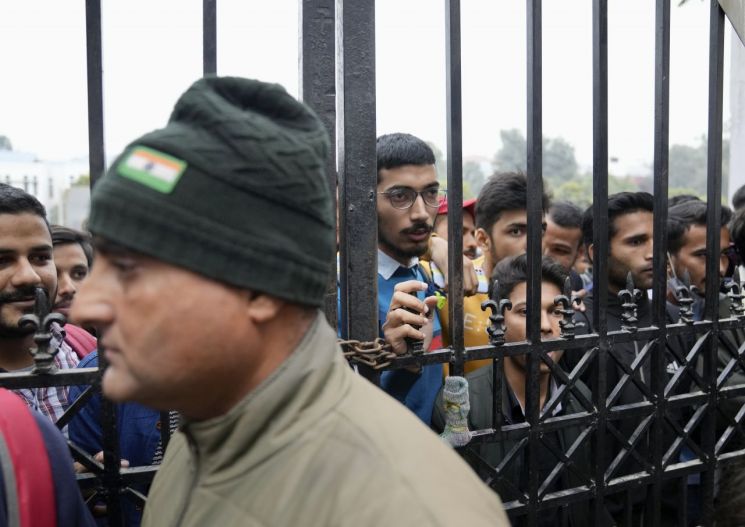 On the 25th (local time), security personnel controlled the entrance of Jamia Millia Islamia (JMI) National University in New Delhi, India, while confronting students. When some students attempted to hold a screening of a BBC documentary criticizing Prime Minister Narendra Modi, the school closed the main gate. New Delhi=AP·Yonhap News
Previously, the Indian government harshly criticized the documentary as hostile propaganda and stated that it is blocking videos spreading on social networking services (SNS). Kanchan Gupta, an advisor to the Indian government, tweeted on the 21st, "The Indian government has invoked emergency powers under IT regulations to block the documentary videos being shared on SNS," strongly criticizing it as "hostile propaganda disguised as a documentary and anti-India garbage."
The BBC's decision to proceed with the release of the documentary despite the Indian government's controversy is interpreted as an attempt to criticize the deepening Hindu nationalism in India since Prime Minister Modi took office. International human rights activists and the Indian opposition have continuously pointed out that religious conflicts in India have worsened since Modi assumed the federal government prime minister position in 2014.
Especially ahead of next year's Indian general election, the Indian government is reportedly increasing pressure on minority groups such as Muslims to strengthen the unity of Hindu supporters, drawing criticism from international human rights organizations.
Meanwhile, among India's total population of 1.4 billion, Hindus account for about 80%. Muslims make up about 14%, and conflicts occur between Hindus and Muslims in various regions due to religious and cultural reasons.
© The Asia Business Daily(www.asiae.co.kr). All rights reserved.

















