Significant Drop in Driving Range After One Charge
"Can't Even Use the Heater... Charging Refugees"
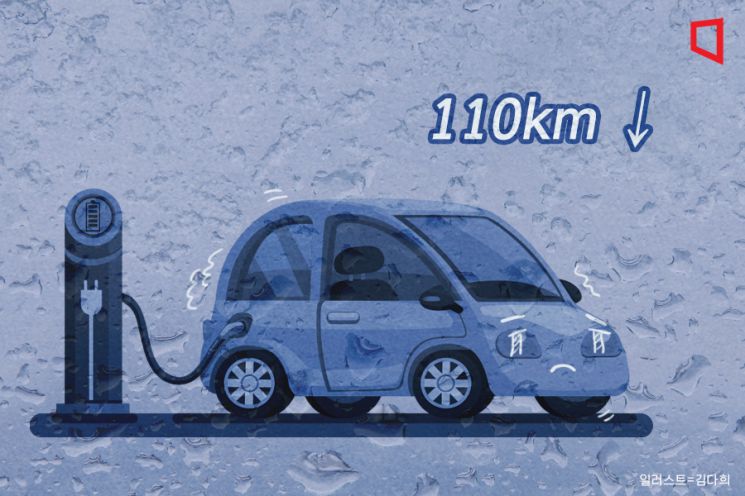
As the cold wave continues around the Lunar New Year holiday, electric vehicle (EV) owners are growing increasingly frustrated. The lithium-ion batteries installed in EVs perform worse as temperatures drop, resulting in shorter driving ranges.
According to the Ministry of Environment's Zero-Emission Vehicle Integrated Website on the 26th, the driving range per charge of EVs released in South Korea differs by more than 110 km between normal temperature (25°C) and low temperature (-7°C). The Hyundai Ioniq 6 (Long Range 2WD), released in August last year, can travel 544 km on a single charge at normal temperature, but its range drops to 428 km at low temperature, a difference of 116 km. The Kia Niro EV also has a range of 404 km at normal temperature, but only 303 km at low temperature, 101 km shorter. Tesla's Model 3 Long Range has a driving range of 527.9 km at normal temperature, which decreases by 90 km to 440.1 km in cold conditions.
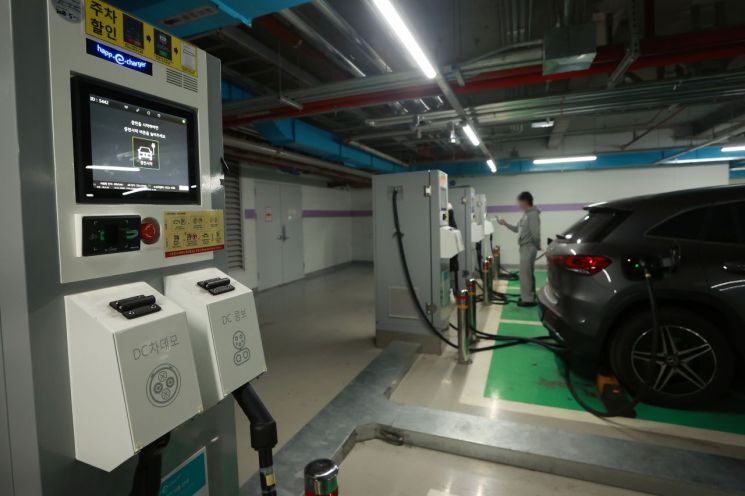
Due to these circumstances, during this Lunar New Year holiday marked by the cold wave, social media platforms were filled with EV owners sharing their struggles with battery charging. They expressed complaints such as "My heart was pounding as the driving range rapidly decreased," "I couldn't turn on the heater because it drastically reduced the driving range," and "Charging stations were crowded everywhere, it felt like there were charging refugees."
There are two main reasons for the decline in EV battery performance. One is the lithium-ion battery itself. Lithium-ion batteries, which use liquid electrolytes, experience increased internal resistance and reduced efficiency when the electrolyte freezes at low temperatures. Charging speed significantly slows down and efficiency drops in cold weather. The other reason is the winter heating system. Unlike internal combustion engine vehicles that use engine heat for heating, EVs run heaters using battery power, which noticeably reduces the driving range when the heater is on.
Meanwhile, the lack of charging infrastructure is also considered a problem. According to data submitted by the Korea Expressway Corporation to Assemblyman Hong Jung-min of the Democratic Party, as of the end of September last year, the average number of EV chargers at the top 20 busiest highway rest areas was 5.6 units. Especially during this Lunar New Year holiday, major rest areas reportedly took about 30 minutes per charger for EV charging, failing to meet the demand for charging vehicles adequately.
© The Asia Business Daily(www.asiae.co.kr). All rights reserved.


















