[Asia Economy Yeongnam Reporting Headquarters Reporter Hwang Du-yeol] The strongest cold wave of this winter has swept across the country, and the severe cold continues, requiring special caution against frostbite.
Prolonged exposure to cold can cause frostbite. When exposed to cold for a long time, the body activates homeostatic mechanisms to maintain core temperature, during which blood vessels in the exposed areas constrict and damage occurs.
Frostbite mainly appears on the nose, cheeks, ears, chin, or extremities such as toes and fingers, which are prone to heat loss because they have less muscle mass, produce less heat, and are far from the heat-generating core.
Therefore, when going out or traveling, minimize body exposure by wearing hats, earmuffs, masks, gloves, and wear waterproof clothing and shoes.
When going to places with heavy snow accumulation, wearing gaiters that wrap around the calves to prevent snow from entering the shoes is also helpful.
Frostbite is often thought to occur only in subzero cold weather, but it can also happen in slightly cold temperatures above freezing if blood circulation is poor due to tight shoes and the feet remain wet from sweat or snow.
Symptoms vary depending on the degree of damage. Initially, there is no pain, but when exposed to warm temperatures, the skin turns red, swells, itches, and a prickling pain is felt.
In more severe cases, pain intensifies, blisters form, or the skin peels causing bleeding. In severe cases, the skin may turn blue or black and become necrotic.
If a frostbite patient occurs, the principle is to visit a medical institution quickly, but if emergency treatment is needed, move to a place where exposure to cold can be minimized, remove wet shoes or clothing, and remove accessories that hinder blood circulation.
Warm the affected area using body heat, such as placing it under the armpits. Avoid hot water above 43 degrees Celsius as it can cause burns, and do not expose the area directly to fire, electric blankets, heaters, or radiators.
Do not press or massage the frostbitten area, and avoid rubbing it with ice or snow. If blisters are visible, do not pop them.
Smoking hinders blood circulation and must be absolutely avoided. Sometimes alcohol is given to warm the body, but since alcohol dilates blood vessels causing heat loss and hypothermia, it should not be consumed.
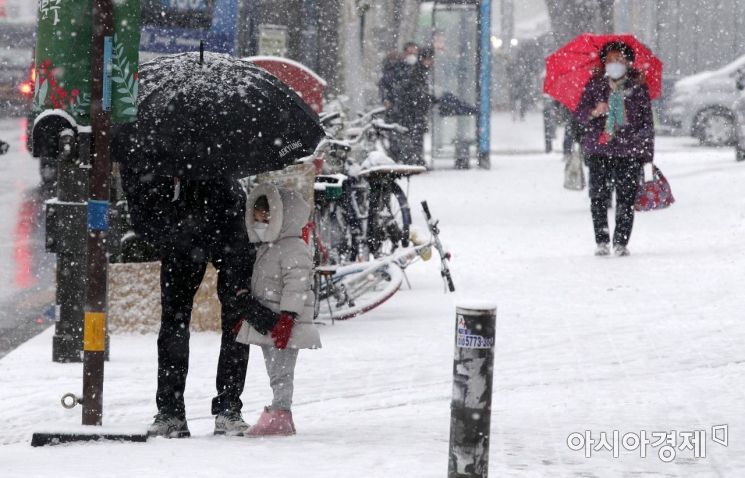 A citizen is brushing snow off his daughter's clothes on a street in Dongdaemun-gu, Seoul.
 [Photo by Kim Hyun-min]
Park Young-min, head of the Regional Emergency Medical Center at Daedong Hospital, said, “Every year, January to February is a time when more people go on New Year hikes or winter trips during winter vacation to gain new year energy. It is good to prepare clothing and other measures before climbing mountains and to learn how to respond to emergencies.”
To prevent frostbite in winter, keeping warm is most important, so it is recommended to wear several thin layers of clothing and use gloves, earmuffs, and scarves.
Instead of wearing very thick socks because of the cold, choose thermal materials that allow sweat to evaporate well to control moisture inside shoes.
Wearing boots that are tight up to the calves or height-increasing insoles that squeeze the feet reduces blood circulation, so wear comfortable shoes, and if shoes or socks get wet, dry or change them as soon as possible.
In cold environments, rather than staying still, move your body frequently to promote blood circulation, and do sufficient stretching before outdoor activities.
© The Asia Business Daily(www.asiae.co.kr). All rights reserved.

















