Semiconductor Industry Expected to Rebound... SK Hynix Surpasses Samsung Biologics
Expectations for End of Interest Rate Hikes Boost Kakao and Naver
Need to Monitor Semiconductor and Big Tech Earnings, Economic Data Releases
[Asia Economy Reporter Minji Lee] This year, there has been active movement in the rankings of the top market capitalization stocks on the KOSPI. As foreign investors and institutions, the major players in the stock market, have shown strong buying momentum, technology and banking stocks, where these investors have increased their purchase volumes, are making significant advances.
According to the Korea Exchange, as of the closing price on the 20th, SK Hynix ranked 3rd in KOSPI market capitalization with 63.773 trillion won. At the end of last year, it had fallen to 4th place with a market capitalization of 54.6 trillion won, trailing Samsung Biologics, but it reversed the position thanks to foreign investors' semiconductor stock purchases. SK Hynix distanced itself by a large margin from Samsung Biologics (56.9392 trillion won), with which it had been swapping places in market capitalization rankings.
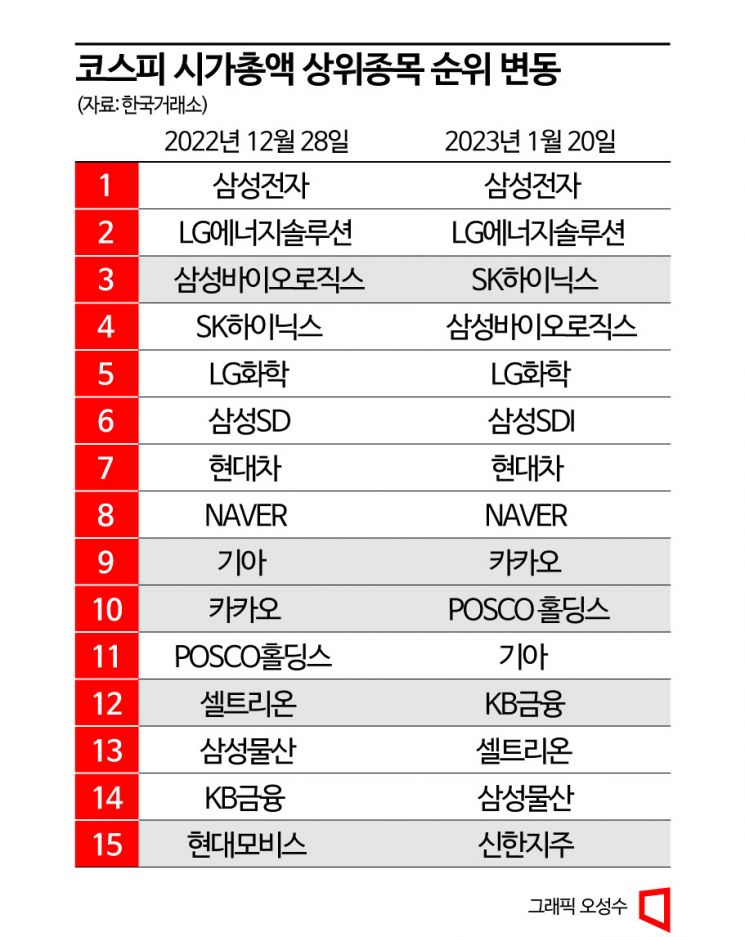
Semiconductor stocks, including SK Hynix, had been on a downward trend due to increased inventory from weakening demand and concerns over an economic recession. However, they rebounded in the fourth quarter following earnings shock-level results. This was due to the significant drop in stock prices and expectations of an industry recovery. News of active production cuts and reduced capital expenditures by memory semiconductor companies also had an impact. In fact, the stocks most purchased by foreigners this year were Samsung Electronics and SK Hynix, with purchases worth 1.4581 trillion won and 476.6 billion won, respectively. Accordingly, Samsung Electronics' market capitalization also grew from 330 trillion won to 368 trillion won during the same period.
Kakao, which had fallen out of the top 10 in market capitalization due to weakened investor sentiment toward tech stocks amid consecutive interest rate hikes last year, rose to 9th place thanks to institutional buying. The perception that the interest rate hikes had entered their latter stages and the rising stock prices of major U.S. tech companies also had a positive effect. Institutions net purchased Kakao stocks worth 182.2 billion won. Kakao's market capitalization increased from 23.6512 trillion won to 27.26 trillion won. During the same period, institutions also bought Naver stocks worth 83 billion won.
Outside the top 10 in market capitalization, banking stocks showed a notable upward trend. At the end of last year, only KB Financial Group (19.8315 trillion won) was ranked within the top 15 by market capitalization, but now KB Financial Group (23.3 trillion won) and Shinhan Financial Group (22.03 trillion won) are ranked 12th and 15th, respectively. Along with growing expectations for dividends, activist fund Align Partners' demands for expanded shareholder returns from the seven major bank holding companies including KB, Shinhan, Woori, Hana, and JB also served as a positive factor for stock prices. Align Partners is advocating for an increase in dividend amounts and the adoption of a medium-term shareholder return policy targeting a payout ratio of 50% of net income.
Although tech stocks have shown strength over the past month, it is uncertain whether this trend will continue. Earnings reports and economic indicators from domestic and international big tech companies are scheduled one after another. Samsung Electronics will report on the 31st, AMD on the 1st of next month, and Apple and Qualcomm on the 3rd. A key point to watch is whether Samsung Electronics will participate in memory semiconductor production cuts. If production cuts occur, positive outlooks for the memory industry are expected to spread. SK Securities researcher Youngjin Ahn said, “For now, it is advisable not to take aggressive investment actions but to gauge the industry outlook from earnings reports and review the U.S. Federal Reserve’s monetary policy before responding.”
Since banking stocks have also risen more than 30% since the beginning of the year, a cautious approach is necessary. NH Investment & Securities researcher Junseop Jeong said, “Although the shareholder return ratio will improve from the existing 25-30%, realistically, the sustainable shareholder return ratio for banking stocks is around 30-55%, and the 50% payout ratio mentioned by some is not very realistic. In terms of expanding shareholder returns, financial holding companies with ample capital ratios such as KB Financial Group, Shinhan Financial Group, and Hana Financial Group are likely to adopt more proactive shareholder return policies.”
© The Asia Business Daily(www.asiae.co.kr). All rights reserved.
![Clutching a Stolen Dior Bag, Saying "I Hate Being Poor but Real"... The Grotesque Con of a "Human Knockoff" [Slate]](https://cwcontent.asiae.co.kr/asiaresize/183/2026021902243444107_1771435474.jpg)
















