First Meeting of Welfare Ministry-Medical Association Council on 26th
Public Disclosure of National Pension Financial Projection Results on 27th
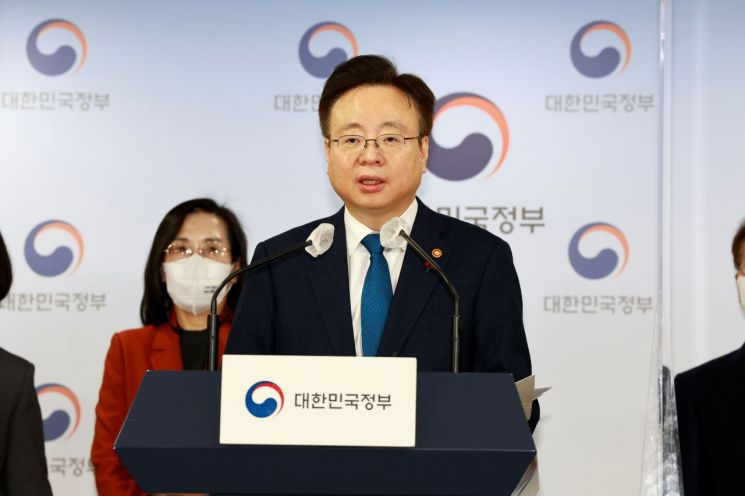 Minister of Health and Welfare Cho Kyuhong is giving a briefing after completing the government work report. [Photo by Ministry of Health and Welfare]
[Asia Economy Reporter Lee Gwan-joo] As the Lunar New Year holiday ends, discussions on major health and welfare policies such as essential medical care measures and national pension reform are becoming active. The government plans to meet with the medical community to discuss revitalizing essential medical care, while also soon announcing the financial projections of the National Pension, which will serve as the basis for pension reform.
According to the Ministry of Health and Welfare on the 25th, on the 26th, the ministry will form a medical issue consultative body with the Korean Medical Association to discuss ways to develop regional medical care, essential medical care, medical education, and the training system for residents. The first meeting will be attended by Minister Cho Kyu-hong of the Ministry of Health and Welfare and Chairman Lee Pil-soo of the Medical Association, and the consultative body will continue to hold weekly meetings to carry on discussions. The government and the medical community will discuss measures to promote public health and advance healthcare, including ▲developing support measures for regional medical care such as regional medical fees ▲fostering and supporting essential medical care ▲and substantially improving the training environment for residents.
Particularly, attention is focused on whether this consultative body will discuss the previously "hot-button" issues of expanding medical school quotas and institutionalizing telemedicine. The Ministry of Health and Welfare had attempted to expand medical school quotas and establish public medical schools in 2020 during the previous administration but withdrew due to strong opposition from the medical community. They announced an agreement to consult jointly with the Medical Association after the COVID-19 situation stabilized. Last year, both sides formed a consultative body to save essential medical care and discussed essential medical care measures, which led to the announcement of "essential medical care support measures," but discussions on medical school quota expansion did not take place.
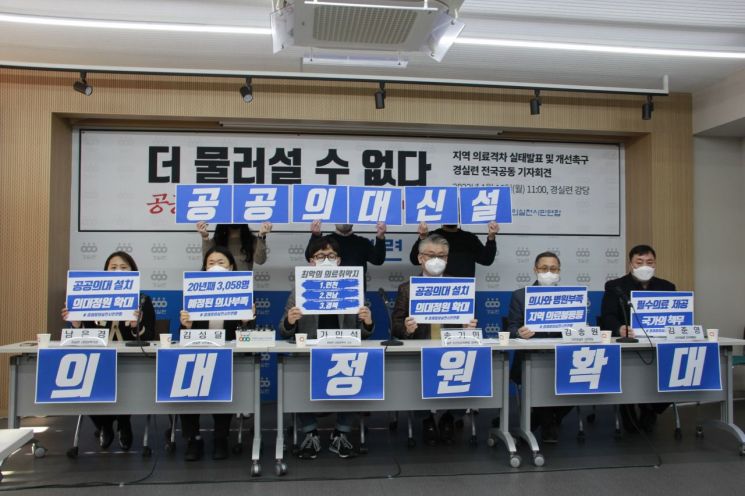 The Citizens' Coalition for Economic Justice held a press conference on the 16th to announce the current state of regional medical disparities and to urge improvements, demanding the establishment of public medical schools and the expansion of medical school quotas.
 [Photo by Kyungsilryeon]
However, opposition from the medical community regarding the expansion of medical school quotas remains a significant variable. Pediatricians, considered an essential specialty facing a treatment crisis, believe that without inducement support for resident recruitment and changes in fee policies, the current crisis will worsen. The Medical Association recently stated regarding the medical school quota expansion claims, "The shortage of personnel in essential and public medical fields is not due to an overall lack of doctors but stems from structural problems caused by the government's lack of proper doctor workforce supply policies and poor medical environments in regional and medically vulnerable areas." They criticized, "Simply increasing the total number of doctors or establishing public medical schools is a fragmentary and irresponsible measure that cannot be a fundamental solution." Conversely, civil society demands the expansion of medical school quotas and the establishment of public medical schools to resolve regional medical disparities.
Institutionalizing telemedicine is also one of the issues on which the government and the medical community have shown differing opinions. The Yoon Seok-youl administration is promoting the institutionalization of telemedicine as a national agenda and has announced plans to complete legislation by June this year. The medical community was initially skeptical about introducing telemedicine but has since unified its stance to lead telemedicine in response to COVID-19.
On the 27th, the results of the 5th National Pension financial projection, which forms the basis for national pension reform discussions, will be announced. The Ministry of Health and Welfare announced during the New Year's work report on the 9th that it would advance the schedule for the National Pension financial projection from March to January to activate reform discussions. Minister Cho Kyu-hong said in a briefing after the work report regarding pension reform, "According to the National Pension Act, we plan to submit a parameter reform plan focusing on the National Pension's contribution rate and income replacement rate by October this year," adding, "We will do our best to achieve social consensus through close consultation with the National Assembly and include the agreed plan in the operation plan."
Parameter reform refers to adjusting figures such as the contribution rate and income replacement rate while maintaining the basic framework of the pension system. In other words, it is a reform concerning how much is paid and how much is received later. The financial projection to be announced this time will serve as the most fundamental basis for this.
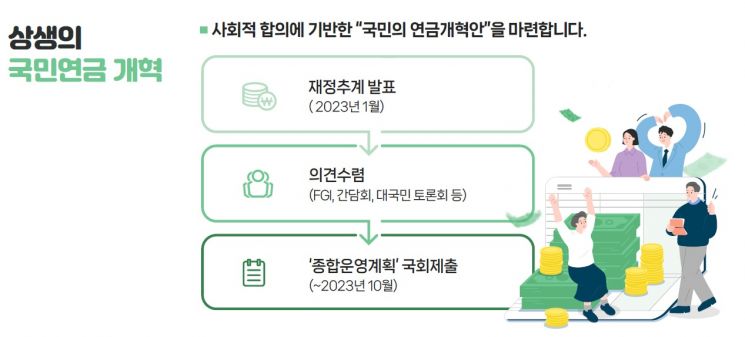 During the Ministry of Health and Welfare's work report on pension reform.
[Data provided by the Ministry of Health and Welfare]
During the 4th financial projection in 2018, the government estimated that the National Pension fund would be depleted by 2057. However, as birth rates have declined and aging has intensified over the past five years, projections are expected to change accordingly. In fact, domestic research institutions have predicted that the depletion point of the National Pension will be brought forward by 1 to 3 years. The Korea Development Institute (KDI) predicted in November last year that the National Pension would turn to deficit in 2036 and be completely depleted by 2054. The National Assembly Budget Office estimated the depletion year as 2055 in 2020.
The National Pension contribution rate started at 3% in 1988 and increased by 3 percentage points every five years until it was set at 9% in 1998, where it has remained since. Despite the lack of social consensus on raising the contribution rate, it has remained fixed for 25 years. With the government showing strong determination for pension reform and a consensus on the need for reform to ensure pension sustainability, attention is focused on what reform plans will emerge in the future.
© The Asia Business Daily(www.asiae.co.kr). All rights reserved.

![Clutching a Stolen Dior Bag, Saying "I Hate Being Poor but Real"... The Grotesque Con of a "Human Knockoff" [Slate]](https://cwcontent.asiae.co.kr/asiaresize/183/2026021902243444107_1771435474.jpg)
















