'Conspicuous Non-Consumption' and 'The Disappearance of the Average'
Prominent Trends During the 2023 Seol Holiday
'Seol' is a time to finally see the faces of family members in one's hometown. At the same time, Seol is also a useful period to check 'trends.' This is because a population of 50 million reacts to keywords like 'Seol' and 'holiday,' revealing visible behavioral patterns. Especially, this was the first Seol after the lifting of social distancing measures. We examined the social and economic patterns that appeared during the Seol holiday.
① Rather than going to hometown, prefer to travel abroad... Overseas travelers
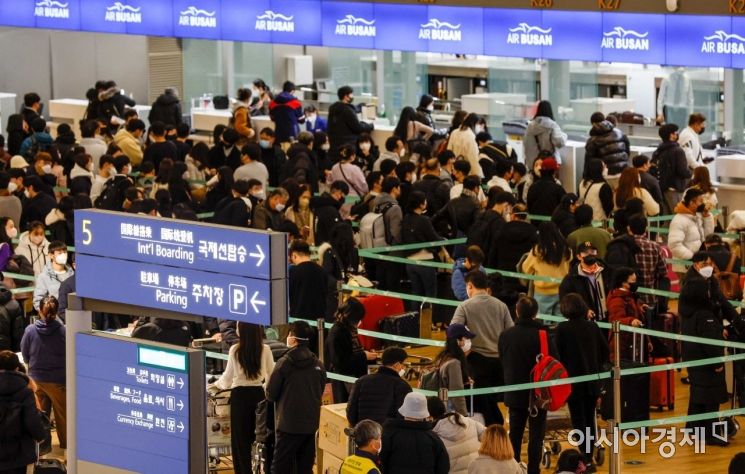 On the 20th, ahead of the Lunar New Year holiday, Incheon International Airport Terminal 1 is bustling with travelers preparing to depart. Photo by Kang Jin-hyung aymsdream@
A 43-year-old office worker A, whose hometown is Busan, spent this Seol holiday at a famous resort in Thailand. This year's holiday period was short, making the round trip by car between Seoul and Busan burdensome. During the pandemic, the family had not been able to travel abroad together.
Although the holiday was short, the airport was crowded without space to step. Earlier, Incheon International Airport Corporation predicted that from the 20th (Friday) to the 24th (Tuesday), a total of 616,074 travelers, averaging 123,215 per day, would use Incheon Airport. This figure is more than 1290% higher compared to last year's Seol holiday (January 28 to February 2, 6 days).
According to statistics released by major travel agencies, the reservation rate for overseas travel packages during the Seol holiday period exploded. Hanatour announced that about 15,000 travelers departed on overseas package tours from the 20th to the 24th, an increase of 7015% compared to last year. During the same period, Modetour reported that overseas package reservations for the Seol holiday increased by 9181% year-on-year.
② Rather stay home to rest or work than go to hometown... Home-Seol group
 On the 20th, ahead of the Lunar New Year holiday, travelers' vehicles are parked in the domestic parking lot at Gimpo Airport in Seoul. Photo by Jinhyung Kang aymsdream@
Conversely, the 'Home-Seol group,' who spent the Seol holiday alone, was also noticeable. This refers to those who do not go to their hometown during the Seol holiday but spend the private holiday resting at home or working part-time.
B, a 36-year-old office worker working in Uljin, Gyeongbuk, did not go to his hometown during the Seol holiday. He volunteered for two night shifts during the holiday. He said, "Thinking about the nagging from family and relatives gave me a headache, and since I was short of money right now, I decided to spend the holiday working."
There are also those looking for short-term part-time jobs. C, a 27-year-old job seeker, said, "Since I haven't found a job yet, meeting family and relatives was burdensome, and I thought working part-time to earn tuition and living expenses would be more comfortable mentally and financially, so I spent the holiday that way."
③ The counterattack of high prices: "Ancestors, we present meal kits on the ceremonial table"
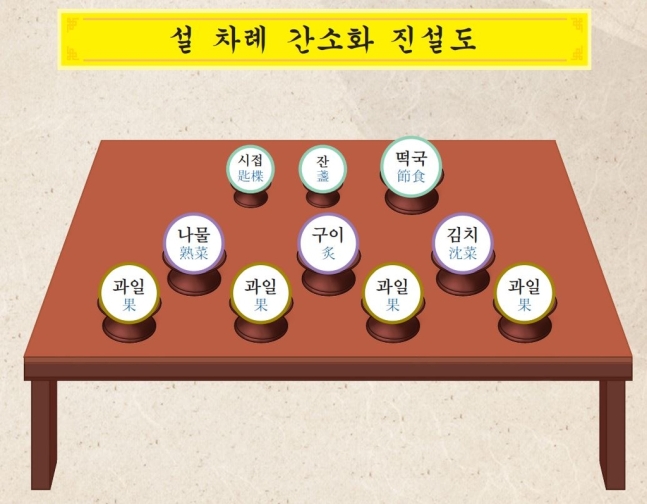 An example of the Lunar New Year ancestral rites table prepared by the Sungkyunkwan Ritual Establishment Committee [Image source=Sungkyunkwan Confucian Association Headquarters]
As high prices continue, the scene of the ceremonial table has changed. A variety of dishes that would break the table legs and lavish feasts are considered luxury. Even the Sungkyunkwan Ritual Establishment Committee repeatedly recommended a frugal ceremonial table.
From May to December last year, the inflation rate recorded over 5% for eight consecutive months. Grocery prices took a direct hit. The number of dishes decreased, and meal kits, which save time, labor, and cost, gained popularity as substitutes.
According to a survey conducted by Incruit ahead of the Seol holiday, 66.7% of respondents said they would simplify the ceremonial table this Seol. Among them, 44% cited 'burden of ingredient costs due to high prices.' More than half of those who planned to simplify the table said they intended to use convenience foods or meal kits.
④ Holiday gifts through secondhand trading... The heyday of 'Holiday Tech'
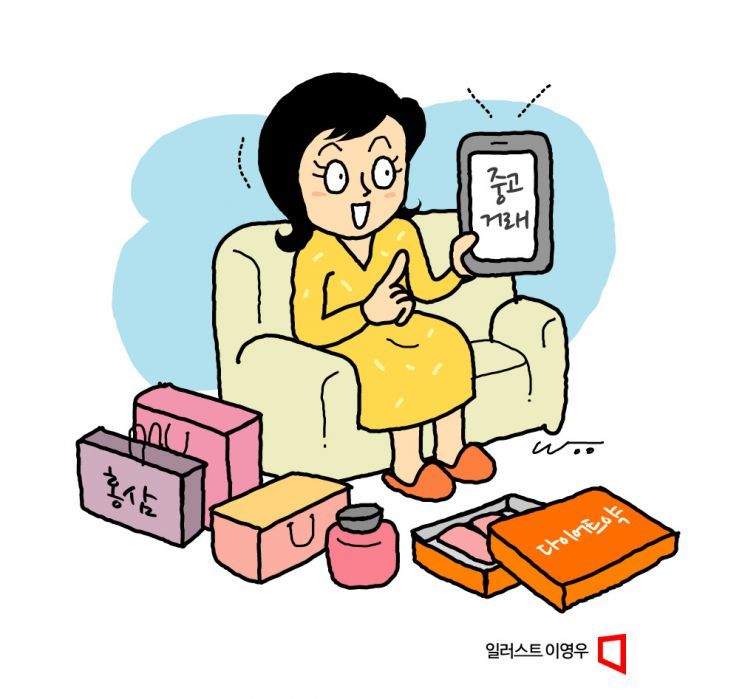
High prices also affected the holiday gift market. This Seol, secondhand trading of holiday gifts was more active than ever.
As of the 24th, many posts selling holiday gifts such as spam, canned tuna, daily necessities, red ginseng slices, red ginseng pills, and red ginseng drinks appeared on secondhand trading platforms like Danggeun Market, Bungaejangter, and Junggonara. Collagen drinks, vitamins, and probiotics were also frequently listed. Most were priced about 20-50% cheaper than the lowest internet prices.
The activation of the secondhand holiday gift market has led to the creation of the new term 'Holiday Tech,' a combination of 'holiday' and 'financial technology,' meaning making pocket money by reselling holiday gifts. D, a 34-year-old office worker, said, "I received a spam set at work, but since I don't usually eat spam and still have the same product from last Chuseok, I decided to sell it unopened."
In the high-price situation, buyers can purchase gift sets relatively cheaply, reducing living expenses, and sellers can profit by selling unnecessary stock, so the 'Holiday Tech' market is expected to be active every holiday.
⑤ "Still, it's a holiday gift"... Premium gifts remain popular
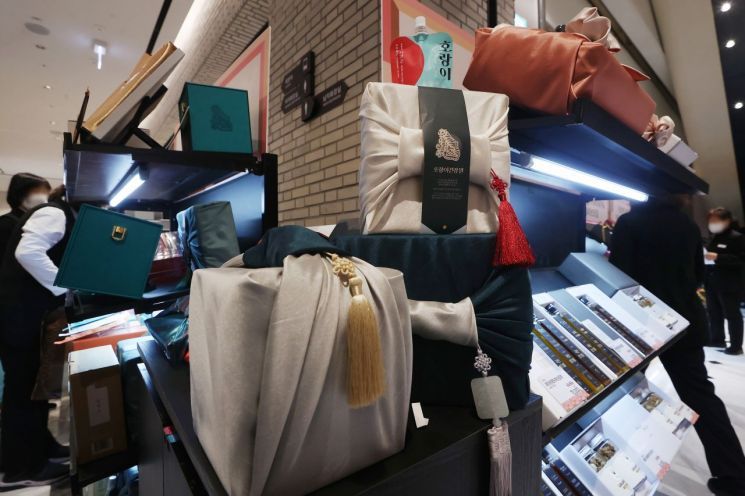 On the 3rd, when the department store industry sequentially began the main sales of Lunar New Year gift sets, Lunar New Year gift sets were displayed at a department store in downtown Seoul.
 [Photo by Yonhap News]
While some tightened their belts, preference for 'premium' gifts still appeared.
Analysis of sales data from Wemakeprice's '2023 Seol Prize' event (January 1-13) showed that sales of premium gift sets priced over 100,000 won increased by 29% compared to last year's Seol event.
Department stores offered high-end Korean beef sets and premium wines for Seol, and convenience stores released unique gifts such as diamonds and gold bars, all of which were quite popular.
As this was the first face-to-face holiday after the endemic, the increase in formal occasions is believed to have influenced the purchase of high-priced gifts.
◆ 'Conspicuous non-consumption' and 'The disappearance of the average'

The 'three highs' of high prices, high interest rates, and high exchange rates, which began in earnest last year, are expected to continue for the time being.
The simultaneous decline in asset markets such as securities, finance, real estate, and cryptocurrency, along with widespread warnings of crisis, are severely dampening consumer sentiment.
The activation of secondhand trading of holiday goods, cost reduction of ceremonial tables, and holiday tech are analyzed as rational choices by consumers who feel the crisis of the three highs firsthand.
Trend analyst Kim Yongseop named 'conspicuous non-consumption' as the trend keyword of the year in 'Life Trend 2023.' It means showing off non-consumption rather than consumption.
People who lack funds to practice 'YOLO' (You Only Live Once) due to inflation, recession, and asset value decline are choosing non-consumption as an alternative.
The cooling of the luxury consumption boom and the significant growth of the secondhand market also show consumers' efforts to cut unnecessary spending. Sharing 'life hacks' and 'saving know-how' is expected to become mainstream culture.
'The disappearance of the average' was also a keyword confirmed during this Seol holiday. It is a concept first presented by Professor Kim Nando of Seoul National University's Consumer Science Department as a 2023 consumption trend keyword.
It means that the normal distribution in consumption patterns is disappearing, with polarization being the most representative example. The polarization between premium and cost-effective Seol gifts, and the separation between overseas travelers and Home-Seol groups are typical cases.
The disappearance of the average also includes the concept of 'N-polarization.' As tastes diversify, the dominance of specific products disappears. This appeared as diversification of popular products in the Seol gift market.
Analysis of sales data from Wemakeprice's '2023 Seol Prize' event shows that the 'Seol event TOP10' products have diversified. While last year’s top 10 included 7 food and health products and 3 beauty products, this year’s top 10 included 4 beauty products, 3 lifestyle and kitchen products, and 3 food and health products. Even within premium products, items that can satisfy the tastes of N consumers are chosen.
© The Asia Business Daily(www.asiae.co.kr). All rights reserved.
![Clutching a Stolen Dior Bag, Saying "I Hate Being Poor but Real"... The Grotesque Con of a "Human Knockoff" [Slate]](https://cwcontent.asiae.co.kr/asiaresize/183/2026021902243444107_1771435474.jpg)


















