[Asia Economy Reporter Kim Bo-kyung] The scale of new regular employee recruitment in public institutions is expected to decrease this year compared to last year. This is because the public institution innovation plan being promoted by the government will affect the recruitment scale.
According to the Ministry of Economy and Finance and the public institution management information disclosure system Alio on the 24th, the government is considering reducing the target for new regular employee recruitment at about 300 public institutions, including public enterprises, quasi-governmental agencies, and other public institutions, from last year's 26,000 plus alpha (+α).
The scale of new regular employee recruitment in public institutions increased from 22,659 in 2017 to 33,984 in 2018 and 41,322 in 2019. It then decreased to 30,736 in 2020 and further declined to 27,053 in 2021.
Last year, new recruitment was tallied at 19,237 up to the third quarter, and it is expected that the total by the end of the fourth quarter will reach the initial target of 26,000+α.
If the scale of new recruitment decreases this year compared to last year, it will mark the fourth consecutive year of reduced new recruitment following 2020, 2021, and 2022, potentially recording the lowest level since 2017.
However, the increase in new regular employee recruitment to over 30,000 since 2018 appears to be influenced by the conversion of non-regular workers in public institutions to regular positions. At the time of converting non-regular workers to regular employees, general regular employees were required to go through the recruitment process.
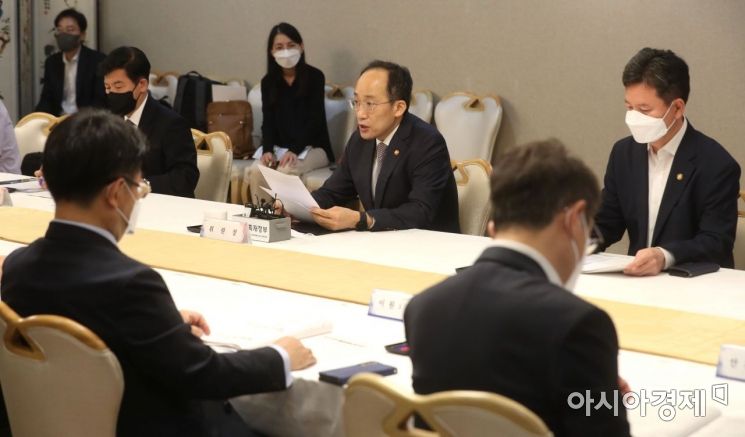 Deputy Prime Minister and Minister of Economy and Finance Choo Kyung-ho is presiding over the full meeting of the Public Institution Management Committee held at the Government Seoul Office in Jongno-gu, Seoul. Photo by Hyunmin Kim kimhyun81@
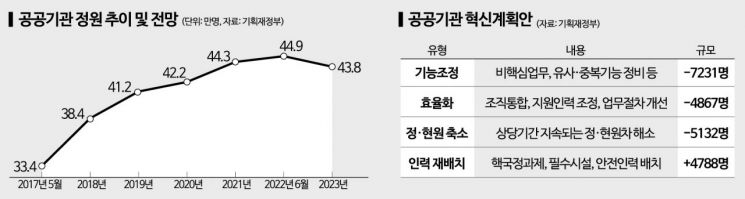
One reason for the decrease in new regular employee recruitment in public institutions this year is the government's policy on restructuring the workforce in public institutions. Last year, the government announced the new administration's public institution innovation guidelines and finalized plans for adjusting public institution functions and improving organizational and personnel efficiency.
The government has restructured 12,442 employees, which is 2.8% of the total 449,000 public institution workforce, and plans to reduce 11,081 of them this year.
The workforce adjustment will be carried out by utilizing natural reductions such as retirements and resignations rather than artificial restructuring, and the government plans to minimize the impact on new recruitment.
The reduction in new recruitment at public institutions aligns with the policy direction of the Yoon Seok-yeol administration. While the previous Moon Jae-in administration emphasized the social responsibility and employment role of public institutions, the Yoon administration focuses its policy emphasis on enabling public institutions to perform their core functions.
With various innovation measures prepared for the 'slimming down' of public institutions, if the recruitment of these representative 'quality jobs' in public institutions decreases and private companies also reduce hiring, the employment opportunities for youth this year are inevitably expected to narrow.
However, the government plans to increase the scale of youth intern recruitment in public institutions from 19,000 last year to 21,000 this year and is also considering extending the existing 3- and 6-month internship periods.
© The Asia Business Daily(www.asiae.co.kr). All rights reserved.
!["The Woman Who Threw Herself into the Water Clutching a Stolen Dior Bag"...A Grotesque Success Story That Shakes the Korean Psyche [Slate]](https://cwcontent.asiae.co.kr/asiaresize/183/2026021902243444107_1771435474.jpg)

















