[Asia Economy Reporter Yu Je-hoon] As banking transactions become increasingly non-face-to-face and digitalized, bank branches are gradually shrinking, and regional banks are also drawing attention by introducing various innovative branches to respond to branch reductions and financially vulnerable groups.
According to the Financial Supervisory Service's Economic Statistics System on the 23rd, as of the end of September last year, the number of branches (branches and sub-branches) of six regional banks (Busan, Daegu, Gyeongnam, Gwangju, Jeonbuk, Jeju) was counted at 803. This is about a 16.4% decrease compared to about five years ago, at the end of September 2017 (961 branches).
The reason regional banks are reducing branches is not much different from commercial banks. The demand is gradually decreasing due to the non-face-to-face and digitalization of banking transactions. According to the Bank of Korea, as of the third quarter of last year, the proportion of face-to-face transactions in deposit and withdrawal transactions was 5.0%, and the proportion of CD/ATM transactions was 14.9%, down 5.2 percentage points and 21.4 percentage points respectively compared to the third quarter of 2017, five years ago. On the other hand, the proportion of internet banking transactions was 77.4%, an increase of more than 30 percentage points compared to 43.5% five years ago.
However, regional banks are also concerned about the worsening accessibility for financially marginalized groups such as the elderly due to these branch reductions. In particular, the regions where regional banks are based have a significantly higher proportion of elderly populations compared to the metropolitan area. According to Statistics Korea, as of the end of last year, the proportion of the elderly population aged 65 or older was 17.6% in Seoul, 15.6% in Incheon, and 14.7% in Gyeonggi, whereas some local cities and provinces such as Jeonnam (25.2%), Gyeongbuk (23.8%), Jeonbuk (23.2%), Gangwon (22.8%), and Busan (21.5%) rose to around the 20% level.
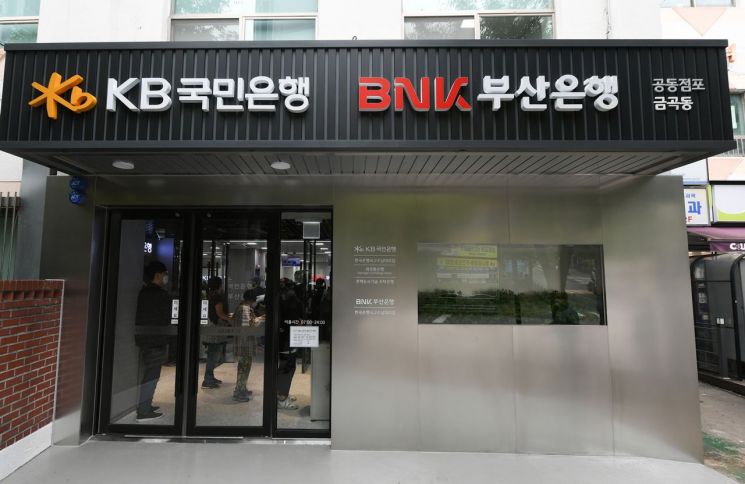
Accordingly, recently, regional banks have been accelerating the establishment of innovative branches to complement this. BNK Busan Bank opened the first joint branch of regional banks in Geumgok-dong, Buk-gu, Busan, last year together with KB Kookmin Bank. The Busan Bank Geumgok-dong branch was relocated to the KB Kookmin Bank Geumgok-dong sub-branch building. Four employees from each bank work at this branch, sharing spaces such as the lobby, automation corner, and parking lot. Spaces necessary for individual operations such as counters and vaults are operated separately.
There are also cases of partnering with different industries like commercial banks. DGB Daegu Bank recently collaborated with Seven Eleven to launch 'Digital# 2 Branch' at the Seven Eleven Daegu Samdeok Jeil branch located in Samdeok-dong, Jung-gu, Daegu. This is the second digital branch following the Digital# 1 Branch at Seven Eleven Daegu Naedang Station branch opened in June last year. This branch operates 24 hours with one kiosk (STM) and one ATM installed. Through the kiosk, about 50 types of banking services can be performed, including new and reissuance of deposit and withdrawal passbooks, check cards, OTP issuance, and various notifications and reports.
© The Asia Business Daily(www.asiae.co.kr). All rights reserved.

















