"Lens Clouds Formed by Atmospheric Changes"
Risk Factors in Aircraft Operations
[Asia Economy Reporter Kim Hyunjung] In the early morning of the 19th (local time), a cloud with a strange shape and color appeared in the sky over Bursa in northwestern T?rkiye (Turkey). Various opinions arose about this cloud, such as "It looks like a rose" and "Isn't it a UFO?"
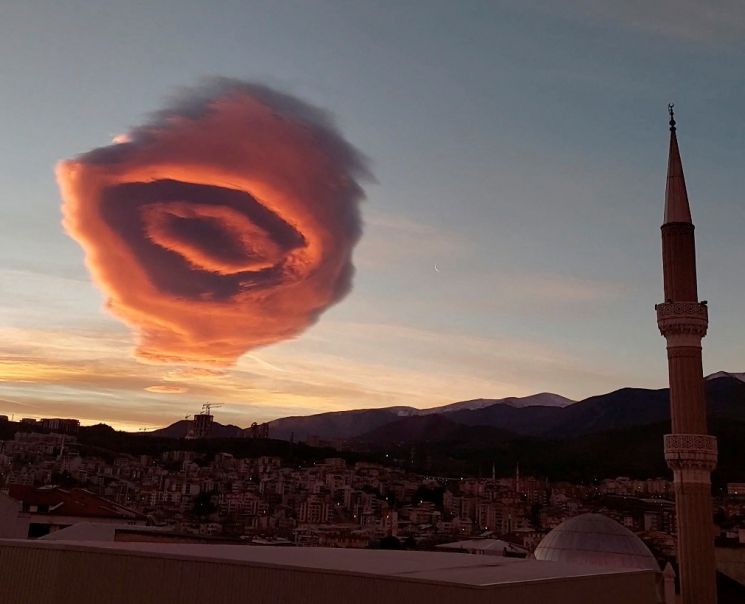
According to the New York Post on the 20th, hundreds of witnesses of this cloud posted photos and videos of the cloud on social networking services (SNS), which quickly spread worldwide. This massive cloud with a reddish hue appeared layered like a rose or a pie. Many people who saw the cloud reportedly felt awe at its gigantic and unique appearance. The cloud, observed around sunrise, maintained its shape for about an hour.
Some raised the question, "Isn't this cloud an unidentified flying object (UFO)?" but the T?rkiye Meteorological Service dismissed this by telling local media, "There is no need to call alien investigators." According to the Meteorological Service, this cloud is a rare lenticular cloud formed due to atmospheric changes. Lenticular clouds generally form when the air is stable and humid, caused by strong winds blowing over hills and mountains. They are most common in winter but can be seen in other seasons as well. In Korea, they frequently form in Jeju, where Hallasan Mountain is located.
Meanwhile, this cloud unexpectedly sparked a 'perversion debate.' Some SNS users reacted by saying the cloud resembled female genitalia. Joining this debate was famous actress Gillian Anderson, known for her roles in the dramas 'The X-Files' and 'The Crown.' She tweeted, "I don't know what this cloud is if it's not a sign that 'God is a woman,'" adding a vote to the 'genitalia theory.' Anderson has 965,000 followers.
Although lenticular clouds look fascinating, they pose risks to aircraft operations. Near the atmospheric inversion layer where lenticular clouds form, mountain waves occur when strong winds pass over mountains, which in turn create severe turbulence.
In fact, in 1966, British BOAC Flight 911, flying from Tokyo Narita Airport to Hong Kong Kai Tak Airport, suddenly crashed near Mount Fuji, killing all 124 passengers and crew. Investigations revealed that lenticular clouds had been observed 30 minutes before the accident. The cause of the crash was attributed to the aircraft breaking apart in midair due to severe turbulence caused by mountain waves.
© The Asia Business Daily(www.asiae.co.kr). All rights reserved.
![Clutching a Stolen Dior Bag, Saying "I Hate Being Poor but Real"... The Grotesque Con of a "Human Knockoff" [Slate]](https://cwcontent.asiae.co.kr/asiaresize/183/2026021902243444107_1771435474.jpg)
















